
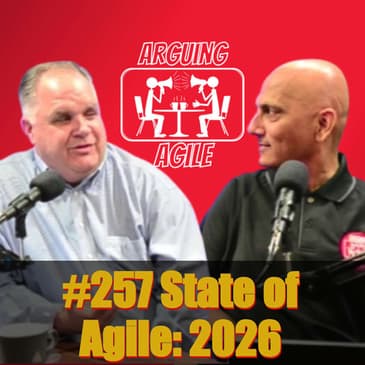
Is the State of Agile Report a clear-eyed snapshot of the industry - or a sales brochure?
In this episode of Arguing Agile, hosts Product Manager Brian Orlando and Enterprise Business Agility Consultant Om Patel are joined by returning guest Ed Martin to dissect the 18th State of Agile Report from Digital.ai. Applying the economic theory of the 'Market for Lemons,' where asymmetric information leads to market failure, we discuss the survey results and 'pontificate' on the state of the agile industry.
Join us by watching or listening as we discuss:
- Why 41% of organizations increased agile investment while only 13% claim it is deeply embedded
- If the Rise of Hybrid and Homegrown Agile is an indicator of a return to 'cowboy coding'
- Analyzing the report's contradictory finding that 63% of companies struggle with quality while 68% claim high-quality delivery
- The critical issue of leaders demanding ROI from systems they do not understand or actively guide
We don't just discuss the report, but we also brainstorm and share actionable advice for agilists and tech workers on how to navigate a landscape of conflicting data and pressure to prove value.
#Agile #ProductManagement #Leadership
The Market for Lemons by George Akerlof, The 18th State of Agile Report by Digital.ai, Inspired by Marty Cagan, The Wright Brothers vs. Samuel Langley history, J.J. Sutherland
LINKS
Watch it on YouTube!
YouTube: https://www.youtube.com/@arguingagile
Spotify: https://open.spotify.com/show/362QvYORmtZRKAeTAE57v3
Apple: https://podcasts.apple.com/us/podcast/agile-podcast/id1568557596
INTRO MUSIC
Toronto Is My Beat
By Whitewolf (Source: https://ccmixter.org/files/whitewolf225/60181)
CC BY 4.0 DEED (https://creativecommons.org/licenses/by/4.0/deed.en)
today are arguing as well. We're talking about State the 18th of Digital A .I. Is it a clear eyed snapshot of where the industry actually is or is it a 27 page sales brochure dressed up as a research? so Ed presented at Agile report from the last Tempe Agile event titled Agile at a Crossroads Frameworks frustrations and the future. And [UH] my take away Ed from that presentation I had strong vibes are of is this is lemons? Is that what this report is telling me? we We could be I'm glad you went there because I mean like it would have been a short podcast if you're like I don't know what you're talking about or maybe a long podcast if you were like I didn't know what we were talking about but [UM] do you know about the Nobel Prize winning George in a market for Ackerlof paper about how asymmetric information causes market dysfunction? that And paper is titled The Market for Lemons from 1970. So you're saying digital dodi I just published a survey of their own lemon lot and they're also selling car warranties Maybe. All right. Welcome back to Arguing Agile. If first this is your time, welcome. I'm your host product manager Brian Orlando and this is my co -host Enterprise business agility consultant and the godfather of product led growth, Mr. Omutel. Instant promotion today, I guess. That's right. I can describe. So all made up their job title anyway. You might as well make So the promise today is like listen, they the slide is going to be what's on the so that what you see on screen. So episode. I hope that you will be informed as to the 18th annual state of by the end of this agile report and you'll have a better understanding of which numbers on the reporter real. I'm not, I don't want to give away my hand before we get into this and which ones are made up and which ones to question. OK, we're going to talk about that You also broad have understanding of a Akerlof's lemons market because we're going to talk about that paper and how it may or may not apply to big a agile. Yeah. How to buy lemons at the bizarre bazaar. Ooh, the bizarre. I have like this on a podcast which may or may not have come out by the time this one comes out. I could not in my head. I was like in the future when everyone's using A.I. and the cost of producing software drops to zero is the game going to be you and have idea you just ship 10 an prototypes and you bring them all to like a trade conference or whatever. like the trade conferences get very specific to that thing. And then you as the vendor just bring your software to that thing. You like your 10 prototypes because you've all lost the ability to actually talk to people anymore because you've got large podcasts. And that's what I'm saying. I'm saying thought leaders on don't talk to people. I question whether there's actually a vendor location anymore. If you just write your own software, it produces it you. for say, hey, You a thing. It says here's your thing. And so now it's personalized software. It's, it could be. And that was the bizarre bizarre. Exactly. Yikes. I want before we get into the first category, does anyone want take to the Ackerlof market for lemons paper, which is like an 11 page paper. So he goes through a couple of examples a shot at defining with the the car lot is or the the car ecosystem. The used car ecosystem is the best example. That is the easiest to convey out of that paper in the 70s. It was the easiest way to convey his thought and statistical analysis of the market. And he actually describes a two by two of good and new and used. And bad and then he provides an analysis and his assumptions of where asymmetrical information helps drive used car sales over new car sales and the potential of good or bad buys to the to the buyer. I would even simplify that to say when one side in the sales market has more information [UH] can hold that information back, than then the buyer can't tell if something is good quality or bad the other side and quality. So then the buyer, after getting ripped off too many times, just won't buy that thing anymore. That's, that's the way I would frame it, which basically what he's, what he's what and misinformation and misinformation also influences the buyer. What, what he's theorizing would it is market collapse. lead to a total Just funny because I don't think he has any solid examples in 1970 when he wrote the paper. But here we are, like many years later, like the, the subprime mortgage crash and potentially what we're about to talk about today. Maybe examples of the Lemon Lot of his paper And what you just pointed out in the in even in the paper, which again, it's only 11 should pages. everyone So read. It's a very quick read. And out of those 11 pages, like probably a quarter of them are just like statistics. Statistical formulas. Yeah. Flip through the equations. Flip through the equations he puts in the paper one of the interesting things he puts in the paper is fact that the market is like that opens up the market to fraud. he didn't use in say fraud in the paper, but he says something else very similar. And the more fraud happens that in the it drives the market to failure. You so interesting. Keep it in the back of your mind while we're talking about this category or while we're talking, while we're talking through this podcast. let's talk about the market, the faster first category which leads us directly into the state agile of report. And we're going to pull up the report kind of go back and forth. It'll be kind of we'll kind of be all over the place in this podcast. But stick with us. My story gets better. So it so a quote from the paper. 41 percent of organizations increased agile their investment in the last two years. Only 13 percent say that agile is actually embedded across the business. So what exactly are these folks buying? Expensive PowerPoint decks. I don't know. it's the percentages and the answers kind of. Yeah. What are they buying? But what are they? What do they believe they're buying and what do they actually buy And so yeah, PowerPoint decks are there. Did they actually get of coaching out it? what's being brought Are they adopting to them There's, it's definitely subjective. The, there's some contradictory stats in here. And I think the, I think the authors even call some of that out. I think we're going to talk about those also. But yeah, it's, it's, it's interesting that as they go through this, you, they're increasing their investment and they're complaining about the cost of A they're complaining about the cost of agility. But then there's the pressures to perform. So here's [UH] issue number one. Exhibit says 41 percent a It your honor. reported increasing their investment in scaling agile over the past two years. 17 percent say it increased significantly. Twenty four percent say it increased somewhat And I'm not going to find the smaller like they're in the in the appendix. All the actual Q &A like answers are there with the breakdown of respondents answers. I'm not going to go find them. did pretty thorough job But we when we were prepping to to to get ready for this podcast to where I a don't want to go and look at every single one of them. But this like increase their spending or increase their investment on scaling agile. To me, that doesn't necessarily mean you increase your agility. Right? Yikes. Not to give away what side I'm on here. And one of interesting the things there is is it's the last two years analysis. Right? Yeah. What about the last six months? So the these types of market analysis of what's going on in the industry, they're changing monthly. And so it what's what's next year's report going to look like is very interesting as well. And they spent a lot of time prior. This has been a report that's been around for a long time. Right? The 18th edition. They spent a lot of time asking about agility and agile questions and frameworks and structures. And this one's all about A.I. I mean, I understand that because don't they want to get left behind in the sort. They don't want to get left behind the market. They want to be seen as a, you know, they were doing A .I. just like everyone else. Right. What did I call that? What I call it at the event with isomorphism. Isomorphism. I think I called it Isomorphism in psychology it pauses there you that go. posits It posit to another podcast. It posits a structural one to one corresponding between a correspondence between subject conscious experience subjective conscious it made my first experience perception and underlying physical brain process Where am I going with this boy? What a terrterrible definition. a psychology and organizational one isomorphism in behavior describes let you hit me with how organizations or individuals adopt identical standardized structures or behaviors due to external authoritative pressures such as good regulation, illegal mandates or dependency on other entities or investors. Hey, I to board went meeting a my board members said hey, how come you haven't adopted A .I. yet? All my other boards that I sit on, they're all gung ho on A .I. You seem like you're falling behind. That is a coercive isomorphism right there or the stock market punishes you for not adopting any A .I. initiatives. That's also, you know, a loosely coercive isomorphism. You could have just and come back from a conference and heard your peers talk about this. So you say come and stop back everything you're doing now. Has it made it to Sky Mall yet? Sky Mall has, has, I was going to say, what you just described them. Sounds a lot like agile We're, we're doing agile. Oh, I just came back from the conference and this other company says they're quote doing doing agile. How come we're not doing agile? It's whatever the CIO says say is or or CFO CFO, whoever. whoever So say so. yeah, Yeah, that that one things that that you you know, know the is the that's that's in of in the the conversation conversation is is one is as as agile agilest. list. And And you you know, know we've we've been been through through this this disruption before you know 2005 2006 Agiles coming out pushing through the industries. We've been through this type of change where it wasn't governed very well. It wasn't regulated very well within the organizations. You of the the things know everyone just came in and said hey play these games let's get together and Let's do this stuff And it just started happening within the organizations. We're kind of seeing that with A .I. now And it's just as disruptive. And I think of that some agilest and who went through that the experience can benefit with their own personal experiences and drive strategy as well. Yeah, definitely. Just to kind of quickly double click there. It's we've seen it before the difference is now everyone's running towards A .I. Whereas before it was only the I guess the ambitious ones that said let's try it. Right. And others are just cautiously waiting to see if it works. Now just it's out like pull all the stops. Let's all do A .I. because just if you don't have it, you're immediately behind your competitors. Yeah, if the if the coaches had the drive to adopt that teams have right now for A .I. Oh my goodness. Yes, we'd be in a different place. Yeah, we wouldn't be talking about that adoption statistic. We were just covering. All right, let me find the, let me find the question one of the survey in the survey questions, question number one says, how would you describe the current state of agile across your organization? And 13 percent of respondents said agile is deeply embedded across business technology and supporting functions. E .g. H shouldn't that be I.E. H .R. marketing legal with work aligned to strategic outcomes. So like I think they just nailed deeply embedded in the business at all business levels. I think that's what they mean. Whereas other other respondents in the more in the majority by the way are primarily primarily limited to team level execution scaled across I .T. But the business is not really involved in Agile's practice in some departments. But the usage is inconsistent. That's like a solid 60 plus 67 percent three is things that I just those listed. So the article points out a minority of companies are deeply embedding what the respondents, the 300 and what are 49 or respondents say is deeply embedded across business function. Which means it's still primarily I.T. Yes primarily I .T but also some some team levels. The majority one is some departments is inconsistent. So it's not even across but all of I .T. The the 25 percent one. That's scary. And their organizational usage size I believe was[UH] enterprises with [UH] primarily was enterprises with 200 or more employees as well. Just from a from a standpoint of who they were talking to. Are you talking about the the survey? Yeah, the survey was across all the survey was that the number of the demographic numbers are here here. don't go They can't this block here. Mm I didn't, I didn't break off the demographics into a section on its own to be considered on the podcast because I didn't because I thought that the this split was pretty fair. Although now that you're drawing my attention to it, I'm like a thousand employees is the low is the barrier like less than 1000. So I zero to a thousand or whatever. One to a thousand places. That's giant. giant. Yeah, A that's or less anyway, that they're trying to show here that they've got a solid split across organizations of all hundred size. But yeah, you're right. Now I'm looking at the breakdown of the sizes of organizations and that's a zero one to a thousand and over 20000 as as the caps of the lower and upper tiers. Like this some is serious And also the the purview is across caps. the world, not just Yeah. America. if you're digging into the methodology and having issues, I just want to let you know it's too early in the podcast for that. We've got a whole section just to say are these numbers good? Supply weight standby by says the days of quote pure play agile appear to be So this So the paper fading a combined 74 want here. to percent. Now use hybrid or homegrown approaches up sharply from 50 percent in Y 16 and 52 percent say The this is why 18 it Y 17. went up from 52 in So percent to 74 percent. It went up 22 percent no sorry 18 percent. It went up significantly between 16 and 17. It went up by two percent. Between 17 and 18. It went up an incredible amount. Comparatively we talked about it a little bit last night at the at the meet up. And it was, it was strongly focused around point the that there's a lack of discipline in some respects. And then there's some maturity in others, meaning the we've outgrown the book. So we're going to do it our way. And we focused on the idea that as long as the team stayed true to the values if you don't want to do a retrospective and that's the time that the team does inspect and adapt for themselves. As long as there is something that the team takes time to do and expect to adapt, hybrid is fine. But if you're removing the retrospective and not replacing it with something else and you're not taking the time team as member inspect and adapt and you're devolving a or not being disciplined in the approach of, you know, quote quote to traditional big agile 74 percent hybrid up from 50 whatever to two percent. What was it? Fifty two percent. Fifty percent from 50 percent two years ago. Up to one. Twenty four percent in two years of people saying we're just going to roll our own oh let me ask you do you are feel people that to the point where they can they just maturing outgrow in the practices is they're too limited. They're too limiting. We just need to, to, to roll our own practices. They're in there. They're in the rea of the shoe shoe area at this point. Not having been in the shoe, maybe they were in the shoe for a little bit, but certainly didn't go through the transition through half. Right. And break all the rules because you know we unique. We see that everywhere everywhere pretty much. pretty much. Right? As As well well as as a a work work here here as as is is. We're unique. Right. unique. So So it's it's going going to to bend bend the the rules, rules, twist twist them, and break break them, them, whatever whatever at At that that point point, are are you really even following anything or just muddling through? So let me, let me play the role on this podcast of the of the other side. OK, and I'm going to say that even the report says last the won't my frustration with be the formatting of this report. And This, this it's not the first time. Won't be the last time. It says a clear shift away from formal frameworks towards adaptive fit for person purpose models that reflect how organizations time that I express actually delivered today. It signals a clear shift away. Yeah. So in that section where they're saying, oh, we went up from us, we went up to 74 percent from 50 percent in Y 16. So that that is a that's a shift away where people are organically choosing this brave new world of how they are. I mean that's one take. But also like my take is a hybrid and homegrown is basically what teams did in the 90s and early 2000s when I started my career when there was no agile shooting cowboy development shooting from the hip staying up until you know midnight pushing that release across the finish line. You know doing pajama parties to do deployments. That's that's what I take out of this is [UH] no structure. Whatever a bar tells us to do. That's that's what I'm hearing from this. Yeah, I guess it would be one thing if the teams were intact over this duration. They matured organically etcetera we that all know to not Yeah, there's plenty be the case. Right? of churn on these teams And this whole offshoring model as well where vendors are held accountable to bring the skin's skill sets that are needed. They don't need to train their staff. Yeah Certainly the contracting company isn't going to train vendors. Right? So yeah, we haven't really matured. one more, one more point. If I'm going to throw out one more point to, to kind this be fair of to the, the, the typical agile coach in the room. So there are no more in the room. But if there was one in the room, not to cut us ahead or anything would say like agility is different for every organization. And report I think that[UM] you're like, you're not going to see a statistic across, you know, all organizations. It's the, the increasing investment. They point out like that might be the right thing, you know, as opposed ceremonies to whatever or whatever, you know, rituals or whatever they're called today. Yeah. And the other thing on the report, it's, I would be frustrated if I was the analytics person trying to make sense of the respondents answers because clearly they're trying to, they're like how can these two things be true? And they're trying to make sense of it themselves. And I think that there's a, there's a continuity in the answering as well that causes some of these challenges. But what's out pulls it real. And are you saying the buyers can't judge the quality of the. I think, I think I just, I think I just jumped your sign on that a little bit. Yes, sir. Oh my goodness. Sir, how dare you? Sorry, I don't know. So what, what specific outcomes let me, let me, let me figure a takeaway. Let me figure out a way to cap this takeaway in this category. So what specific outcomes will putting dollars into agility at your what, business? Like capabilities are we buying with these dollars by funding scrum masses or by having these people who are at this coordination layer in the organization? I feel organizations are not good at asking that what what business question. Like what, what business capabilities are we? Because we talked about on the package before and we talked about when they cut these positions, they don't think of it, they think of it as [UH] as like [UH] cells on a spreadsheet. They don't think of it as like we're going to cut away business these capabilities. We don't need to talk to people anymore and talk to customers is overrated. Yeah, that's, that's very, very, very true. I mean, some of the measures that you're talking about could be, you know, time to market, improved time to market, for example. Right. Smiles per customer, those sorts of things. But I dare say there's not a huge focus on those. The focus is more inward looking and on vanity metrics. Still, for the most part, efficiency at the art level or velocity you know know you and things like that. They're still pretty prevailing out there unfortunately or prevalent out there or like sorry I was going to say efficiency is like a like a dollar metric of hours per like ROI increment or some dollars per point. Yeah. Somethingmething like that. Yeah, yeah, yeah, yeah, yeah. But you know, if your objective is customer retention, right? The metric is churn rate, right? So making sure that, oh, we're going to, we're measuring customer [UH] Well, how are you using a leading indicator? Using a lagging indicator Are you really measuring it? Are you, are you helping yourself? One of the one of the people I had talked to said that we released these features and we won't know for 12 months. what, what can you measure right now? That will tell you every two weeks for the next customer retention. 12 months. Yeah. So you can. So that would be the leading indicator. Not waiting 12 months to find out So yeah, there are ways. And when one of the team said, members hey, you we're we're releasing 12 features. And then so I use this. So what test? So what? Right? You release 12 features. So what is what's that value you're hoping to get out of those? And that helps drive that conversation into what metric you should be using or where the value is Speaking of so what? So what do you think is your organization know, in that 13 percent that have mastered agility? Let us know in the comments is breakdown a most contradictory of the stat in the entire report. So investment is up but adoption is shallow. All right, and we're going to sing Lady Gaga and Bradley Cooper right now. We're going to sing Shallows. All right. So that seems like [UH] two stats that that can't both be true. Right. Maybe. I don't know. No, I don't think two of us can say. So let's, let's read let's read the lyrics to shallow. No, I'm going let's read. Let's say let's, to read what the paper says. OK, it says 63 percent. You know what I'm going to, I'm going to put is do I have a quote for this? Oh yeah, I do. Yeah, it So it says 63 percent three all angles of respondents say, quote, we are struggling as a company to deliver reliable, high quality software. And then at the same time, the paper say, says 68 percent quote, 50 five zero five zero 50 50 55 [UH] I guess you have the [UH] at least 50. Let's see. That was a Mike Miller joke At least 50 percent of our applications are and with high our next discussion delivered on time quality. Wait. Oh wait. Sixty three percent are struggling and 50 percent are delivering 60 to one hundred thirteen percent. Sixty three percent are struggling. No, no. Because remember the numbers don't overlap. They're not there. They're not exclusively. That's right. Right. So 63 percent of people says said yes, we are struggling to deliver reliable high quality software. And then 68 least 50 said at applications are delivered on time percent of our percent and with high quality. So then, then in an absolutely wild moment of self-awareness that the paper, I don't know, some some some editor who was like an intern or whatever, left this. And he said the paper says the paper says, quote, both statements can't be fully true, which suggests organizations are either sacrificing quality to hit deadlines or defining quality so inconsistently that success and struggle coexist I would say I would say only because I have a little background in this subject This is not a binary of like it must be this or this. It's probably a range of things. Yeah. Success and struggle does coexist. Yes. Yeah. So yeah, different teams, different products, different answers. That would be the, that would is be the argument here hey, listen, every team's different. like, One team's quality definition has nothing to do with another team. Like get off my back, Brian. I would argue that different people on the same team answer would be different[UH] Oh, probably yes. Yes. Yeah. And then they will say, you know, something like, well, quality. I mean, that's, that depends on the team[UH] you know, it's contextual. Right. That's the other argument that they'll make it's funny because we didn't, we didn't go into the other one that I thought was going to was up, come the, which in the A .I. era, like the falling the data reflects that quality, that, that, that, that like dip in quality Everyone's hyper aware of it now. So that means everyone's paying attention to it. So that means everyone's asking more of quality in the air. And that is what's [UH] responsible for this. Now I'm not saying like one of these is the answer sure everything else. I and mean like it could be a salt salt pepper of all of the things at once. And as we know, because leadership is like nowhere to be found. It's just everything just kind of like falling apart at this. Like you're living in the house and you're like, why are these walls crumbling? There's nobody. Does nobody take care of any of this? And then you look around and there's no adults there. Yeah. Leadership is not being taught the way it was 25 years ago. So you know both numbers can be can be both things can be true here but also a smattering of other could be true. Yeah was it just pointed things out that when you got both of these answers, that just tells me that nobody understands what quality really means I think we agreed. Yeah, I think it's actually in the quote in that second quote that [UH] they're either sacrificing quality to deadlines or defining quality inconsistently. So yeah, definitely it's there is done. I shipped it over the weekend. I worked, you know, a 70 hour shift to get it done. But it got done because the sprint goal was everything must be completed this month even though it's twice my trending capacity. I thought you were going to say because it's 1999 and that's how we were. Yeah. Oh yeah. Yeah. But why do we had to get done? It was a hard. That was a hard deadline. I'm saying it was a hard deadline. Thankfully it turned out to be a nothing burger because all because it's the QA guys killed it. They did great. Somebody made money. So I'm saying yes so now would be the time of the podcast for maybe for me to take a break and say[UH] this category is just one more reason that it was really infuriating to read this because of conflicting statements that it's not that the numbers conflict because they even pointed out like hey guys we know this is weird. Like wink wink nudge nudge. We know it's weird. And then they didn't go into it at all. But it's true. It's[UH] right. It's weird but it's true because that's what the people say. But but like if you're running if you're running a statistical study. Yeah. And then you find statistical anomalies. You report on anyway. You're just going to like this. It's not wink and be like it's all cool right These are funny. Like you're not going to do any in depth. You're not going to, you're not going to go correct that. That sounds back and like hard work. You're going to send your intern to at least ask the people like what. No, no thing. What do you mean by that? And, and also, and also, when we were prepping like when I look through the last like three or four of these studies this way. Every study that I've ever seen because we are let's just put it regularly reading research papers on the podcast. that's Now it's taken longer to get podcasts out They have some sort of like statistical rigor that has gone into, you know, year one. We're going to measure X, Y, and Z, one of the reasons and then we're going to report on it. And then year two, we're going to measure X, Y and Z against the baseline that we established in whatever previous years. You know X minus whatever previous years. How would you do that? Ask the same questions. Yes. OK. Yeah. You would have to make sure I'm true. You would ask the same questions or at least the same categories. But when we went back to the different years with report, not only were the questions with with this different but like this, the reporting was completely different and the categories were completely different. And I couldn't even find questions like I, I just quit. I was this is not worth my time. I don't live on the planet. I don't know you people. So instead of the 18th state of agile report, you're in the first state of [UH] I report. This is something. Only if the second report focuses on the same thing. So this report doesn't seem to me like meant it's comparative from my to be previous one. Right. It's just snapshot in time. Here's what it is. I know the I think is new and therefore it is a snapshot in time. First one. But even the previous ones we looked at, they were all unique and differently structured. Oh I worked for a lot of psychopaths in my career and I will tell you exploiting the data massaging the data to make it fit. Whatever point you're trying to make whatever tool you're trying or to sell is very easy. That sounds like a malicious angle. Leveraging the data to your own advantage. Oh, I thought you were going to say you're going to say what's the what's the what's the code that you had that so good it's a being economical with the data. Oh yeah. Being economical with the truth based on your incentives. Yes. Yes this companies do in their quarterly earnings reports. You know when they often say here's what we project. Yeah. And then they'll say that's just a forward looking statement and performance is no guarantee of future results. Yeah. Safe harbor. That's mandated. Yeah. But you know and you use the word malicious and I just want to defend them a little bit. I don't know that they're being malicious, but I do. The responses they got are very concerning. And to what's being said, what is, what's takeaway? And then the consistency of, you know, lasters report the year the before that you know, we saw say you go all the back in time, you see agile adoption, you see safe growing, you see safe declining. And then you know, here we are. Their frameworks are missed and everyone's [UH] rolling their own and no one's actually delivering or getting anything done. It's, it's just a, it does create conversation. So the point of our meet up last night conversation. was about the reports there. What does that mean to us? Because we're all trying to figure out where to go. And the only thing that we can kind of lead on from an industry standpoint that's reported out there is this. And there's and it's Here's what the questionable and confusing. Right? Just like today's market. Well I like to end categories on a on a on a positive note. And I'm glad that we're on a positive note now because I am done talking about this category. So stats the here are and they don't offer consistency before they draw conclusions, which confusing. they don't even bother trying to do that. They just throw numbers at us that are yeah, bro, that don't work. Like get off of my boat. And I'll thank getting off of my for you yacht. Next question. So so we're going to move on. So stick around while we discuss the real problem that is at the root. Yes, it is. Is that the root of all the issues that we just talked about and more? OK, so only the report says only 15 percent of organizations say that they're it's respondents only 15 percent of respondents say that business and executive leaders their in organizations actively shape agile practices. But 76 percent report increased pressure to prove ROI. So we're going to say that again because it's slightly important. Leaders are demanding faster results from a system with which they are not engaged. And you know often I don't use proper English to describe things but I figured I'd do it now so that people on the Internet can be like Brian you're just being a jerk. I say And yes. will the numbers don't lie. Yeah. Yeah. What can go wrong when leaders aren't engaged and yet demanding a return on investment? What can go wrong? I mean, the funny thing is this is the J .J. Sutherland quote in the in the on page 90 says 76 percent report rising pressure to prove ROI on agile investments. Yet more than half admit they can't prioritize the right work. Fifty three percent can't can't prioritize the right work or track business impact at 52 percent. are Leaders results from systems they don't demanding faster understand or actively guide. That's a, that's a J.J. Sutherland. And unlike Marty Kagan and Manuel Pius and the other guy [UH] maybe he'll respond to my tweets. I don't know. We'll find out. He may. I've seen him interact quite a bit on social media. Yeah, I mean, growing up with a dad who would always send me out to do something and ask me why I wasn't done yet. But you know, I couldn't get the lawnmower started because I couldn't pull a cord fast enough hard enough or to it actually start because he wouldn't clean the carburet carburet or give me a working system to help me mow the grass. But it was my fault you know, those kind of feelings well up in me when when I think about [UH] lacking leadership and lacking direction and lacking clear visual guidelines. Real, real, real late 70s, early 80s energy right now in the podcast. Like I total boomer move right there. Ed is like not a boomer, not a boomer. I'm make XR. But at the same time, kids today don't understand what all they have to do is press the button. Your dad. Oh yeah, my dad is. How dare you inconvenience me me But breaking by back to leadership, your right? There is a need to lead back to leadership. There is a need to recognize arm? that there's a struggle with the team. There's a struggle with the system and going out and being actively involved remove the struggle, remove the impediment to help the team get done what needs to get done here. Not just demand more and more of, hey, give me more reporting on where the ROI is on the thing that I'm not telling you what to do. Yeah. here in that stat, the shocking thing in that quote from Sutherland is over half the people don't even know how to prioritize the to right work. And again, he said over 50 percent of the people that don't know how to track the business So impact. our effort, money and energies on? Right. Who, who would be, who would be asking that? Who what are we spending should be asking that question? Could say that's leadership. But again, we're lacking there too. So the odds are stacked against us here. And that goes back. Yeah, that goes back to that. So what story? Right. So the team is saying, I released 17 things and I'm and I'm assuming those are the 17 things you wanted because they were on the backlog and they were part of the sprint that you gave me to do. So I think I'm good doing a job because I did the 17 things you asked for. Yeah, but if you, if the team can't answer this, so what? And the business can't answer this, so what? Who is, you know, how do you measure an ROI? How do you measure client engagement? How do you manage or manage cost cuts on the things that you're doing if you're not thinking about it before you actually start? Yeah, yeah. The teams are asked to work on 17 things because they're not necessarily the highest priority. Seventeen things from from the quote. Half the people prioritize those even can seven. So the half that can. Great. But the otherhalf, the team's like to your point. They'll just say we've delivered. But then yeah, so what do we deliver the right things? And leadership's they are saying are in their fist on the desk. Brian, we're going to give me all right. It's like, yeah, just throw money on the wall and see what sticks. Yeah. Do we, do we cover later about project versus product funding I don't know. I'll jump in that a little bit right now. But right now. Yeah. Yeah. So we're jumping a little bit right now is you difference know the project funding is between product and they're asking about ROI but they're set up as a project team delivering the 17 features for the project and there's no the funding is based on that and they're going to ship off that Sprint and you know are. Those are the last 17 things. Now it's disbanding. They'll go do something else called a project But yet when they're working on that, this other thing they just left behind has some craft on it, has some things that have to get done. Oh man, Martin Kagan just had great this retweet [UH] a morning about that, that I responded to that. He, of course, won't respond to either. But did it? Did I tell you that earlier? Oh, Oh, I I showed them. Oh, I'll show you so the trade off while I'm finding that tweet no, sorry. It was a LinkedIn post while I'm finding that the argument here is listen you don't want leadership in the weeds of everything to like you don't want them in the weeds. No, I don't want them in the weeds. I don't want them in the weeds. But well some[UH] want I priorities. The top, the top quote fixes. Requested in the in the survey here. Twenty nine percent of people pointed to culture focused on outcome and adaptability. Is that the thing they need from leadership? Basically 27 percent said stronger leadership support and alignment. 17 percent wanted clearer connection between delivery work and business goals. I mean between those three things there's some strong like yearning for of what think basic product manag. I as So what, what's wrong in these organizations? We don't have basic product. How can you have agility without like the basics of product management And I think to answer that question, I have to pull up the thing that I told you I would pull up here me to find LinkedIn[UH] which requires and then find Martin Kagan. is a study and is in the screen a post a of I'm showing on that I responded to today. Actually weeks of are them where Martin Kagan ago. None retweeted Sorry, was it called on LinkedIn? Is it called retweeting? Resharing? Resharing on LinkedIn? What's, what's he sure to repost? So he reposted Mike Fisher, who's the CEO of My Fitness Pal and the CEO of My Fitness Palace talking about. He's talking about. And again, this goes back to the market for because lemmas again, product operating model, project model before it was or whatever. Like Martin Kagan, obviously benefits when we sell the product operating model [UH] there's not a judgment. This is just a reality. Benefits when we try to undermine the project model and install the product model. The previous, the previous market for lemons was selling agile on installing the project model that had scattered results. Arguably now the product operating models here. So reinforcing. he's only reason I bring The it up is because we had a discussion which may or may not be in the podcast about the people behind bad reasons of why we're still doing like, oh, you didn't get this done or you didn't do whatever. So trust me, it's, it's, it's a long story but it's relevant. So Mike Fisher points out that turn of the century, Samuel Langley, he had funding, he had visibility, he had expectations. Arguably, he all had the Right. experts. And the relationships and relationships to get the the first aircraft, the first flying airplane produced and flying. And the Wright brothers came along and did it before him. Even though and even though he obviously had this peer team technology funding everything at his fingertips, seemingly. OK, right. And the post said, which I'm showing on the screen here but for everyone listening he says at the turn of the Samuel century, funding visibility Langley had the and expectations. His work produced artifacts. He showed progress. It checked boxes, but it did not fly. And nine days after his final failure, the Wright brothers, I think he only had two test flights. Nine days after his final failure, the Wright brothers achieved a controlled flight, not because they had better resources but because they were solving a different problem. They weren't optimizing for output. They were obsessed with an outcome. And that distinction defines product teams. Today, we asked for ROI before we've anything. learned We shape experiments to fit spreadsheets and we confuse activity with progress. So he's making a very specific statement with this post which I appreciate because it's more about like hey listen not every experiment is going to directly have ROI that you can see right away. And you need to like check yourself which is a good and this is where learn early is better than il fast, which is a good point. OK, and we did a podcast very hasn't come out yet recently it and about when you focus only on outcomes like you very quickly can lead yourself down the path to evil because you're just like completely focused on that. We talked about the gorilla experiment. Yeah, people are watching the ball getting passing. Yeah, that's classic. Yeah, I didn't even know what that was until we did that podcast. Oh really? No, I didn't. And so I replied to this one and I said hey this is great about like a mixed total point about project for this product and totally makes a point. But we're like going to talk about if not project versus product and models and agile and scrum and all these frameworks and that kind of stuff, we're going to strip all that out. We need to talk about the Wright brothers and Langley, the people. We need to talk about the people because in a very short amount of time this morning I went through and I read a little history of Langley was a real character that was a quote of difficult to work apparently Langley with and was described quote. Where did I put quote [UH] domineering quick to as hand down orders and impatient. I put an article in the in the post there [UH] probably. I'm sorry. That article link is 1213 fraud yeah, yeah, yeah. guess No, no, no. Because in the art, no [UH] in the in the article, I guess now I got to link it in the article. They're talking about they're fraud the talking about was[UM] apparently Langley and the people that he's like his like the people that followed him were predecessors, successors, successors in the Smithsonian. The people he installed basically they they put his prototype airplane in the Smithsonian with the plaque that says like the first powered airplane to ever fly. And the Wright brothers were so upset by that because they were like, well, it's a fraud. That's not true that they sent their plane the to Kensington Museum. The Kensington Museum in the UK. Yeah, yeah. And And that's because now the, the Smithsonian obviously has the right, the flier but yeah, but it was like only until after Langley died, I think did they come to that you know. But that's like the fraud of it is like he was so he was such a character in that aspect that like even he couldn't acknowledge like the obvious truth, you that know, because was I, and I sat down when we were talking about the, the planning for this podcast. And I said you know, project his personality. And versus product model and agility or not. Like I feel like there is, there are some checks and balances you can do to realize I've got these people in my organization and they may not really. The collaboration and cooperation of the people may not be their strong seed. That might be the problem. But that comparison contracts. I mean, the Wright brothers truly Yeah. Right. The comparison right there is night and day but it also is what many consultants run into with you know, the had an outcome. big behemoth groups out there who have been there, done that. They have their size and [UH] they can do no wrong. They must be right. And so let's, let's keep sending them money even though the outcomes aren't necessarily measured And sometimes they are successful. Not trying to, you know, be too difficult. But you know, there is that is their success rate worthy of the attention they receive? I put some of their success to chance variation getting back to the report. The report talks about cancel project cancellation still being the biggest failure. And so you know how many of those projects just end in cancellation. Yeah. Yeah. Surprisingly high number. Yeah. Yeah. I'm want having to prove the ROI of agile or here in to we cut funding. it's if see I a bit of a misnomer in my opinion. Like, well, the biggest, the biggest challenge with most coaches when they come in is, you know, we used to say, hey, three sprints. You'll, you'll, it's going to show you where the dysfunction is here. Three sprints. You're going to know. Well, a lot of times now as we're bringing the roles are as in [UH] changing, that's brought up in the book in the in the[UH] report as well as as you get more towards strategy and you come in with a different level of skill than what was expected from prior coaches. And you start talking about costs and funding and you know the dollars and cents of the business. And then you start challenging them that on on those things it's hitting them. They're emotionally responding. They're allergic to those conversations more so than we're going show to you dysfunctions in sprints. Yeah, because you can walk in right away and say your team's not changing. Your team's not doing this and they don't like the answer when you tell them. what would you say if I tried to push back to say those those agilists that are saying that they want more leadership involvement like they don't necessarily didn't necessarily want more autonomy to be able to push push improvements to the organization and three like take ownership of problems just they[UH] want So from I think what I heard the question visibility. was from the agiles perspective who want leadership. What do they really want want I'm I'm a going to tried try to to describe describe it it without without quoting quoting which which organization organization it it was was. but But about about a a little little more more than than 10 10 years years ago ago, I I was was introduced introduced to to an organization that actually had an executive Kanban board and that executive team managed their own epics. manage They initiatives every their own top 10 quarter and that then rolled down to the teams to make sure that the teams were doing things that were aligned. And right now, I don't think most executives understand what is on the team's boards and whether or not they tie to what they say their priorities are, what their road map is. The road map is produced as a wishlist and forgotten about it's after after produced. They come back 12 months later, say, why don't we get anything done? You know, that's a that's a that's a broad brush. Yeah, but I think it's pretty close to most organizations and what thenumbers say I'd agree with that. You know, I think if you're doing it justice, road maps aren't something that you still want to put away. I don't want and done. They constantly have to be updated, reviewed, et cetera. So sometimes there's construction on the road. You got to go a different route. That's right. Yeah, yeah. Sense and respond you're and coach you're stuck in the a if 85 percent, you're 85 percent. Meaning the opposite of the 15 percent that say that their leadership are actively involved. So you're part of the 85 percent. Your leadership is not involved. Mm Nature anyway. Your form But they're still asking for, you know, ROI numbers and that kind of stuff What's your path forward? Forcing factors making sure that the teams that I'm working with are coaching or whatever at level actually producing output from the reportable output. I Not not deliverable. I'm talking about can get to are reportable output that shows what we did, where our impediments were, and tells the story so that over the course of time, even though that isn't being read by that leader, at some point they're going to go, why don't you tell me? I told you here. I told you here. I told you here and you weren't looking. And so you're that becomes that forcing factor that the and CIA. That's not what it's I'm trying to not describe. I'm trying to describe that I have done. The team a has done everything we could to make you aware. You chose not to be aware. And so now that you want to be aware, I don't have to go back and make the story up and dig up history. I've already got the history that we can talk about. So many teams wait for the request to what did you get done? When did you get it done? And then all in there, they're going back through their backlogs trying and to figure they got it done. And then they're realizing their own what they did when out backlog hygiene is horrible and it takes them weeks to actually produce that data. But if you have the discipline, the hygiene that you're producing at the end of whatever your iteration time is, whether you call a sprint or not, but some fixed iteration less than a quarter this is what we did. These were our challenges. This is what we're working on. And this is where we thought we were creating value. And this is where we thought it aligned with business objectives. This where is we thought revenue, decreased cost, customer satisfaction or infrastructure needs. And you can answer that. And it's on the spot met it when it's requested your increased for. That helps you with trust and credibility at the moment. It's requested. Yeah. Just add a little bit to that[UH] if these leaders are not engaged, you're not suddenly going to get them engaged. You know, you know, but they're going to be reactive. Yeah, I mean, leading with data is great. Right. But also, your them messaging shouldn't be about efficiency measures, to things like that. It should be about terminology that they resonate with. Right. So you know[UH] why they're asking for more ROI but you have impediments etc. Instead of just raising those as impediments, you could say the cost of these impediments. the opportunity cost lost or whatever in terms of measures. They understand dollars and time wasted. Right. Maybe get them interested you'll in engaging further going forward. The challenge with at the team at the team level reporting up the challenge with cost and ROI is most teams don't know what their cost is, what their fully burdened labor costs are. They don't know what their infrastructure costs are. They don't really know how to communicate cost because they don't have necessarily someone in that seat that's helping them to understand it. And then from an ROI standpoint, they don't necessarily have visibility into where's the where's income. They don't see the income sheet to see where the money is coming from. Did I actually increase my retention rate? Yeah, this is where agile coach or somebody the like that can help. Right? You can really work out the cost of a sprint, et cetera. Right? The blended average cost of a person and so on and so forth. But yeah, the team level at that level, maybe they don't have that, but they can get help. They can get. But they have to know to get help. But if they're in the churn where they're getting the pressure. Right. The pressure's on to deliver and execute. the don't They have time. They're not thinking through that slow is fast. Right. And to slow down and figure out what they need. And I think that was one of the things Shane brought up. Right. Sometimes you just got to slow down. Yeah. Yeah Speaking of [UH] slowing down to speed up, So the single most useful thing that what do you think? you need from leadership, what, what is it [UH] or[UM] is leadership? Just just just, stiff army. They don't want to talk to you. Get out of my office. That's what they're saying. So let us know in the comments. That's what I'm saying. So get out of my office. But and then get into the comments. Sorry, I almost started singing a Billy Ocean song right there. It came on strong. I didn't mean to. So So we already talked about in the report that most people feel their leadership is not engaged. And then of course [UH] we laid off all the scrum masters. So we don't have any more people to help us communicate back and forth because we didn't know what they did. So we just got rid of them all. how, they how didn't who does that leave to these quote agile realize. all jobs? do please. It leaves a dev lead to be the personnel manager, to be the product owner, and to be the scrum master and an individual contributor to execute. I like where you're going because [UH] the study says or the paper says 29 percent of agile practitioners are now accountable for tying delivery work to business outcomes. 26 percent are doing less coaching as teens move to hybrid hybrid models [UH] percent and 23 evaluate A .I. tools. And if your have been asked to job feels different than it did 18 months ago, you're not imagining it because it is different because things are changing direct quotes from the report are pressure is mounting, roles are shifting, and frustration with agiles application is rising And [UH] that brings us to[UH] the, the, the term that was all the rage last night and bifurcating roles are bifurcating. Exactly. Yeah. traffic eating. That Sometimes could be that too. Exactly Yeah. The roles are bifurcating. You're either you're either going towards strategy or you're going towards obsolescence See, a lot of people last night were like, oh, you're going towards strategy. And I'm like, I, I, that was one of the ones that I didn't say anything about because I had a the haughtiest hot take. Sorry. I had the hottest hot take not going to move that's the management. You're your agile role product towards product management because product management has already segmented the market and said, oh, this is mine. And it is like that's that that's done. That ship has sailed. It's gone And [UH] I guess you can try to move into that career field. But that's where those, that's what, that's where that is now. That's where those responsibilities have migrated to about talk didn't this I went through the we numbers today, the thing in the numbers that really stood out were the ones at the very bottom of question three where last night, but when it says my agile related responsibilities. It's talking about agile related responsibilities at the bottom. It says 14 percent say my agile related responsibilities have decreased. 13 percent said that they've shifted away from agile and five percent say that my role has been eliminated or absorbed into another function. So between those three again, they're exclusively of each not other. So maybe someone ticked all three of those boxes if they got laid off or whatever. But if you add them all up, I mean that's like 30 percent. A little over 30 percent. And that is a significant number that say [UH] we're just going to not do this agile thing anymore. It is. But it's, you know, going back to a prior question, you know it's good enough. It's better than nothing. I better than mean nothing maybe solid maybe on that one. But yeah, 30 percent, 30 percent of the people are they became buggy whip salesman overnight. Right. And so that they went somewhere. They tried. Some fell out of the wagon not to be seen anymore. And others found a way to [UH] do something else with that product. Listen, and I didn't know were going to flip that you positions by this by guessing you were going to beto be arguing in the market for lemons. But I feel that what the like one of the things I guess I have to point out is good. Like this role evolution was long overdue. Mm The like nobody knew what these people were like. There's so many developer YouTube videos or whatever. There's like treating Scrum Master as a joke that there's so many people that I met at networking events or whatever that are like you can get a bot to be your scrum master. They obviously don't understand scrum master does and that is so what permeated. That if you were living in a that world, you, you had to occasionally had to take a step back to say there's no way this job role survives when when everybody thinks about. I think the same. To be fair, I think the same thing about product management. By the way, there's no way this job role survives because so many people like the Silicon Valley people think it does one thing. The bank people think it does another. Normal companies think does it something else. them, even inside of their own companies, are the same. And that's before you Right? And none of inject AI product management and the pump and dump of AI product management and all that. You know product management is in the same place all over the map. No two product managers at companies, even two product managers in the same company, don't do the same job. And if there was a point you thought I was going to, there's not. No, I was just the one part long overdue. That's it is overdue. part long of But that was missed in the in the description you made was, you know, the, the entrepreneur who is [UH] self-funding his teams. Someone is doing a product management role. Someone is having to help that person execute, the organization deliver. And it's not just a job function that is paid by some investors or some. You know, it's when you have that relationship with the founder or entrepreneur who's funding business, that that's a completely different delivery model than when it's a job for some other know, logo in a business that who's truly funding it. I know where you're going and I agree with you I agree. But that's the majority of the businesses. 80 percent of the way of that path. I agree with you. The, the, the 20 percent where I don't agree is the business folks are doing product management do that. They have to have that as part of their job. Even and they can't not if it's like even when you're a small company, every entrepreneur, every they are the product manager. They are the product manager until the company grows or the product grows or whatever. And they have to separate and then they bring in the founding product manager or whatever principle, whatever, whatever they call. I agree with you. I would also argue every team grows every team divides except with that one. Oh, we're like this is going to be a great meme afterwards about the the joker is like it's like product manager from separate the founder and nobody bats an eyelash separate as a coach from the founder and everyone loses their mind. Like suddenly we have to spread it. We have to, we have to say like who is an expert at breaking teams into and figuring out was this team break a good break? Was it the right number of people? Whatever. And like that's not a real skill. Actually, it is. It is a real skill. last night about the[UH] I talked to you idea of [UH] tiered systems across delivery models when you can matrix that out and start formulating actual team based on the number of packages software packages you have in your organization. Well, you also were on a podcast before we were talking about everything breaks at at threes intense threes intense. Yes, yep. podcast. There's one numbers. Yeah, it size was a number. It was a number is a number that started with a one. It's divisible. I think I think it was[UH] I think it was a Tim Ferriss article or interview with the CEO Rakuten to to help people find it if they were interested. But [UH] multiples of three three and 10 [UH] at or three people at 10 million or 10 people. The processes you put in place to run the business for an organization that million size break in the multiples of threes and tens of revenue or people. So what do you think about these as takeaways? I just threw these up here for for just to have some takeaways here because I really didn't know where to go with this category. Is a list of three responsibilities that you spend most of your time on with three responsibilities that you know that that we're supposed do. You're supposed to spend your time on two years ago. come on, let's take a step back. None of these, none of these leaders have been there roles two years [UH] And then tell me about the gap. I think, I think there's one take away in in one that could be a one point one type thing is what lists the three responsibilities spend most time you tail on that you actually enjoy. Yeah to because you're back to, you know, the bugging web salesman wagon wheelmaker or whatever [UM] those jobs went away. You know, Ice Cube delivery guy just exist doesn't anymore. something about your day that you enjoy right now. Yeah figure out how to turn that into something that you can monetize. Yeah But there's because I spend most of my time on the most of my day on things I don't necessarily enjoy that just have to get done. Yeah And so I try to figure out how to use the tools and techniques that we have available to us now to not spend as much time on them So I've automated as much of that as I can and try to focus on things I which do enjoy working with people coaching people [UH] understandingproblems, fixing the problem is and moving on to the next problem close this podcast out unless the last category here and then we're done. right. You ready to Let's let's get to the list. Number five, right? Yeah. What's this one about? Oh, this one's short, but no idea. Yeah, you I'm glad [UH] like and subscribe because the next that category, like category is one that I have to blink twice if [UH] I'm being held hostage and be forced to I'm if talk about A .I. that the paper includes a healthy dose of A .I. because let's be honest, it has to. It's 2026. Yikes. So if that lets you know how I feel about it, 41 percent of organizations are actively implementing A .I. tools across their agile workflows and percent 49 clear have for how A .I. is used. And that gap is the entire story of this section and probably the next guardrails several years of people talking trash on the Internet. Listen, where have we been on this roller coaster before Remember that went back in the agile the whirlwind days of agile. People are going, you know about that as work. We know what works. Can't charge the milestones work. So we've been there and now it's the same thing .[UH] just That's different Award. where we're at. We're also, we're a also in the Web browser world. Right? So our company, we only use Internet Explorer. Our company, we only use Chrome. Our company, we only use Claude. Our company, we only use open eye our clothes. Yeah. So we're in this, we're in this tools world right now. That is the first web browser world as well as you know, there's, there's limited tools you can use and we're going to block it by in DNS. You can't go there. Are you saying AI is just another tool, Ed? How dare you? Well, I, if you know those who with were described as a, you us last night, I know, I described as my exocol skeleton. It helps my, it helps save my knees, save my back you know, it's, it's the thing that I wrap around me to help me do my job every day and I do it a little better, do it a little easier but it's not, it, it's not me. It's a, it's just a thing I use that does improve the outcomes of the work we do And from a coding standpoint, it is my pairing partner. So back when pairing was all the rage and we can't afford developers to one developer's job. do If you're not using to A .I. as your pairing partner [UM] you're missing out on a lot. So I mean the crux of why they put this in the paper is they're saying A .I. adoption is outstriping governance governance. Right. Well, which is true. But I mean like what is the what is the word governance? Like what is that? I mean again, you're you're in a most companies at least like the Silicon Valley's of the world. Like they're all about move fast break things. And like any like founder small companies all about things. So they're not even to give any credence to this. Even even if they're the what was a dove or whatever the company is. You know they're the doves ves of of the the world world or or that that the the Randolph's randoms of of the the world. world. You And know you know, they're they're them them or or Uber who just move fast break decided they were like, oh [UH] we're not taxi. We're not taxis in London. We're just drivers with an app and a car has nothing to do with taxi. We're not taxis at all. So I mean like on one hand governance like is like an an outdated outdated word word because because governance is is definitely a word that is important is and needed inside industry and outside industry. Right. How's your personal it's it's it data being used right now? Because you were told to put everything on Google Drive. You put all your stuff on Google Drive. And hey, what's the idea with your Google Drive? Are you looking at personal personal storage home you bringing you bring everything again? back home because the cloud is a scary place right now. If you, if you look at what you might have put there over the last 15 20 years. Yeah. Or even now right now that what's topical is the banks are now getting scared. Are know, crazy. They're talking to one another now saying the last we're going to do with the you. A .I. now? Was it this weekend? Was it this weekend? They said that we're we're slowing down this very weak. Exactly. Right. The slowing down the model. So one of the things about governance is there's really nothing from regulatory a perspective at least here in the U .S. Europe is a different story. Right. Because they do have a regulatory and legal guardrails. One of the better expressions that companies have to abide by. Right here. Not so much. not at all. I'm glad I'm glad you pointed that out because that that let me introduce that opened the door. So like we're lawyers over here that opened the door for me to [UH] introduce some new evidence which I hadn't brought up at this point. I was like blink twice because I don't want to talk about notice I it But did reading this paper, which is they don't really go super in depth in the eye. They just say it's the thing when I was move fast and governance has to catch up and you're behind. And you know, you don't want to be left behind with the tools but also you need to like the enterprise level needs some sort of guardrails. Like governance is a genuine gap at the enterprise level because the risk is just becomes so huge at the interpress level. you're like a 50 Yeah, maybe if person company or whatever, maybe the risk is like you. I mean, you can contain it in a day, right? Maybe. Right. But when I was reading paper and then I was also looking into the background of [UH] data. So what's the name of this company? Data A .I. What's a digital? Oh, when I was looking into the background of digital A .I. Apparently digitally is like three companies put together over a period of time, one of which was the original company that did the state of agile reports. And apparently they have like a, you like know, have they development like a not maybe not a body shop but like like a like a software development like custom development shop. They have a consultancy. They have agile coaching. They have these things put together. And once I realized that they had like you know, A .I. governance services and whatnot as part of something that all this clicked into place, I was like, oh, that's why a software this isn't here. Hey, for the enterprise customers[UH] is a big risk. And if you're worried about your A.I., come just to us. to happen have. This A .I. services solution We for you. Check out our domain. Mm hmm. Check my dot. I check my stuff. Buy my book. Yeah, but from an enterprise standpoint, I'm going to go way out on it on this example. But you know with the training is stuff that's entered into the stuff that you're you're querying against the tools and you're asking questions about and it's given responses of. And that's and it's it's training elsewhere. Right? The extreme you don't want the example is Coca -Cola recipe guy to load it up and say, how can I improve this? Right? I mean, so there are trades and that was obviously an extreme example. But you don't want your company's trade secrets, your proprietary information just suddenly leaking out because your teams are trying. Hey, help me with this code. And oh, here's all my API keys. Oh, help me with this. And here's my trade secret. Oh, here's my client list Right. These, these could real be damaging to organizations And that's where government governance needs to cover that from an enterprise standpoint. Yeah And I would also like to cover it from a personal standpoint that my own, you know, my wife, who, you know, may not be as technical make a mistake. That becomes a life children. They don't altering event for them or us. So I have takeaways here, but I'm not going to list them all just for the purpose of the only time. The out from the takeaways here, one which I'm not going to show on the screen. The only one I want to point out from the takeaways here is the bottom one whereas like if you're on a team where you can make the most immediate impact, it says if you can't name the reviewer for some code that went in, the person worked on it, then you don't really have a government process, a governance process because every there was a there was recently a thing in the Linux. I don't that I want to point know how how much you follow like tech news and stuff but like people maintain that the Linux they apparently like Linus Torvald like made a thing where he's like hey I'm saying using A .I. and it's pretty good but like you still need to review the code and then your name goes on it as the person to blame. Yeah. You know, it's the dev tools. It's blame is part of the tool. And we talked about that a little bit last night is [UH] in the talk last night. The conversation was you can't say I generated it as an excuse as to wrong. why Right? You generated it's it using A .I. Yeah. So you can, you can allow yourself or your team to fall into the somebody else. That it's not my fault. It is your fault. That doesn't got to be lies with you as the human. Correct. Absolutely. That does counter a bit of the hype online that says you can just turn these over to Autonomous Systems and they'll do everything for you and they'll wash your car and take your kids to school and everything. What he just said, the neck was topical just not Yeah [UH] what you just said though. too long ago. You know, in the early sort of early to mid days of A .I., which was again not that long ago. Two years ago with a genetic A.I. Now people are saying, let it make all the decisions because it's smart. It's learning. Yeah. And that's where I feel like people are absconding there. You know I guess their accountability responsibility as the human in the loop and simply saying, well, yeah, I did that. And isn't the eye much better than any human because it's superhuman. Right? You know what? In a race, in a racing matrix fits A somewhere in.I. there but so do you. Yeah. You're in the A column as far as I'm concerned. Exactly. Are you saying there's a U and T man? Is that what you're saying? Yes when it's when it's me and my when it's me and my agent. Yes, I'm tired, boss. But yeah, the point I was just trying to make is we do need to maintain one accountability person, someone you can actually talk to so that you can learn what happened. So it doesn't happen again. Right? So that member that team the provide some grace, provide some coaching. Right? Depending on the severity you know, there's a great Jack did it as a leader Welch conversation of, yeah, I just talked, you know, you just learned how to lose five million dollars. No, I'm not going to let you take that lesson to someone else. Don't do it again. Right? So there are going to be those big mistakes that are going to happen using AI. But you can't blame. It's still you and own it. Own the responsibility. Learn from it. And then [UH] as leader, show some where you can And you learn from them a as well. Yeah All right. So let's, grace let's, let's clear this category. I governance situation at your company? Is it, do you have a formal policy or are you based on viving So [UH] what is the or you don't talk about it because I mean listen, no strategy strategy. news travels fast. a is So if you have an incident from any related thing, you Bad just basically bury it. That's what I'm seeing happen. Right? It still leaks out sometimes. But yeah, let's see. For everyone that leaks out, how many don't bring your shovels? Is that like a listen Justin Wang's out here trying to sell shovels. So just bring your shovels and any other jackets. Friend of the show in your cool of the jackets. So comment below if you've got a cool of the jacket. And that's the five main that segments wanted to talk about today. So we we talked about spotting the lemons market that this the kind of the whole we didn't we didn't go super deep as the podcast went on. Like the one the juries out on governance that it's dangerous to thing to see if [UH] the point where you know you just can't use it without guardrails. And we'll see what happens in the in the next [UH] six months to a year with AI. But the rest of it, the positions being eliminated and all that kind of stuff. there's a lot of market for lemons stuff in this report that came to my mind I mean shouldn't want people listening to this. Think about it We about also talked using report to push back on transformation theater. We kind of talked about it along the way because there's a real stats from the lot of stats in here that I don't know. They kind of contradict each other and don't really make a lot of sense. Well, maybe they do make sense but they're not in the way that they were reported is trying to say like and then I'm wondering if people are coming online to my more cynical side of the house of there's, there's a lot in here between data and sentiment and just pure So I, I'm interested copy. sales in what people are taking away from this podcast. So any closing thoughts[UH] Ed [UH] or Oh, I think that the I'll let you close. But I think the, you know, taking the time to read the lemons market study 12 page documents. It's worth the time because it does allow you to kind of think a little bit differently about what what this what this information in retail and a retail sale would influence you situation how that And then the study in of itself, you know, if you take every result together and try to come up with one final assumption or conclusion, they, it's, it's contradictory. But collect, if you look at the, if you look at the responses and can try to get into the head of the people doing the response, there is some meaningful data in there. There is some useful information. The take the write up is worth reading because they did statistical anomaly and acknowledge that it exists versus try to take some just putting it out there without acknowledging it. So I think it's worth the time to read both of them. I think it's, it's worth the effort to understand them and find out what the takeaways mean to you and your organization, your team and your career specifically [UH] where you talk about where the section was about the bifurcation of the roles. Understanding that some roles are going towards strategy, some roles are going for obsolescence. And then how do you make a safe you landing for for you and your family? Yeah. And let us know what you think how about today's do podcast and any other topics you'd like us to delve into. Maybe a year from now when the next report comes out, we'll see if there is any sense in like doing the comparative analysis Yeah. While you're in there please like and subscribe because every like supports a puppy somewhere. Siri set a timer for one year.