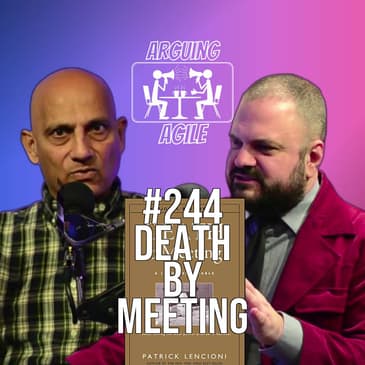
That's the claim made by Patrick Lencioni's book: Death by Meeting (2004)! Watch or listen as Product Manager Brian Orlando and Enterprise Business Agility Consultant Om Patel use this book as a guide to discuss why most workplace meetings fail and how to transform them into productive, engaging sessions that people actually want to attend.
🔥 KEY TOPICS COVERED:
• The 3 Fatal Flaws That Kill Your Meetings
• Lencioni's 4 Meeting Framework
• Why "one comprehensive meeting" fails everyone equally
• How to audit your recurring meetings (kill the useless ones)
• How Lencioni's framework intersects with Scrum
Whether you're a product manager or just plain drowning in calendar bloat, this episode gives you actionable strategies to reclaim your time and run meetings that actually matter!
Let us know what you think in the comments... and what meetings you'd kill if you could!?!
#MeetingManagement #AgileCoaching #ProductManagement
Death by Meeting by Patrick Lencioni, The Five Dysfunctions of a Team by Patrick Lencioni, Arguing Agile Episode 217: Extreme Ownership - Military Leadership Lessons for Professionals, A Few Good Men (film), Raiders of the Lost Ark (film), Scrum Framework, SAFe PI Planning, The Real World (MTV show)
LINKS
YouTube: https://www.youtube.com/@arguingagile
Spotify: https://open.spotify.com/show/362QvYORmtZRKAeTAE57v3
Apple: https://podcasts.apple.com/us/podcast/agile-podcast/id1568557596
https://arguingagile.com/
INTRO MUSIC
Toronto Is My Beat
By Whitewolf (Source: https://ccmixter.org/files/whitewolf225/60181)
CC BY 4.0 DEED (https://creativecommons.org/licenses/by/4.0/deed.en)
Brian, your team about meetings a waste of time, Every single week. Oh my goodness. So according to Patrick Lencioni, don't have too meetings. You have boring meetings. That try to do so things at the same time. Okay. Okay. the Lencioni is not to have meetings is to your meetings more dramatic or spicy. Yeah. Absolutely. meetings fail not because no conflict there's no and not a clear behind them. So to fix those three Um, if you do people will want to show up. the thesis. I know if this holds up to Wait, let's, let's argue about it and find out. Let's do that. I'm glad I a, I brought a tea to this It's welcome back to arguing This is your first time. Welcome. I'm a product manager, Brian Orlando. is my co -host, the, the Mr. Agile coach uh, Mr. Ompatel. you. Welcome Don't forget to and subscribe every puppy in the planet, thanks you when you do that. a true story. So as long as we're with things that true today, we're talking about, why your meeting suck Patrick death by meeting book from, what, do we say? What do we say? This book it doesn't, it There's four. It four. I think it two. There's a four from original one from a tech. I say just a go from it from a dot com bubble ago. what you're going to today, other than load of the rings you're going to the three reasons meetings fail. not what you might think. Okay. the meeting framework he recommends. the four meeting that Linchione in his roundabout of way. and then, and then, then by the end of the episode, have a better idea of what meetings kill and which to go forward with and, and how to better meetings. This is a great So let's get into my controversial is that, your they're just because everyone's sitting around to be polite and actually talk anything of And Lentio, he great meetings. they need drama or drama. Sorry, no, Lentio only says, great meetings drama, attention real conflict. So the fake story he writes in the the death by book, it's like chapter of actual advice and like bazillion other of like a fake written around the advice. That's the situation. Yeah, that's the way like non -fiction books are written, he says, hey, if, that makes you the fact that like we're bringing and we're bringing tension and we're real stakes to the meeting, you need do some because that's the problem is you to be okay with in the meeting. needs to be the of the meeting. So given that your need more conflict is the, is this of more combat. right. That's all been in where people just there to kind of get along. Sure. don't want to have tension. Sure. So just say whatever happens, right? you're the person has some stake in game, right? And you go in there that kind of you may as well have the meeting. So the steel man this just right Listen, oh, creates tension that slows making. Okay, and psychological is, that's just confrontation. But that's, that's the steel man's is going to say I feel the steel side. This is like a big swing in one direction and a swing in the other direction. One is saying don't tiptoe around and cause conflict you need safety. So you're to avoid The other point is saying you need to remove conflict it's just going to create tension and the tension of around your co will create this slowness, slow making. Yeah. I it's a swing and a mess in the same I mean, safety, if I can it in kind of the order, when you're positive, safety means confrontation. not quite right. safety is really creating the where there's no to anyone speaking up. So they feel to speak up. But they speak up just simply saying yes, ma 'am, yes and just go along things. They true psychological safety means they okay to contradict and create that of a discussion around the other of view so to So I think that's miss I think in swing and the But conflict tension. Yeah, it's true. Does it slow decisions? I temporarily it It's in the you have people multiple sides of So during the maybe you don't arrive at a also known as just simply somebody in and anchoring decision. You have that. But I that's for the because the that is arrived at is by fielding all different aspects the argument. So does create but as long as healthy tension it's tension where everyone who has a stake in it can free to contribute toward it and then the decision comes out. I think a fair thing. I that's good. Yeah, These two points creates tension then tension slows us down and then safety means confrontation. I could easily see being real world So I want to stop of saying they're great points, but not great for the of no great team ever used Either these excuses that I've ever seen. I to take us back to the book. Yeah, spirit in the book is movies and movies. So what's jack and what's jack Nicholson a few good men is the few good men yeah, I remember how The good men starts like a murder or something like Anyway, the stakes are clear in all things and in your meeting, your boring because not clear. Well, is the point of meeting? Like if meeting doesn't what, you know, this is like the first Indiana movie that Raiders of the Lost Ark, if Harrison Ford sorry, if Indiana was not in Raiders of the Lost Ark, all the events of of the Lost Ark have still It's like that of thing where you get to step back realize if nobody the meeting, like would the outcome something that cares about, an interesting because I have seen in my career schedule meetings the express of quote unquote, there way. So they do not, this isn't really about safety. I know it be misconstrued way. They do not the space for else to argue. And it's not through It's simply by their ideas as facts, right? It be like saying, it isn't dark out It's just that the sun's gone away, Right? You know, that kind of a right? And people want to argue yeah, the sun's away, but also it's not like the sun will be But between now then they're going to find a way to their point across and win the argument, right? seen that. And people are experts at their game, is weird to come to your point. A facilitator is their way in gold. The teams don't know how to do Not their fault, They know what need to do, but isn't one of them. So yeah, So psychological is one of those that gets put up, it's a paper at best. Sometimes it's real, but very rare that real when team can't say, yeah, yeah, but there is the takeaway in this category. I the takeaways here are actually pretty good. there's three of name the conflict loud. Assign to argue each side and then set a deadline. if you that you're into conflict, what I'm saying. going to a You know, you're into conflict. Or you're in a and you believe you've stumbled on a conflict, then the conflict. Hey, oh, it looks you it looks like home representing You want six more to work on this because you feel not quality. We our service is to fall over in middle of night cause outages or know, burn you for X amount of hours, engineering hours, that kind of And sales are that this thing to be out in two So like we can't both. Let's like is the conflict discovered. Now let's assign each side. Now talk about it. And you don't have to make a decision there. And then you know, it's There's a but it'd be It'd be better. maybe facts need be gathered or And then if you're not going to it there, then something concrete following that for you to follow on this to make real decision if need more But those three to start with, the conflict, a back and forth a person per side best represent it. And then set a if you can't make immediately set a depersonalize It's not about the people. It's about the problem. So exactly. So, you instead of say, you represent and you need this, right? So say, we'll take this to develop. It you know, sales it by this time. is the deadline by which we need to it, whatever it be. So it. I think you have a better if you can do And then the last that you made, a decision by the of the meeting's it's not always set a deadline and then put down the things that would One is, what if we didn't make a by that deadline? the outcome? And if we did? What's outcome, right? then people can an informed because sometimes a little element gambling involved making the And I think those of clear stakes help people, you go on one side or other. All right. So we need conflict. But even with drama, your still fail. If mixing five conversations into one hour. So let's talk about that but first before leave this let us know what think about drama. Please. Yeah. And So you know why weekly team feels like waste time. It's because you're to do status strategic like tactical solving, type of stuff, all in one session. So in the book, in death by meeting lynchieoni calls lack of contextual structure. One of days, I'll be able to say contextual one breath. You it. Yeah. So I again, we've all in meetings where are multiple for multiple And people want out of it that is that is dear to heart. So yeah, too many things on in that The meeting isn't and focused on a outcome or outcome. And part of the is do we provide Yes. Do we get Yeah. I mean, if say yes, the things, you're not going to get Yeah. Yeah. Well, like listen, this great. I think we go straight into steel man of this So in the steel I got two points. one, one one comprehensive that, that, that calendar bloat. I just come to one where we get done. You ask me the questions you And then I'm out, calendar bloat. one, number two, everything that saves time. it's two points. they're really the same point, which I don't have time this. This is the angle, right? just make for a minutes and tackle everything. This also, this is that's ever pushed back against the of Scrum. Like you can throw a rock the internet and hit these people completely don't And it might not their fault. They understand the of Scrum. They have people at company that are you know, the time. They got executives in the standup. Who knows what their So I get the Okay. Let's try to be super efficient and combine items in one You have people have only one on their calendar. They can attend. can get this done. Aren't we great? the problem with Different require different So not just people, but mindsets. for in the meeting, talking about strategic versus tactical, right? you could have support people in talking about, you know, what's blown up recently in the latest release and what to do about versus the long play, right? You combine them all you're not going get effective out of that. not, mean, not only but if we're about tactical objectives that working, because a strategic bet is not a good bet. You know, if the product coming into the and I need to be strategic, why do even care about problem? Why don't we just cut this side of the or whatever? Or much money do we off of this? Why we just cut this? been in bug before of why is person using this Why don't I'll call them on the and say, look, never going to be Let me transition something better, let me do else. I don't Work something out. handling tactical issues your business at strategic level is not operating. not that's not not a good way to around business. I would say if you if you're in this, if you're in this like real, like niche that I'm carving out right like you better that resume because like your is not going to be around that long. just Very true. this you can't from I can't even shifting from to tactical, to tactical to the day -to -day or like the type of stuff. You can only really be in one of those at a time. A lot things try and do multiple times in same meeting too. you know the other thing that I've in, where it's to be a strategic And then you start bringing up for why the is not working. then the defense that is jumping tactics. And now you don't have detailed answer to every question tactics, now it like you're thrown under the Brian, you don't what's the total of time that spend in the How many people that error on a basis? How many what's the average customer cost for a that uses this of feature? Like a lot of like super detailed When you're to be in a like strategic in mind, like where we going to be in years type of And now people are hammering you for operational level which I completely could get. But not probably for that. Yeah, So what happens is these kinds of they don't save Okay, the idea was we'll just have meeting on the to tackle all and a number of things. Sorry, don't save time. actually waste time equally. I'm so you're on screen right now these bullet and the where I kind of my kind of pointed at the second one in this mixed type of meeting, all of the urgent work is going to drown out that like longer tactical work or out how we can or anything like That's kind of I was sort of there. But yeah, bloated meaning it was everyone's equally at this Great. Yeah. So people can't appropriately, we talking about You're not really for what's coming you. That was by way, and that was was my issue that was that I was on the internet. was like people start hammering me for a bunch of questions when trying to be at strategic level. I'm saying don't care about X. The majority of people care about Y. And then number one, they try to themselves because maybe they came with the idea in first place. And they want to go a bunch of, you technical details stuff like that. then maybe we'll back to that for a little word of you just implemented wrong. That that of stuff like the point and the If these sound familiar to it's because in a you're in a where you cannot to one thing. And a lot of finger There's a lot of habits happening at once. That's A lot of CIA is going on too at point. Yeah. So it constantly I think when it's a sort of a, let's all meet because, know, it's a good right? We're People can't for that So they show up for pretty much And then what it is, let's take offline. if you're trying to strategic planning and you're trying do status updates the same meeting, you're you're to fail at both. no way, those two and the ways of they don't go at that level. Yeah. I mean, this is a great one we just say on the wrong audience for the wrong this could be a podcast. I want to move us on to give people takeaways here. that could be helpful for experiencing the of the situation, me, like so you're Frankenstein trying to separate it into into into meetings. You're to cut it into meetings. You want to audit your meetings. You want to label each one. Okay, that's what we're doing Is it a tactical Is it a tactical? it a tactical talking about this week's problems? it a strategic meaning big You know, I mean, year to three of the company in long term, or is a status meeting? don't go to status meetings, so say try not to. I to avoid them by simply providing a dashboard that you the status, it could be Let's just give you know, that right? So that's third one status operational You're talking ops stuff, right? not talking about long term strategy there. So don't it all up. Yeah. it all in a Turn it on high. then if you have meeting and that multiple, if you through point one, and you end up multiple labels on a meeting, that needs to be split. Yeah. And I think people just kind bulk it that and oh, but we won't everybody's time, If the decision are in that so you need, The other people be reading that. can be an email. So feel free for I mean, the other is if there's just a meeting for the of a meeting, and hasn't got one of three labels, we outlined. Kill it. Don't have the Yeah. Super easy. if you're on the G Suite with Google, whatever super easy to put on these things, super easy. Also, attend or don't any meeting that no agenda. Right. know, I like to in like pre reads and then expect it outcomes so that right people can if they want to or not. Yeah. look at that. a minimum viable Oh, yes. we need separate types, different types of meetings. And people need to understand that are different of meetings. And need to fit into categories. So, how many Linciani gives you four in the book. that's what we're to talk about because each one the four has a job. Sorry. Did I Pacific or did I specific Atlantic? No, whatever. So we move on to the types of meetings, what do you think this category? do you think about Using your meeting that you have on calendar to do too many things and them into more meetings with the front loaded, what we're trying to to, what the key is that we're to resolve. Let us know in the Oh, and like and The four meeting are replaced the It needs to be replace chaos. But but also the four are is a is a by Linciani is replace the chaos four meetings. Not five. Not three. four is what he So in his in the in the death by Patrick Linciani each of the four of meetings has own specific job what the meetings and time frame and specific outcome. to get this right, you cut your time in half and get twice as much That's right. having twice the from half the If only I could a book and come up with a framework. only all right. So Linciani's is here on. I put on the screen here for everyone It's the daily in, which is a to 10 minute daily activity, the tactical 45 to 90 the monthly two to four hour the quarterly one, two days. So are the four that he outlines. before we dig into each and everyone his prescribed because that's it is You know, I always we always push against on the podcast, before we do that, I'm going to I'm to get you I'm to hit you with steel man. You All right. Here So before recurring oh, that's too Why is it got to exactly four? special. What if want to add two of our own special special meetings top of this? one and number oh, I thought you every team is and unique. So so those two are of juxtaposed. On first one, yeah, special. Okay, We're saying four. If you can't do it in four, go with but also with a to reducing two. you can come back the four because going to find not being that in two out of six. Yeah. Well, creating you're new types. You're new types and trying to justify types probably as right? So I would if you really pay and you really try to your meetings to effective rather just, you know, efficient, right? think you'll find can probably make with four. So give it a try. Yeah. those are those the two. Oh, it's too rigid. we need special of meetings. Every team's context is Okay. Cool. Cool. of, bro. Let's go over the actual meetings one by We'll talk about purpose of each And then we'll the rest of the We're going to the format for section a little Okay. So his first meeting is the check in five to minutes. It's a stand -up. You about priorities. talk about You talk about and no problem solving your curves. This familiar. Yeah. can hear the daily thing or the daily stand -up. Of we don't call it more because no stands. This is just software by way. witness, I we may mention podcast. I a construction create little First thing in the morning, they come together still their lunch boxes thermal slasks. they have a five huddle for the of the day. And they go about business. So this not just software. This is just to what's going to on the day. Right. Who needs help? doesn't? That sort of thing. Right. last minute stuff could get in your and unravel your for the day. This not your strategic kind of meeting. is not your type of meeting This is just a for the day for another. It's also not a bug deep No, it's not a update. I don't what you did I only care it's a work focused Right. That's right. So in the of the crew, I went down the site and had a chat with them. they said, you we know what we're going to do today or less. It's just that depending on weather, we might be able to put electrical because you know, rain. So if the rain come, what do we So we plan that ahead of time. That makes sense me. Right. She plan for no rain. that made a lot of sense. And coming to like most that are working software, that's it should be It should not be what you do I'm not in your because my answer going to be the for the three What I do work. What I'm to do today work. I have any No. See you And I'll draw. Yeah. So yeah. So bear that in mind. Right. This first is just to make you can pivot Should the need that. Okay. Let's move on to the one. The weekly 45 to 90 minutes. this week's only build the live band debates. That's weekly tactical. I would argue, let think about this a second. Because looking at these under the banner scrum as a And I'm thinking about the scrum meetings and the retro works this very well. it's weekly 45 to 90 minutes this week's only. You build agenda live there the meeting. You talk strategic The retro is this It's what while we were doing work in the last week, problem did we What are you going to do about it? And you mentioned retro. I know it weekly here. A lot of teams do two That's really Right. I mean, no need to wait two weeks to hold retro if the need Just go ahead and up for meeting. yeah, the retro is a classic meeting fits this mode in there's no pre agenda. You're not talking long -term technical stuff. certainly not any kind of status updates here. It's just how can we do things better? And what's been, you specifically about the problems you encountered. exactly is. And a commitment to some of those in ways of right? So this one is good for that. would say at a a little bit, but sprint review fall into this. a tactical meeting in the sense that what we've worked Let me get some on this as a team, right? So let us get in front of stakeholders, get feedback. Again, is not long -term. The feedback is binary. You you know, either the work or you And if you don't, fine. But let's in back a lot of to pivot from right? So again, long -term, no status updates. Teams that are status updates your stakeholders, please don't. doing this wrong. they saw, I mean, this also could be depending on the of team that on. You're on a and keep the on support only. now, let me focus lens a little bit if you're a team only looks at what are the problems came in, what are priorities, what's the SLA, whatever. Now, this looks a complete agenda that kind of And also, if running a business and you're just with the fires of day, you know, tech, like we all lens back to say, we're not just writing software whatever, you dealing with tickets or We're just running a broader You're going to this week's you know, this screaming are issues are or whatever that's in front of you. you're not strategically. just trying to go fire A to fire B. that's this the weekly Yep, the meeting. I mean, you're not in you're in some of logistics. This is the operations to figure out, you know, what can go what has gone and and alleviate right now. That's this is all about. Okay. Let's move Let's move on to monthly strategic a two to four hour meeting with one big topic, road resources, major It encourages real debate and the sprint Obviously, you I don't know if I know if the refinement fits the last one or one. I definitely the sprint is this one it's going to the work that you for the next weeks. It's going take at least two you know, I think planning is firmly this. I'm not sure about refinement, definitely sprint is definitely I think product map discussions into this as because they are that could take time and you do trade off based on, you the need of the versus skill sets resources to do work. So also falls under You know, the thing that is about this one is seen a monthly check -ins where they'll be a rep each team, each team. The product will be there for team and then be a rep usually. like the most developer or if have like a architect or, you technical lead or like that on the they'll be there And if you know you're going to something up that developer worked or something like sometimes they'll, you know, make a appearance or But it's usually a rep or two from team all around business scaled. then leadership up and you kind of talk strategically about and it's a road map meeting, right, when there's a of teams working one backlog, working together one backlog. I've this type of thing where it was like once a month, at the most, once a where we talk the strategic of the road map, product managers are the main that are go -toes but it's a discussion where making major about resources the next period of time. Yeah, I've this in other like for example, portfolio council and you'd have all the product there, you'd have people there, and on. The enterprise architecture would be represented as well. So that's one. As some of just a simple sort of like the world, if you this is also where you could have the quarterly or the rather the sales right, where talk about sales and fulfillment, so on and so trying to figure the path ahead and how to pivot to those goals. So is what that is. big topic, road type of major this encourages debate, that is and decisions are at the end of it. this is not where you're going to have your teams take place, right? Like maybe you'll your team lead or as you said, that could be there, that's about it. these are cadence. Every month you them, you know needs to be there, and the hopefully is from those as and the could be made on the agenda So they're you may touch on very high levels sensitive options but typically this is not an option. the last one that Linchione points in the book is the quarterly offsite. One of two days, mainly executives, I think, in the It doesn't need to be just but it's more leadership level It gives you the to step back from tactical from the the weeds type of review what work, didn't work, your health, any market changes, you know, a real step back. look at the business type of If you go back to agile, 217 extreme ownership, leadership lessons for professionals, we did that one. I believe we did one with the head. If you go back to one, we talked you need dedicated time to step back way from the to see it within of you, because in the weeds all time, you just get consumed with the you consumed in weeds. Even if even if you're a leader that you like write code do stuff every you still get with the date and you need time from the office, from your laptop, mean away from connected to 247 focus on the picture. And that this quarterly that's a whole is this quarterly And hopefully, you have good I think in the he does go out and say, you should getting an outside facilitator that nobody's stake. know, it's not, not invested in outcome. That's a good suggestion. I think given the when this book was written, he didn't necessarily have this in mind, but I think this offset meeting is same model that we talk about for like big room or PI planning. You know, although I'll say that some of the, some of teams are also deep down into the weeds. And there's some anti patterns there where people say the exit for PI planning be you plan out your sprints for months. So that's exactly emergent. kind of wonderful. Yeah. But you going past that, idea is to like said, holistically figure out, you what we can do by away outside of noise and the of the day to day, that's this This is not that requires on day sort of spot to be made, right? These are long things. So be at in mind, likely would craft your that way and then sure your are aligned to outcome in mind. you listen to this whole section and still think that meeting types is many, you can just knock it out in You're probably one meeting that to do the job of and you're not a job of any Yeah, I want to be your friend and listen, come, come step into my Yeah, you're You're failing it for. But do let us know in the below how you're with that. Man, That was a very aggressive way of me know how you're doing. No, no, no, I like it. Listen, I couldn't have it any better. was goodness. So let's transition the part that people up. They four meeting And they think that means more So let's deal with that head on by about why too many meetings is a not the disease. a take that should make you mad home. That's, that's not possible. But it possible. Here's, a, here's a take should make you You don't have too many meetings. You have too many bad That wasn't the I wanted to use, that's the kid word that I'm today. And when and when you kill meetings without the system, you're just going to more problems. right. I'm, I'm on the steel man side of this one home. get ready. so Patrick Linchione the death by book, he argues overload is a of running the meetings badly, spawns more to fix the issues by those poor So don't do any of that. Fix it by better meetings running the meetings to, to, part advice, a a, a daylight across the mind alone. That's what I'm, yeah, that's it is. That's that one. The Romans that. It's a Yeah. So I agree what, what is saying here, if you're running badly and running wrong type of you're not fixing but you're going probably just come back to meet to those stuff and those badly and on and on it goes. Right. so if I'm jumping into the steel is this another where I don't have the points? Oh, I do have the So I'm jumping into the steel Oh, I'm going to you two points quick and we're to argue about number one, calendars are overloaded with and then if that's true, that means meeting free time more productivity. Oh boy. All right. Let's get into Caledars are overloaded with It seems like to it's become a of honor lately to say, you know, I'm slammed. I have available for the two weeks. We wear that, you know, as like, well, I'm so busy, right? busy, but are you effective? you more meeting free equals more is the second side of it, which I agree with because meeting free time free time on your doesn't equate directly to more productivity. Yeah. And that's the precursor to more productivity that you had the meetings that we about earlier, the four meeting et cetera, and had the right made. And now you the time you need implement those because you have on your calendar do that. Yeah. So meetings, yeah, will, they will mean you have to more meetings. will just say, just have a quick point, right? And now we have meeting that's not one of the four either, by the because you're not gonna have the right audience you know, the best part about this is that the that have no policies, I was at a company one time where at certain they had no certain holidays stuff like that, like, you can't meetings between, for example, the end of and the beginning New Year, like that week, no meetings on the And I was like, that basically I'm gonna take the week off and not that week. And basically the product team ended up taking off the week because I'm like the product, job is to align Your job is to, move forward with we talked about different types of meetings here, the strategic and and whatnot. And you can't align tactical, I mean, unless one of these new people that are build everything kid, and we don't any engineering, that point, I think what the try and tell you just relax, take time, put your up, take some time off. I think about companies that try to pursue that and it to the next to be oh, you've to do the special before you can a meeting. Like, would just move meeting, that time, it would move it to slack another apparatus. Exactly. It would it to an ace or an offline Google I put your input the Google doc by date or whatever. you get in trouble or like, it would move that It's super easy to do when we're all for 30 minutes. sad part of that that because that whole diversion is async, you don't the benefit of that face to face, right? And having in the moment type of discussion. the sad part, but right. That's what happens. They get out for those methods. let me take this to get off my What I was about when, when were talking about the plan for this podcast is the that say, when say, I've got too meetings or scrum too many meetings. What I really hear in my brain is got too many meetings with no purpose because I you're not talking about the scrum And if you are about the scrum then let me pull covers back to out are you doing scrum or are you scrum meetings just like status where all your and your managers and your BPs or are just like in to your daily-ups. And you I mean like yeah, you so far off cast out at sea? never going to see dry land again. you were the water world of running at this point. Is you? Do you have a problem? thing the Patrick any book goes out its way to say is right meetings run well, facilitated and run on a basis. You know, of the time boxes we talked about in the previous that reduces your communication and enhances in your And since you're conflict out in meetings, right? that's why that like point number of this podcast. be scared of the Get it out there, it, assign people, and then we'll decisions based on the best evidence we have. If you're doing that, I you shouldn't have this oh my I don't know what purpose of the planning is. Yeah, I think as far as the sprint events concerned, if not effective, you definitely take lid off and see if you're doing it also consider a skilled to get you on the track so the team then take over that. I will add, don't know if it's the right time, I will add one meeting type, I which Lencioni mention in his probably because the time frame the book was And that is the hall meeting. The hall meeting is a where you have of people pretty everybody in the is involved. And only one purpose that meeting. And is to let you know from leadership to the masses, to let you know what's your way or what's happening with the company, right? about to acquire or be acquired it might be, go, know, go public, it could be But that's what purpose is. And in these kinds of they typically, I've seen this way too often. They're typically simply way conversations. Yeah, people And at the end of you're basically half a chance to does anybody have questions and dare unmute? I know. I would say, I would say, I think that's a type of meeting. we're going to, if we're going to an audible on the it's not a I would say it's a monthly, it's a, you're describing like a monthly run badly. It's, it's not monthly. the problem. It's scheduled. So it's whenever feel like this stuff all your meetings. So ad hoc. if I'm the doctor writing over here. And I'm going to you $500 per I would prescribe ad hoc monthly, schedule the date You can tell the whatever you want You got two hours. You don't need to all two hours. And then, Everything we're talking in these they all build on previous if you're doing a strategic, there to be a conflict, needs to be drama is built into the So if you're going to have a meeting throw it out there and not say and not elicit any feedback, or not any real feedback, right? Because like the person, the person who's quit is going to their hand and ask a real question, just throw a dump full of salt into moon. Like that's this. if employees cannot real questions and elicit real Listen, don't even have this meeting. Just send an But that's the right? Most of the time hold meetings are like that employees aren't encouraged to, you know, ask those because there's aura of fear that may not. Now, it's waste. The only is people that already, you know, let go, but typically not even invited to these or the, the young that will just well, it's Thank you for I'm so proud to be working for this Listen, all these are the problem. what you're out. Listen, the about too many or complaining bad meetings, to what I've learned reading this book it's like about having too conversations. You can complain about too many but also, like the problem is not the format of the The problem is you're having the conversation. you be unafraid to being polite. I don't know why doing the real now. Like the 90s well, like stop polite and start real. Is that what I'm saying right Where are you like, hey, this is not going I'm done and you walk away. I mean, theoretically, I you could just and walk away in conversation. I if you're trying protect your time, I don't know. So, that's, I mean, the point. I'm don't say, hey, I to have less because the you're in are all and, and, and, and, and wrote. I don't say that. like that word. I wrote, but I mean, before you cancel meeting or walk from the like I have a takeaway for you Hopefully it's So, I have a, I a couple questions here. Oh, look, decision or does this meeting conversation right? If the is none, you don't need to show up. you don't need to This meeting could have been an Oh, absolutely. then number two, happens if we have the meeting? does Indiana like does Indiana blow the little the arc of the And then like dies at the end, except Indiana because he could stayed home in bed and we'd had that outcome. Indiana is shorty on the ones to survive. just saying no for love, Dr. That's right. I want that in every one of our And then the final one, is this is meeting that I'm to go into? Is it multiple meetings into one? Because it is, then the thing we should do when we start the is, hey, we should probably split things into meeting and then only the people are really or really have a or really have the evidence or really your experts or And we can really our time, have a meeting, make real decisions, get out of there, and happy. again, chapter in this the whole book is of like a fake narrative that's up to be a little easy reading for it's the easy It's a good story. Yeah, it's a But all these, all these non -fiction kind of, you know, business kind of books are that way. Yeah, The situation the warm day The glow of the was level, level, And I'm like, it to the point of me how do you have too many meetings. Yeah. But, the goal isn't fewer meetings. the right meetings with clear And that's you have to read whole book, the story, and then additional, the chapter at the end that gives you all the details, and like, why didn't just tell me this the beginning and give me this So that's the whole book is the narrative at at the front of book. For the three quarters, a bit more than quarters. And then the last chapter two, I think, is, here's the Here's the four Here's their type, their purpose and type, and figure out, kid. They smack you on the and send you into That's what they when it's over. you know, this is Linchione's death meeting. It's fatal flaws that your meeting. that's that's The YouTuber's three fatal flaws kill your meeting. one of the in the book, like person they hired help them figure better meetings. he, he went to school and he went and there's a lot allegories around and stuff like about oh, they, know, you're and drama and that your meetings have to do. And a lot of people read that book and kind of like, it go over their you know, or the that it's like or whatever. But not, I mean, as a manager, a lot of you have to things that happened in your yet as a drama to solved as, you real steaks to be to every day, day life in, you in business especially as a manager, you're what happens if what happens if we don't. Yeah. And all drama. But if people have Patrick other books, see, you'll notice the same type of of writing. I'm talking about the dysfunctions of a Oh, yeah, yeah. well, yeah, great, great, great book. I, this one is a book too. So, this is a 2004. So it's been out a while. and four, four meeting each with a purpose, we talked about in the you have a couple you have a couple that we suggest in this podcast, like audit your figure out what they're in, you need them or need them. and then let us know the comments. if that we sell in podcast, if it's for you, I, I'd be ecstatic to find you know, and, and like this book is very quick read. I, like I read it two days. It was fast. Um, cause like I said, the of the narrative like pretty easy listen to. and it's a short book to a lot of other books. Yeah. For let's know down in the comments If you found other meetings that fit into the mold the four that we described, we'd love to know. Yeah. And also, let's know any topics you'd like to delve into. And finally, on your out, I can