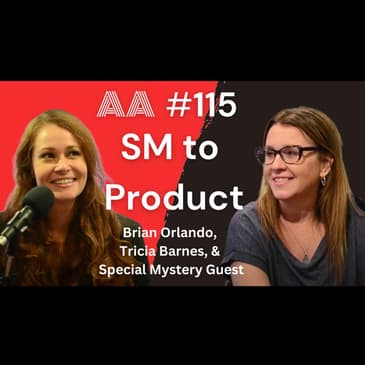
Both Product Manager Brian Orlando and Product Manager Tricia Barnes have been recommending to our favorite Special Mystery Guest that she consider transition her career towards Product Management.
On this episode, we talk about the benefits, advantages, and concerns of a Scrum Master moving into a Product role.
Bonus points if this has been your career journey - we'd like to hear from you in the comments!
0:00 Topic Intro
0:12 Less Stress
4:32 Growth for Scrum Masters
12:33 Leadership Skills
15:44 Accountability & Decision Making
20:41 Accountability & Communication
26:09 Compensation
30:47 Agile Experts
33:46 Equity, Permanent Roles, & Consulting
35:10 Business Analyst
37:07 Ad-Hoc Salary Searches
39:07 Communication, Empathy, & Advocacy
42:23 Career Advancement
46:35 Accepting Responsibility
47:55 Summary
48:46 Wrap-Up
= = = = = = = = = = = =
Watch it on YouTube
Please Subscribe to our YouTube Channel
= = = = = = = = = = = =
Apple Podcasts:
https://podcasts.apple.com/us/podcast/agile-podcast/id1568557596
Google Podcasts:
https://podcasts.google.com/feed/aHR0cHM6Ly9mZWVkcy5idXp6c3Byb3V0LmNvbS8xNzgxMzE5LnJzcw
Spotify:
https://open.spotify.com/show/362QvYORmtZRKAeTAE57v3
Amazon Music:
https://music.amazon.com/podcasts/ee3506fc-38f2-46d1-a301-79681c55ed82/Agile-Podcast
Stitcher:
https://www.stitcher.com/show/agile-podcast-2
= = = = = = = = = = = =
AA115 - Going from Scrum Master to Product Manager (and why you should)
Welcome to Arguing Agile. We are here with two product owners and one scrum master, which is myself, and we're going to argue why a scrum master should move their career to focus on product. First thing as a scrum master, you hear this from all Scrum masters. It's considered less stressful to focus on being a scrum master than it is on product. Do you think that's true? It's absolutely less stressful to be a scrum master, however, it's a good, fun stress if you like your job and you're good at it. I'd rather be at a level where I'm working and, and actually making a difference than kind of just talking about process all day. And I would rather the stress that comes along with product is worth, I think is worth it. Interesting. Stress kind of drives me. Stress drives you. And Trisha, you have an interesting perspective too, cuz you've played both roles. Yes, and I found myself bored, although I did, I've always, I started out as in product. Then went to scrum master to be a, more well-rounded agilist. Mm-hmm. And to learn that role and I needed to go back. It wa it didn't last very long because I, I, I was, I didn't have the same control that you get when you are a product manager or a product owner. You get to make those decisions. You are the difference between a customer being happy and not, and you just don't get that same reach as a scrum master. And for my personality at my what, what drives me, I need those things. Okay. That makes sense. So she feels like she has more control and more influence with leadership and business. What are your thoughts? I think any role that you're in, you're gonna be looking to move up to the next level. Right. And if you're in a, let's say you're in a scrum master position and you have one team, two teams, couple teams, right? Normal scrum masters, you're probably gonna have a couple teams, right? Maybe you'll float a third and be like, oh, I'm kind of stressed that's true, right?, I think of, I think of the positions for a scrum master that are like financial shops where you're like a, a, a safe scaled scrum master where you're like helping conduct release train events and stuff like that. Mm-hmm. That's way more stressful to me Yeah. Than the concept of being like a single team product manager for a single product like that, that, that, that idea like just freaks me out because you, you're not at the point where you're a scaled scrum master. You're not even a scrum master anymore. Like you're more of a project manager the, the majority of your job is like operations as opposed to developing a team and, and helping a team move through and develop their agile maturity. I try not to say maturity on the podcast cause it's not a great word. Doesn't really communicate what I'm trying to say. Okay. As a product manager, you could stay in the track of a product manager, of being a product manager for many years Yes. And still develop things that you haven't been exposed to early in your career. Absolutely. You know what I mean? Just by changing industry, I mean, it seems like every product manager job is different, right? There's no, no two are exactly the same, right? Mm-hmm. I could see from the perspective of less stress Yes. In that the, like the, the, the weight of the business does not lay on your shoulders just like a mm-hmm. Like a company founder Exactly. Or a business owner or somebody like that. Right. Sure. However I feel the, like the best scrum masters that I've been coupled with know how to do the product job, and they can see where the product owner on the team is kind of fraying at the edges and they step in and help with that. So from that perspective, like you're already doing parts of that job. Like why not just if you, if you are, if you're kind of on the periphery of the job, why not just figure out how to do the whole thing and then mm-hmm. Just move over. Mm-hmm. Just move over. Maybe I don't want that responsibility of making decisions because really in a, in a scrum master role, at least in the positions that I've been in enterprise, well, I was a scrum master in an enterprise situation. I was an agile project manager. Essentially a scrum master, but in a startup. Mm-hmm the agile project manager was very stressful, it was two different teams and seven different applications. Separate mobile applications. Yes. So in that instance, but that's not a normal, when we were talk, I, I think, I thought we were talking about a normal scrum master. See, with one team. Mm-hmm. See, you say it's not normal, but I, the, my scrum master experience is your reward for success is, is another team down with more teams. And I, I, that is true is not normal. I, I'm saying I think you could be right. You could be right. If I'm the business owner and you're the scrum master in my business and I'm trying to grow you as an employee, What is your next step up from Scrum master? We're we're sitting down to have our career counseling session and be like, where do you want to go in the business? Jessica, you've already sat down and you've already worked through these issues of team empowerment. You understand issues of org design where other people don't, you know what I mean? You have like, people have to go through MBA classes to even get exposed to this kind of stuff. How does a team develop? How do I start a team new? How do I get people working together, these, these, these types of issues that this is not like a professional, you could argue that HR should have these skills. People know when I talk about HR on the podcast, like that's the end of the podcast, so I'm gonna hard pivot to not talk about it. But once, like once you have all these skills of getting people to work together mm-hmm. Where, what's the, where, where are you launching to after that? Don't you think? It depends on the company. Sure. It sure does. It has, it has to because are they are, are they Scrum where they're taking it all the way to Agile coach? Are they Right. Are they really looking to embed Agile in their company? And if that answer is no, you really have reached the ceiling. I think, I mean, where are you gonna go? You're right. If it is more of a we've adopted Agile and this is the way we're gonna go, then you do have a little bit more leverage and you could end up being the head of project management or The Scrum Masters or the PMO or whatever. But I, I, it absolutely depends on the level of the agility of the company, I would think. Sure, sure. Interesting. Yeah. I mean, as a Scrum master, Like you mentioned, if I get air quotations promoted, it's really me moving away from my teams. Right? So like I'm allowing them to work more autonomously. I'm moving myself from being a scrum master who's very involved, maybe to more of a coach, making sure that they're mm-hmm. Is staying and doing what they're supposed to be doing. And then, like you said, we get more teams, right? We're promoted to more teams. Well, the, that's, I mean, the, the reality, again because I'm, I'm concerned about everybody, like with all the layoffs and people and stuff that you see going on and happening. Mm-hmm. Yeah. I'm very concerned that companies don't see value in, they can't connect, that's directly connect value to the position. I promise I wasn't gonna bring this up on the podcast, but here we go. I don't know if this is gonna survive,, I, I'm concerned that now, like you see a drawing down of the roles mm-hmm. The good roles where you can actually like expand your skillset and be influential and, and make a difference. I see those roles drawing down in the market. I see less of those jobs. I think 10 years from now there's going to be even less of those jobs. I think they'll move on to other things. I agree. I, I absolutely 100% agree that We are doing it now as a startup, we are surviving and we are creating products and services without the need for a scrum master, without, I mean, yeah. Do we have problems? Yes. Would a scrum master fix them? Possibly. Are we gonna invest the time and money in getting a scrum master? Absolutely not. Probably not. Yeah. The last couple of companies that I've come into in a purely product perspective, I've sat down with the leadership of the company and laid down some guidelines like, Hey I have all this experience building teams and understanding when teams are going off track and understanding like I can see poor engineering practices happening. Mm-hmm. And I do know how to correct it. Mm-hmm. However, That's not what I'm here for. Like I have to dedicate myself to learning your business. That's exactly, becoming an expert in the domain of, of figuring out and maintaining your roadmap and your backlog, talking to your stakeholders, talking to your investors, leveraging relationships, and I just don't have time to, to do this of the job. Although, the small business person will be like, well, you have the skill, so why wouldn't you, why would you not? Right? Mm-hmm. It's just because it's a matter of time. Like, I I if you read even if you go back to like Marty Cagan inspired like the, the, the Bible Yeah. The art typical product manager book. You know, even in that book, he's like to do the, the good job of a or to do a great job as a product manager. I have never seen anyone that works less than 60 hours. That's that's right. He just says it in that book. Right? Yeah. So that's way more stressful. I don't know many scrum masters who work more than 45 hours a week. Well, you, you don't, you don't need to like I, I will push back against Marty Cagan. I can't believe I'm going here. I'll push back against Marty Cagan and say, I think you can do it in 40. You can do it in 40. If, if you're with a company that respects the position and understands that there's only so much you can do before you start dropping things. Yes. Like any employee, right. There's always work to do in product. There's always work to do. Yeah. Whether you're looking through your backlog or you're gonna write some user stories, it's all about what it needs to be done today. The typical product managers are not gonna go for like, working 60 hours what is it? Uh diminishing returns. Yeah, absolutely. At some point you just, there's only so much creativity. Mm-hmm. And and stuff you can drag outta somebody in an eight hour, 10 hour day, you know? But the point of me bringing all that up was, I was drawing a line in the sand with my leadership to say like, Hey, if you really value someone that really understands organizational design, someone that can sit with the teams and help them develop somebody that know who has been where they are going and can guide them along the way, you need to find, you need to bring somebody in and, and dedicate them to doing that. When the team asks because they are at like, at an impasse or just frustrated or whatever, I will tell them what's on the other side of the mountain. I'll be like, Hey guys if you're frustrated because you don't understand, this is why we did the, the last podcast the podcast is that's live right now on going from a team who estimates and has like all the estimation problems and stuff Yeah. To a team that doesn't estimate at all. You don't even spend any time on it. You just bang out your story. That's what we don't, we don't, yeah, we don't estimate. But you, you, in order to get there, you have to have somebody who understands like, okay, we're pointing now and we talk about this and these is the reason we're doing, pointing this, whatever. And then, hey why don't we try instead of having like a an eight and a 13 and a five and one, two and three, how about this? Um, if you guys don't feel that a story is a five or you know, 1, 2, 3, or five, just say it's too big and we'll keep breaking it down until everyone on the team just thumbs up. It's a five or less and we'll just start with that. You know, or like if you're doing time Hey, can I finish this and put it out to production in two days? Okay. And just keep breaking, breaking, breaking, breaking down, and just stay in refinement until everyone gives a thumbs up. And that that's a strategy you can get to. Sure. To start to move beyond estimation. If you're all hung up on like, yes. Oh, I don't know. It might be an eight, it might be a five. I don't know. Like, cuz the value is not in the eight of the five. The value is in the discussion that gets you there. That's exactly right. Anyway, like the point is, you've, as a scrum master, you probably have already been through a bunch of teams who started with like chaos and then moved to pointing or moved to hours or moved to something else and then got through that and maybe evolved past that. Or maybe evolved out of the scrum you know, events and now they're doing kanban just cuz when they have something in the fit to show, they just get the users, pull a demo ad hoc, throw it on the calendar. Yeah. Show the user and then they move on and they don't, they basically don't need a sprint planning and all this other stuff. Mm-hmm. So if, if you've been through all that I'm just, this is, I'm gonna roll it back into my pitch. If you've been to through all that and you understand all that, and especially if you're in a company that has limited resources and maybe they're looking for a product manager and they don't they, they're having difficulty finding one or finding the right one , and they have this scrum master over here who's like, oh, well you understand our products cuz you've been here for a while, you understand our um market segment or our domain or whatever. Cuz you've been here for a while and that all the teams know you. It makes a lot of sense. Yeah. To just move over into this lateral position and everyone will know that you have to be trained and mm-hmm. You know? Yeah. You have to be trained anyway though. You have to be trained anyway. You have to be trained anyway. And every job is, the weirdness about product, and I've told you this before, is that every single place is different. So product. Brian and I have the same role, but we probably ha our job and our day to day looks vastly different. Mm-hmm. I have a hardware component I have to deal with with that it's just a completely different, it's more of a startup. We're getting ready to raise our series b I don't know exactly where your company is, but it's just, it's, it's so different. Anybody they get from outside, they're gonna have to train. That's They have to train. Yes. Yeah. So why not you? Well, so one thing that I don't know how they train, I haven't seen many places train around this is conflict resolution and negotiation skills. And I feel like that they're not gonna train for that. Of course not. But that is so important to have those skills as a product person. So you go outside and learn, take a LinkedIn course or beef that up. Well what, because those are important. What you're pointing out now is that as a scrum master, you have already acquired leadership skill because like the servant leader position is not, it's, it's not a management position. I mean, like a project manager is sort of like a management position. Mm-hmm. Or like a, or like, I guess some, you could make the argument that some SAFe positions or like management position anyway. The leadership skill that you've acquired by not having authority in the organization and only having influence when, when they say influence for scrum master mm-hmm. They really mean leadership. That's what they're talking about. Yep. You're using leadership skill and ability to communicate with different people to align them to what you're trying to do. The product manager uses those same skills to establish and promote a vision mm-hmm. For the product, right? Mm-hmm. Which comes from the company's vision, right? Yeah. And to follow along with the mission and the vision, and to develop strategies and to drive strategies. All that is doing it through influence. Like, you have no control over sales, you have no control over marketing, you have no control over your stakeholders and your customers, right? Mm-hmm. That's all influence. So these are all transferable skills that transfer into the position of product. That quite honestly, I'm trying to think of all the literature of product that I'm, I'm like inspired and stuff like that. Yes. Like, I, I don't think they go into all of these leadership skills that you have acquired I guess maybe in terms of stakeholder management, what, what are they leading to? Right. You know, where are they going? Um, if they're going to. Leadership. Mm-hmm. You know, which you normally get from like, business leader, like executives and stuff like that, or you know, directors of departments in larger organizations. It makes a lot of sense. You would move over to product management so that you can, all these skills that you've spent time developing, now you can use 'em full-time in your job. to a much higher effect. Much more effective I have. And you're already doing negotiation in your, you don't, you just don't realize it because it's, it's more subtle. You're negotiating every single day with your teammates, right, to try this or try that. Or What about this? Or what about that? Or, why didn't that work? Did you try this? You're already doing that. It's the same skill. You're just using it for a completely different reason. That's a good point. And like you said, it is more subtle, right? Because as a scrum master, if you're working with teams and you want them to change, you kind of pitch it as an experiment. You know, Hey, it's just an experiment. If it doesn't work out, we can go back to old ways. But for you both as product people having to negotiate with product who's, or with business rather, who's incredibly demanding, right? And sometimes unrealistic. And so you have to navigate that conflict and be honest with them in these conversations. Yes. Humans are notoriously uncomfortable with conflict. Absolutely. Right. And if, like you both mentioned, they don't train for conflict resolution or train you how to give you negotiation skills. Mm-hmm. So this would be really stressful for someone who's moving into product experiencing this for the first time. I I would say it's even more advantageous to have these skills because there are pieces of product management that even, even product managers don't get exposed. I feel okay going out on a limb to say like 75%, like a major, an overwhelming majority of product managers don't deal with Well, I almost wanna back all the way up to, to don't deal with like, defining the strategy themselves. Like they're not in the room when strategies, defined strategies. It's true. Directed to them. But, even if I, even if I'm like willing to be like, well, I'm not sure about that a percentage. I, I will firmly stand behind pricing go to market strategies your marketing strategy, when sales is in front of customers, like they have a rep from product with them, like 75% of product managers that are, are out there not listen to this podcast, are totally in the room. But for the other 75% for the other 99% of people they have to fight to be involved in these things. Absolutely. I think of the scrum master has to convince executives of like, well, maybe if we split this team, then maybe although like you're lobbying to be like, well, maybe we could try to experiment when you know that splitting a team of 15 into two teams of eight and seven is gonna basically double their productivity. Right. Like snap of a finger. And, and, and probably you could probably get like 400% gain on speed of delivery if you actually cut them into three teams or more. And, and you just know that you, but, , again, you can't just be like, Hey, we should do this. No. Right. Because they'll be like, well that's ridiculous. Who do you think you are? Get outta my office. How you fine. That's exactly right. Yeah. Whereas a product manager, on the other hand, when you're like I can't get anything out because this team is too big and there's too many lines of communication and we need to split them up. Oh, right away, sir. I'll get it right on that. Hmm. Because you've said the, I can't get anything out. Right. Because it stops with you. The buck stops with you. You're the one that is responsible for getting this stuff shipped. And when you say, I can't do my job of getting this out, they listen because it's product, because it's the thing that makes them the money and they do listen. And that's why it's such, I feel it's a more rewarding job, but risk and reward. Right. You ha it come, it's yang and yang mm-hmm. For that reward. And I don't know about you, but I don't have it many, many days that I feel like I have even a one win. Mm-hmm. So it's, it's a far and few between with the wins, but when you do get them, it's worth all of the work that you put in. I know that I lost a lot of battles as a scrum master that I should have won because I have like I have data on my, I have results and data on my side, right? But again, like the, because the business is not there, there are no metrics to measure a scrum master being successful in org design. There's no org design metrics. Again, you would think HR would be invested in org design and, org efficiency or whatever. Empowerment, I don't know what metrics, but as a product manager, you can lobby for metrics and results and be data oriented or, or data driven in your decision making. And you could say, Hey these last few sprints, I had this many people, whatever, I broke two team members, three team members off to focus on this goal and this is the result of that. And the business will follow you because there are so many other things that the product manager is bringing to the table that is either result oriented or data oriented it's much easier to make metric-driven, data-driven decisions as a product manager. Yes. Whereas you might not even get into the conversation as a scrum master, huh? Like, you, you should be able to be perceived as the expert because you are bringing the before and after. And even what Trisha just said is like, I, I lose arguments all the time. In fact, in fact, when I'm writing a investigation type of task for my team, normally I word the investigation task the opposite of whatever my opinion is and how it's gonna turn out. So if I'm like, Hey, we're gonna go we're gonna go try to prove that if we introduce functionality A nobody's gonna use it. And that's the way I will word the story. If I expect, if we introduce it functionality a, like everyone's gonna adopt it and everyone's gonna love it. Mm-hmm. And then I will word the story in the opposite of what I believe because I, I'm worried about coloring it, you know what I mean? The, the, the scrum master thing is like, if you wanna go out and you want to try something or Hey, let's, let's try adjusting our definition of done. Hey, let's try, releasing ourselves instead of handing off over the wall or whatever now you've gotta you gotta get managers together. You gotta get your boss, you gotta write your congressman. I don't know, whatever other things you gotta do. I don't know what I agree with you Brian, I, I do think that you just, you, you seem to have more pull because you're already in a position to make those decisions. And again, it comes down to shipping product. Mm-hmm. If you can tell the business, you can ship product faster. They're all ears. That being said, considering your position and how you are taking full ownership of the product right when things go wrong, for instance, or maybe it's a late they night when you know there was a release or something. Sure. They're gonna call you. Sure. So you hope. Yeah. You would hope, right? It's your product. So I would argue that you have better work life balance as a scrum master than you would as a product person, because essentially you're on call in moments like that, not if you have a good quality product. I don't get called in the middle of the night. Do you get called in the middle of the night? I don't do releases in the middle of the night. Because I would lobby for the business. Like I have all my people, I have all my people in the middle of production day. So why, why would I not release in the middle of production day? Because if your confidence is, super low that we can do it in the middle of the per production day and not impact servers or whatever, then we need to resolve that. If you can't go to production like immediately without any worry about your systems or whatever, you have to have, you have to have a, a little sit down and talk about, your release and deployment systems. I can't tell you how many times in a week I see people talking about this on LinkedIn, and, and I, I'm so thankful I don't have to deal with my team, when they, whenever they finish a story and an individual story, it goes straight to production Oh, by itself. Straight into production. And I can tell the stakeholder or whoever we're like in my Jira, I haven't done that in a while. I have a field, a dropdown for the user persona that mm-hmm. The story is for mm-hmm. Yep. Yeah. So as soon as a story closes, I I have a, the user persona. I know who that persona is, like by name. Yeah. I know who to contact. So I'll contact them and say, Hey, your feature went to production just now, or today, or whatever, whatever yesterday, whatever it is. And I'll ask them to go check it out, or, or if it's something big, and then I'll schedule something with them and I'll say, Hey, you're teaching production. Let me schedule something with you so I, I, I, I just, I don't deal with this. And if I had to deal with it, I would be pushing my engineering leadership, pushings not a great word I, I'd be pushing my engineering, I'm gonna say it again though. I'll be pushing my engineering leadership to, to say, Hey, other companies have solved this. You, you really should invest in solving this for us. Yes. Because I can't go through that. I can't go through pajama parties. I can't go through middle of night deployments. I can't, I can't put that stress on my team. That's exactly right. Yeah. And you can, you can figure that out when you're interviewing. You can ask what their, what, how their release plan goes, what their standard procedures are, and how that works. And if they are like, well, we do it at 11 o'clock at night, start asking some questions. Right? Why? Because I've, I've seen it happen where the product person was on the call
with the engineering team at 11:00 PM up until 1:00 AM because things went wrong or whatever, and then they wanted to do the validation on the call. Mm-hmm. They don't wanna wait till the next working day to do that. I think you would have more influence over something like that as a product manager. Yes. As a product manager, you can kind of control the percentage of technical enabler infrastructure work that rolls into the backlog. So you can, you can make a concerted effort and you can make a pitch to leadership with your engineering leadership behind you to say, we should really fix this. Yes. We really have to do it. Absolutely. Whereas as a scrum master, you could see this, you could see the same problems. I've, I, I have to go back to my years of working on development teams as a member of the development, like not a scrum master and what product owner or whatever. And all the times that we've pointed out like, Hey, we really should fix this. Hey, we really should do whatever. And the product owner, like having absolutely no idea what we were talking about, cause they had no idea about tech. They came purely from the business. They had no exposure to technology at all. And they're like, I don't understand why that's important. I can't like, just get my features out. You know, like I feel as a scrum master, you have a certain exposure. Maybe you're not specifically technical, and this is like a whole separate podcast, right you have enough exposure to what a development team does, where if you flipped over to being the product owner role on the team or a product manager because you have exposure to this stuff, I think you would be a little better lobbying Yes. To, to, to kind of weave the concerns of everyone into the product backlog. Mm. Which would be your responsibility. Yeah. Mm-hmm. Mm-hmm. That's, that's exactly right. No, I agree with you. And I also think that you, the easiest path of least resistance for you would be getting into the product owner role? I see the product owner role and the product manager role split. I think it should be one person, but I see it split right down the middle. Product owner is the, is the development side and the product manager is, is more of the marketing, the market research, the plan, the strategy, this is what, what we're gonna do and this is how we're gonna do it, or one of those two. Mm-hmm. And being as the scrum master, you're closest to the development. So you learn and hone those skills as a product owner. The, the backlog management the releases, the team, how it's working, their velocity, all of that stuff. And then as you start to gain, you can do that in your sleep, like Brian and I can for year cuz it's, it's repetitive, it's the same stuff. Different team, but same stuff. Then you start branching out and learning about strategy and the vision, how to set the vision, how to talk to the ceo, how to get good customer interviews. What metrics those are the, the, the. The, I think the, the, the meat of product management is that, that side of it. Since you're already on the front lines with the product owner, you have a way in knowing that piece of it. And that's how I would, that's how I would get bridge my way in. Hmm. This is good guys. Topic number two. I've heard from other Scrum masters that they would never go into product because as scrum masters, we make more money than product people. Do you think that's true? I, I don't believe that at all. I don't believe that at all either. I wouldn't trust a company that paid. A scrum master who manages a process over a product manager that managed an actual product, I would not trust a company. Why is that? Because the getting, because you can get a product out the door without a scrum master. You do not need to have process. It may fail. Yeah. But you can get it out the door. You don't need process startups that are a series A or, or bootstrapping, they're not hiring ScrumMasters yet. They're getting product out the door. Hmm. Product manager is a necessity. A CEO can only do it for so long. Product management is a necessity. No, a ScrumMaster is not a necessity. It's a nice to have. Sure. And that's why product people, they're the ones that are making the decisions. They're the ones that are talking to the customers. They're the ones making, making major decisions on when a product should go out, when it should decline, and either be revamped or, or be killed off. ScrumMasters aren't making those decisions. Mm, and if a company is paying a Scrum master more than a product person to, to, to manage process, I, I believe that is not the kind of company I would wanna work for. Wow. What do you think? The, the issue with the scrum master position is it's so, it, it, it's, it varies so much. Of what they're looking for. Like, are, are we talking about like a, a, a scaled scrum master, like a, like a safe scale, like a release train? Mm-hmm. Like person who's a scrum master but has like eight teams, or, like are we talking about? Mm-hmm. A, a project manager who's actually named Scrum master because the company told their board their, their agile now or whatever, like versus true versus product manager who are pretty standard. The only thing I would caution about that is I, I think there are more product owner and product manager positions than there are scrum master positions out there and I think 10 years from now that, that, that ratio is gonna be even more tipped toward product managers, I think there's gonna be less the scrum master positions, and they're gonna be even more competitive than they are today. And if safe continues gaining market share the scrum master positions that are out there won't even be, I mean, they're not real. I'm trying not to attack safe here, the, is a safe Scrum master really even a scrum master topic for another decade? Yeah. They'll, they'll, they'll, I think they're gonna move further. It, it assuming safe gains, more market share, you'll see more of that, that sector that has those types of scrum masters, safe scrum masters, like the financial and banking and healthcare and stuff like that. You'll see more of that and less of the scrum master that they're looking for, that is developing teams and is involved in org design and actually you know, deals with agility and, and can help development teams and stuff like that. Like that. It, it, it's more of a mini project manager by another name. Normally, I can see both sides and defend both sides of a point. This one, I can't, I, I like if you wanna say as a scrum master and you see that if you, like 10 years from now you're like, I still wanna be a scrum master, or maybe I'll be a consulting scrum master or whatever I would run out and get a couple of safe certs so you can work across industries and I'd run out and I'd get my PMP certification. Absolutely. My PMP certification, so that you, you do not get so frustrated with companies that, are mixing the two and they don't, that not mixing the two because they just don't know mixing the two because they just don't care. Now if we're talking about a project manager who has a PMP certification, who's been doing something in the project management space, maybe for the government, that's different. The, the question on the table was scrum master. Mm-hmm. Project manager is, I believe, completely different. Yes, there's shades of project management, but I do have my PMP and there is a lot more, there's a lot more on the plate of a project manager than a scrum master who works on a scrum team in an agile business. Hmm. So if you wanted to take what you have as a and and as your experience as a scrum master and go into a project management role in a big company, maybe possibly for the government, then you're talking probably some pretty good money. if that's what's driving you and decision making and that kind of thing. I think what we're saying is the scrum master role as it is now in Scrum with businesses doing scrum, they're falling by the wayside. Yeah. Wow. They really are. Wow. Yeah. Is that just your personal belly barometer going off? Yes. Or, or have you actually, that's just my personal read this from experts predicting that we're gonna see this change in the future. Well, it's my belly. The problem with querying experts is that the only experts out there talking about scrum masters on the internet are all the people with podcasts and blogs that are trainers. This podcast is about the only one on the internet in, in this space that's not hosted by a trainer or someone that stands to make money off of Scrum. That, that's the issue here is you would never, at the point where the house is on fire, you'd never get a, a smoke detector signal that like, this job is in decline or companies don't respect this position across the industry or whatever. You would never hear that clearly cuz there's so many people that have a lot to lose by broadcasting that signal. You occasionally you'll see an event that happens that, that brushes against this like the, like the Capital One layoffs, well, how long have companies now been doing when I moved to my FinTech company back in 2017, they were doing their Agile transformation. Mm-hmm. How much longer are companies gonna be doing their Agile transformation? Those are the kinds of questions, right. You can, this is exactly what a product manager would do. Search the market, do some research. What's happening with this position, who's getting laid off? Who, who is Facebook laying off? Sure. Yeah. What, how, what's the percentage of Scrum masters? That's exactly the kind of research you would do for your product. And, and now you're using it to do for, for, for a for a specific position. But you could really dig in and find out, find out those questions if you if you did some, a little bit of research, I bet on who's getting laid off and, and what companies. That's why I'm saying it's a belly thing, because I haven't done the research. It's just my instinct. Yeah. As I'm talking to people. Mm-hmm. I'm not hearing about Scrum Masters or really even people doing Scrum, but that's in my, that's in my area right now, which is completely outside of Yeah techno. It's in, I'm in a, a completely different space now. You know what, and this isn't me arguing very well on the scrum master side, but just having this conversation with you all, maybe four years back, I did hear from a leader. Who is doing a, a lean meetup and he said, yes, scrum master role won't last forever. So definitely continue to get your certifications and push yourself into a coaching role as soon as possible. It was a thing. It was a and, and we know somebody that made a, a lot of money off of it. I think that companies ultimately found and are finding ways around the prescriptive nature of Scrum for, for various reasons. Whether it be due to their, their funding, their, their products, specifically the, the, the complexity of their product. Maybe they have hardware like I do, that adds a complete different layer to it. So it's difficult to do Scrum, but I think Scrum had its day and I think that in, in, in a lot of cases it might be kind of on a, on a decline and, and something new. But that's just my opinion. I, I could be completely off base. I'm not in that technology space anymore. Hmm. I still wanna look up to see the actual salaries. I couldn't find anything that was good. Like I, I was trying to find, I was trying to look on Glassdoor and I was trying to look on a, yeah, I'm a glass door. What is the highest salary of a product owner? You can't look up product owner. Look up Product manager. Right? It's 1 42. Does that seem low? Yes. Yes. Okay. And it depends on the space too. It dis Yeah. It depends on the space. I think, I just think the market is far more expansive for a product manager than it is for a scrum master and, and for example, Like the podcast I really would like to get to with Tricia of being the first product manager at a company like there, there are, there, oh my God. There are equity options. Yes. And all kinds of other things that, that would apply for a product manager that would just never apply First Scrum Master. I totally agree. You know, and, and, and in fact I think the, the, the more realistic scenario is a small company like that will just hire a contract Agile coach to somebody to get them over whatever pains that they're experiencing at the moment and then cut 'em loose once, once they get to a certain point. Absolutely. You know, and that's, that's the career field. So I mean, if, if you are, if you're on board with like being a career consultant coming in for a certain period of time or whatever, and then bouncing out once you empower them with a certain skill or whatever, that's cool. I'm not trying to say that's not a good job or, or a career or whatever. It certainly, it would be interesting for someone who really, really, really enjoys that, that type of work do you think there's actually a need for a business analyst because that role isn't described in the scrum guide? I think in some big giant enterprise companies it is because they are the ones that have to extract what they want from these, no, nothing. People that have no idea what they're asking for. Mm-hmm. So, yes, like in, in big giant companies, I think business analysts are actually more important than Scrum Masters. Sure. I, I worked at a utility for almost a year. And they had a whole staff of business analyst. Yeah. I, and, and honestly they needed them. Yeah. Because think about legacy applications that companies produce and then they run for 10 years and then all the people that built the system or whatever leave are gone. You need people to reverse and, and people with technical skill. Yes. And people with writing skill and communication skill. Like you need them to reverse engineer entire business systems. Absolutely. Toand how they work, what the workflows are. They can do, they can do a lot of stuff that u i UX people do actually. Yep. They can do user journey maps Yep. And yeah, they have a lot of valuable skill. The a, a big, and, and in fact a, a big boon of of my career is I did the business analyst job very, very early in my career and it helped me my entire career. Yeah, absolutely. What a great foundation. Yeah, yeah, absolutely. And when, when I was, because when I was a scrum master, I could, I could perform that skill to the team, to the development team. I could help them write better stories, and I, I could be a, another voice helping them break epics into stories ab help them deliver things in a specific order that, that, that people saw value in. Mm-hmm. I had that skill years before I ever started being, being a scrum master. Yeah. Yeah. But I, I mean, that, that should be the benefit of being a scrum master on the team, is you have the bandwidth to absorb skills of the different team members to help them when they need help or whatever. Like if, if the BA is stressed and overworked or whatever, maybe they can spill over some tasks on you. Mm-hmm. Same thing with the product manager. Uh with, with backlog management and stuff like that, you, you, they can spill over some tasks to you. You know what, it's interesting, Tricia said, look up what a product manager makes. And that's the amount. It says, it says 1 0 2 to 1 25. And again, that must be on the low end I look, so I just searched Glassdoor this is not a great search. I, I just search, I searched Glassdoor and I, and I swiped once to see the different salaries. I just, I typed in product manager and I swiped, and then I, and then I changed, and I typed in the scrum master and I swiped, and with scrum master, the salaries are capping out at about 1 20, 1 30. Mm-hmm. And with product manager, went up into the mid 200 s. Whoa. Oh, that's, that's a big difference. The salary.com said, I didn't, I didn't click the salary thing. I just looked at jobs and just looked at what it was recording. That's, and I just, that's tracks for me. So I, I would, I would say, I mean, , I'm, I'm completely open, no filters, no nothing. I don't know where any of these jobs are, but but again, I, like I said, the, the, the range of jobs and the people looking for scrum master jobs, I would expect like a lot of stuff is off the table. That would be on the table for product. People, like I said, product people, they're, they're willing to bonuses, they're willing equity, they're willing to do a bunch of stuff just to get you in the door because experience people in the door. Yes. Because it really is when, when a company, when a startup gets to a point where they need product, they need product. Mm-hmm. The, the CEO is, is, can't take it any further and they risk not being able to take that next step. So it's a huge hire, which is why you probably wanna talk about that. It's a huge hire that the first product, well this is, this is part of the draw that I'm, I'm trying to outline is, is you probably already have a lot of these skills that are difficult for these companies to get, in a product manager, they're trying to get these product managers. I, I see so many applications, product managers of people straight out of school. What? Yeah. So many with no experience. I'm, I'm talking like 75% of the resumes submitted to job openings are people with absolutely no product experience. And these people are not coming from an adjacent position. They're coming from school. They have no experience, they have no industry experience, no product management experience, no experience basically. But as a scrum master, you already have experience working with development teams. You likely have experience sitting with development teams and helping them break stories into smaller stories and helping them understand good acceptance criteria. Not even to mention the, helping a team grow and all the team skills we talked about before. And, and all of that is before we even talk about like your personal communication skills. Right, which I mentioned before, before this podcast. A lot of product managers, especially people like me who moved, moved over from tech. Mm-hmm. I have to work on my communication skill in order to be a better product manager. Whereas it would've been a lot better if my communication skill was already excellent and then I moved over, see that my communication skills, I wrote a blog on it. I don't know if you read it, but my coming in as really I came in as an educator. I got my degree in elementary education and my ability to communicate and have empathy. I've been work, I had been working on my Emotional intelligence, it went a long way. Right. Because my, my whole thing, and I'll stand to it to this day, is people over product. When you start learn the people, learn the team, find out how they tick before you ever even start at talking about making any changes. Mm-hmm. Because the buy-in at that point is, is crucial. If you come in like a, a I'm gonna do this and I'm gonna do that, it, it doesn't work. And your ability to communicate from being a scrum master and your empathy mm-hmm. And that it. It's, it's more important than actually knowing the product. And people would argue that right now, people would argue that, but I would, I would say none of those people would argue that are leadership. That's correct. Because they already know I so many times, like Om and, I harp on this a lot is like leadership new leadership comes in and what's the first thing they do? They hire all their friends and they bring them in. You know why? Because they trust them, because they know they have these communication skills or the, or they know that they can work with these people. Mm-hmm. They already know, Hey, this is someone I can relate to. They have empathy. I can trust them, and they have a communication skill. I'm gonna bring them in even if they don't even know my business. Mm-hmm. I'm gonna bring them in. Why do they do that? I mean, there, there's a lot of bad reasons why they do that, but I'm a focus person. Right. Let's reason, let's, we're talking about the good reasons, right? The good reason is if you, if you already have these, communication skills, you already know how to build a team. You're, you're shortcutting halfway there. All the difficult parts of the job, you've already shortcut. What do they say in, in product soft skills, right? Are everything right? They really, really are. You're, like we said earlier you're gonna have to learn the product anyway, right? You're never gonna find a job unless you're, unless you're specifically looking in the same industry, it's never gonna be the same product job. You're gonna have to learn that product. You're gonna have to learn that industry. You're gonna have to learn those customers. Sure. So if you can come in front loaded already with the soft skills, they don't have to worry about that, then you can start learning that piece and it just flows and, and you've probably already spent a significant amount of time advocating for the customer to be involved, which, which is what you would do in product management anyway. You'd be advocating to say, Hey, how can we make the decision without the customer in the room? Let's talk to the customer. That's right. So you're just moving over like a tiny little side step. Well, let's talk about the last topic here, which is job advancement. Mm-hmm. Now, for a scrum master, usually they're trying to ascend into some sort of coaching role, just making a blanket generalization statement here, but do you think it would be wiser to instead move into a product management role? Where do you want to go with your career? Like, do you, do you want to start your own business? Do you wanna be a business leader? Because if you do being a business leader on somebody else's dime and like failing on somebody else's time and, and budget, that's where I would want to be like, Hey, I'm gonna try things in the market and explore new markets and fail, and you're gonna pay for all my learnings. And then when I'm, when I have learned enough about how to do this successfully, now I'm gonna launch my own company. If that's where you want to go, it's an immediate step towards that. it depends on where you wanna go. Yeah. What do you wanna do? Do you wanna work with people? And coach them and continue to talk about Agile and Scrum and, and be that person. Do you want to learn something new and wrap your arms around a cool product that could help people or help the environment do you wanna start your own consulting business and maybe go in and help people learn about product? the, the consulting for me and product is tough. Mm-hmm, because I don't have any skin in the game. Mm-hmm. And my passion comes from caring about the product that I Yeah. Am building. Yeah. And, and most likely you're not gonna be around in, in consulting, you're not gonna be around long enough to see the actual it's like, it's like you're, you're like a consultant leadership team member. Yes. You know, in order to make real changes, like call, call, you should, like as a scrum master, right? To change the culture of the organization you need time. Yeah. Like a significant amount of time with applied effort from the leadership to change the culture. Product is a similar way, , if you're a consultant product, you can make a lot of changes. You can help them build a roadmap. And as long as you are there, you know that they're gonna stay the course because you're helping them build. But as soon as you leave, I mean it's, it's just like when you're like a consulting scrum master. This is why Agile transformation gets a, gets a bad rap too. Right? As soon as the consultants go away, the Agile transformation goes away over the consultants. That's exactly right. Right. Products is K. Leadership culture changes kind of the same way how many times have you heard this? The person sponsoring Agile at the company mm-hmm. Went away and the whole agile transformation collapsed when that person went away. How many times have you heard that over and over? This is the exact same thing as of why, like when I would rather be permanent product at a company, because I'm making big bets to change the direction of the company or to change the direction of the product or to make them a, a boatload of money yachts for everyone. That's what I'm saying. Yes. And I want to be there when all the yachts come in. That's exactly, that's what I'm saying. And, and I do too. It it, you're giving a piece of yourself when you're a product manager, a good one. And it's very, very difficult to walk away as a consultant it's anti-climactic. I can't imagine finding fulfillment in that. Right. Yeah. again, the, the, what I'm pointing at is you, you've already developed a lot of these skills that are directly applicable to leadership. You've already developed all these skills. Where do you want to go with all these skills? I feel as a scrum master, you will reach a critical mass where you've seen the same problems over and over again, where you get tired of solving the same problems, you're not growing. Yeah, I see that. Yeah. Which creates burnout. Sure, yeah. Apathy. Yeah. Or, or you become, dare I say like me, where you're like listen, like I, like I can work you through the solutions and I can I can bring your team along and ask questions and all that, but I already know what the answers are gonna be. You know, I like, I don't need to lobby. Please skip to the end. I don't need to lobby for three months that you need to split this team of 30 into a couple different can we not do this? Yeah, sure. Can you just, can you just take my word? Right. Uh of all these, that's why you hired me. Right? That's a good point. So I don't, I like, part of it is like, well, what can you put up with over time? But also it's like, do, I mean, do you want to keep doing that? I, I can't imagine. I don't, you wanna take on something new and learn something new? Mm-hmm. You will be so good in this capacity. I know your personality and I just, I think you'll thrive. You'll be nervous, of course. But yeah. I should let the listeners know too. Both Brian and Tricia have been my product owners previously, and both of them provided me personally with the feedback that I should move into product. And we stand by it even this many years later. Yeah, it's been several years. Both of you're saying I should, and you said earlier it's because of the you have more control. You do, right. You do have more control. And, but with that, it comes the, the risk you have to be able to take the mistakes. You have to be able to have accountability and say, my mistake, let's move on because it's your product. You are the one that's making the decisions and the development team is following your lead. So if you're not the type of person that can take the blame for an entire team and shoulder that and move on, then it's probably not the right role for you, but I do think it is. But who, who else is gonna do it? Like, like who, who else are you gonna hand that off to, to be like, well, I don't, I don't know if I'm the right person. I don't know if I'm that's a lot to sit on my shoulders of the leading the business and leading the product and forging forward. Like, who else is gonna do it? That's exactly right. Someone who doesn't know how a team's constructed and, and, and is afraid of failure or blames other people or that that's who or is toxic, right? All right. Well, I can't believe you guys made this a good argument. What did you, what did you learn today, Jessica? What'd you learn today? All right. Yeah. Let's wrap up. Let's see. The first topic was it's less stressful as a scrum master. You both argued that it depends really on where you're working and the expectations there, and that's not always the case. Right? And then the second one was more money, right? We, it wasn't very helpful when we googled this. However, from both of your experience it sounds like there is more money on the product side, potentially. Yeah. And then lastly, we talked about job advancement, and that's more so like we mentioned, a personal preference. Yeah. You gotta really dig in to see what, how you wanna spend your days. Yeah. This is good. Well, I hope you learned something I, I learned that you're working on the wrong job. All right. Well, oh man well this is like hopefully o will be back next podcast. And I will not be like running all over by myself unsupervised. I, I look forward to being supervised again. It was a great, great podcast. Thank you Brian and Jessica. Thanks, Brian. I appreciate it. I appreciate it. Thank you for showing up and hanging out. And that's it I, I like to end these awkwardly and I, I feel like I have a comp mission accomplished. You definitely ended it awkwardly.