Building and maintaining a Product Roadmap can be an infinitely complex task - or it can be easy. What are the challenges and how might we overcome them are the questions we tackle in this episode of the Arguing Agile Podcast.
#productmanagement #agile #career
0:00 Why This Topic?
1:24 Starting in the Right/Wrong Place
3:24 Down the Hierarchy
6:01 The Difficulty of Mission & Vision
8:00 Building Alignment
9:56 Alignment & Incentives
13:02 Speaking Different Languages
16:19 Disagreeing on Mission/Vision
19:26 Delivering on Strategy
21:21 Examples of Mission & Vision
24:20 Build Me A Roadmap
26:22 Roadmap Format Examples
30:04 Takeaways
32:14 Why Don't I Just Make It Up Myself?
35:03 Step Back for Perspective
39:35 Future Podcast Musings
41:56 Shaky Wrap-Up
----------------------
Watch us on YouTube:
https://youtu.be/T1doj980NuE
Subscribe to the Arguing Agile Podcast: https://www.youtube.com/@arguingagile/featured
Or listen on:
Apple Podcasts:
https://podcasts.apple.com/us/podcast/agile-podcast/id1568557596
Google Podcasts:https://podcasts.google.com/feed/aHR0cHM6Ly9mZWVkcy5idXp6c3Byb3V0LmNvbS8xNzgxMzE5LnJzcw
Spotify:
https://open.spotify.com/show/362QvYORmtZRKAeTAE57v3
Amazon Music:
https://music.amazon.com/podcasts/ee3506fc-38f2-46d1-a301-79681c55ed82/Agile-Podcast
Stitcher:
https://www.stitcher.com/show/agile-podcast-2
----------------------
AA103 - Challenges to Building a Product Roadmap
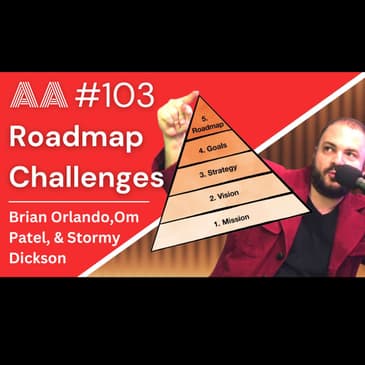
Om and I had a discussion before we went into this podcast we had a discussion and the discussion basically went like this, are we doing too many product? management related podcasts. And Om said, I don't know, maybe. And then I said, if your scrum master or agile coach is going to help you be a better product owner on/to the team, to the organization, whatever, shouldn't they have some level of expertise, some level of understanding, knowledge yeah. Some, some knowledge, yeah. In this subject, and the subject was, Hey, if you're having difficulty establishing a good roadmap, it's probably because all the things that come before the roadmap, are, are like built on a mountain of sand. What do you mean, Brian? All the things. your product roadmap comes from your company's goals. The goals come from your your company's strategy, and your strategy is informed by the vision and the mission with the mission being the, the foundation of everything that's built. So how are you gonna build a roadmap when your company has no goals? Mm-hmm.. And why does your company have no goals? Well, maybe your company doesn't really have a solid strategy. Well, why doesn't your company have a solid strategy? And we, and we work backwards in this pyramid, right? All the way up to, to discover what the real problems are. This is like the five why's of product management here. Mm-hmm. trying to work backwards to say, well, we, like our mission is super shaky of our company. What is our company trying to achieve? Here we go. Like, let, I, I kicked it into gear. I, I kind of threw out the challenge of, hey, if you don't have one of these, obviously the next one's gonna not gonna work. One of the first things I, I want to comment on here is what do most people do in, in the product space when they, when they go into a new organization, right? Well, we need a roadmap. They start there. This, that's been my experience anyway. Right? Absolutely. And what this model saying is that is the wrong place to start. Right? Start with the mission. And by the way, the mission is not what's stuck on a plaque in reception as you walk by the front desk. That is just corporate speak. Yes. Uh, that, that is not really the mission, I don't think realistically a company worth it all. Any company really could summarize their mission on a plaque. Mm-hmm. for one thing, if you're doing that, that means not everybody is really bought into it, right? Mm-hmm., it's just there for, for show. more often than not, the mission is not missing. It is muddy. Yeah. Right. So the trick is when you go in, ask people, ask your teammates, ask everyone what is the mission of our org? This is stuff to bring up in the interview process. But you get told what you, what they want you to hear. Yes. You could, you could start that, you could start the interview. Yeah. But who are you actually interfacing with there? Right. Not your team members necessarily.. You know, the interview process that you are interacting with. Yep. They may have some overarching understanding of, of these things that lead up to roadmap, but I think to your point Om, it, it doesn't matter. These, these things are just words that make no impact whatsoever if they aren't really seeped into the culture. Mm-hmm. of every mm-hmm. person right down to certainly down to the developers. Do they understand why they are doing what they're doing? Yeah. And do they buy into it? Yeah. Like are is this their mission too? Yeah, exactly. So when it comes to a product manager and you're going from a prioritization perspective, am I going in the right direction from a roadmap perspective? Am I going in the right direction when I'm working with the team to kind of pull people in so that we are all moving in the right direction. We should be able to all agree in gen generally that on the understanding of what all of these things mean specifically to the company that we are working for. Sure. And I think the farther you go down any hierarchy, the more muddy that tends to become Yeah, yeah. Right. Very true. That's very true. I wanna make sure I understand what you're saying. I think what I understood you to say is this, the further down the company hierarchy that you go down. Right, right. In terms of rank maybe. Right. Yeah. Position, if you like title. the, the muddier, these things are so at the lower levels of the hierarchy of a, of an organization, they really don't have a clear understanding of the mission. Mm-hmm., they couldn't tell you what it is. They'll say something they won't, you know, and that's something may be completely. fuzzy. Yeah. Or it may be obfuscated. Yeah. So you really, that, that I think is what you're getting at, right? Yeah. And this is assuming basically that we even have these things established Right? Well, we you don't think you make a good point there. Yes. Serious. You're going where I want to go. That's what I want to go there. Yes. Assuming these things are even there, right? Yes. And if they have been there, in my experience, they generally are, are wordsmith and created by some, right. You know, by either consulting or some executive leadership team or marketing and it's not built in. So what the experience, experience that I've had is that, I'll give you a little, an example. So my daughter, my youngest daughter went to went to an elementary school and they used the, the fish pH philosophy from Pike, you know, the Pike Fish market in Seattle, I think it is and I don't remember what it stands for, but doesn't matter. So every, so every teacher in the school, all the leadership, they had it posted everywhere. It was ingrained in the the curriculum this was an elementary school. So if you needed to kind of guide a child back to, hey, what was, you know, what was the implications of this? They brought it back to the fish philosophy or some level of that. It was. Cons. It was in the culture. Yep. Everyone brought everything back to that. So that, that, that was, that, that, that was their mi you know, their, their values. Mm-hmm., right. And then ultimately they had mission and goals, but those certainly were the values that were, that were intrinsic in the teachers, in the leadership, and ultimately in the students. So much so that the teacher could say to any student and say, okay, you did this. Tell me, tell me which, fish philosophy, which one of those could have helped you to make a better choice here. That's ultimately from an organizational cultural perspective. And well, it's not easy to write a mission and vision. It's hard. But once it's done, the harder part is truly getting everybody to buy in and that means repetition, giving examples, and bringing it back to that over and over and over again. Yeah, exactly. You need to live it, right? Yes. You don't need to just create and put it away. Is is it difficult? I had a bunch of stuff I wanted to dig into and, and cut into and talk about, but I now that you brought that up, Stormy, I kind of don't wanna talk about any of that. I kind of want to talk about is it difficult let's look at mission again. The mission. What are we trying to achieve and the vision. What does the world or our product look like when, when we've achieved it? Like, are those difficult? I think those are probably easier to envision, to let everybody know, Hey, if you want to join my organization, this is what we're about. I think those are probably the easier part. I think it's the strategy and goals where everyone gets lost. True. It's not difficult to craft them, but those are foundational and the point there is to integrate it into culture, which means there's a lot more riding on the mission and the vision. With a far longer shelf life. Yeah. I don't than the, the, than the others. That you have opportunity kind of change out a little often more often. I, I don't disagree. I like I'm with you on this. I don't, I don't disagree at all. I think you're right at like where you started in this kind of like segue, which I don't even know if it's a segue. I think it's a whole segment of the podcast., I think you said something along the lines of like the, the deeper you get in the bureaucracy of the organization, the further away from these foundational items you get, which is funny because , everything you do should come back to these foundational items in the organization. Agreed. And, and if you have leadership that is expressing uh, opinions, desires, goals, whatever, something. In, in an opposite direction of any of these two foundational level items then you have a problem that, that, that like one department had, or one team, or one grouping or one whatever No one team can deal with these issues. You're gonna muddle through as a result of that. I agree fully. Right? That's the only outcome if you don't know. A hundred percent. Not kind of sorta, right? No, not kind. People have to be very, very clear. No, no, it can't be. If they're not, you are going to model through. Right. If you're listening to the podcast and you hear, oh, that's my organization. Maybe I'm a team leader or maybe I'm a developer, or whatever. And to me, like I don't really understand what the vision for my product is, basically the, the strategy that my product is taken care of for the business. That's not clear to you. You, you should stop for a second and say, Hey , I, I don't really understand what this product does in terms of strategy for the company. Mm-hmm. and how that strategy fits into the vision and mission of the entire business. And hopefully that's a 15 minute conversation you could do the same thing as a scrum master on that team, or an agile coach for that team. Mm-hmm., you could do the same thing and say, Hey, I understand you guys don't understand how this rolls up to the company's vision and mission. Let's sit down and talk about it. And if, if, if I'm not the right person, or if I'm not sure, I will get somebody from leadership in the room at a separate session on, just on this topic. Maybe you work on software for CPAs, for accountants and stuff like that. Okay. Well, I'm gonna go get one of the CPAs from the company and they're gonna come talk to, to us. About how our software links into the company's vision and mission, and the team will completely understand how what they're doing affects the, the, the company's vision and moves the company forward. Yeah. It's really about aligning everybody right to those tho those bottom layers of the pyramid. And in practice though, you know, in practice what may happen is let's say uh, a, a lower tier person from the hierarchical perspective, ask somebody that he's working with a tech lead scrum master. The scrum master made themselves not be a hundred percent clear on this. So instead of just winging it, they need to step up and say, that's a good question. I don't know. To your point, let's go get somebody else.. Maybe, maybe get somebody from higher up the organizational hierarchy to say mm-hmm. Please share with us . Clearly what these are. Yeah. And if everybody does that at each level, then you ha you're gonna have alignment. Otherwise you're gonna have that, misalignment, which magnifies the further down you go. So interesting that you say that because one of the things that I have experienced is that that the incentives dependent on where you are and the level that you're at in the company do not match up to the, the, that mission and values. So all of a sudden, now I'm conflicted. I may, I may have a perfectly clear understanding of what that mission, you know, our, our mission and, and, and vision and, and strategies are so, for example, as a salesperson I may well understand that, but that doesn't, but I really need this feature. I really need this built, or I need this for your bonus so that I can get, I can get this in this, this sale done. Sure. Right? I need this for an, you know, an RFP. I need this. If you can't, and I need to get, not only I need to get a confirmation, it could be done, but I need to get a timeline Account management. I'm in the middle of an invitation. Somehow we've uncovered some kind of data migration that wasn't uncover. Right. And now that I need this, I need this done now. Sure. Support. I need this done because I have this customer screaming at me every day. So this is, I need you to put this on the roadmap and I need you to make sure that it gets done asap. So what I would say there, to your point, here's where that scrum master has the opportunity to jump in. And I know this is something that you've talked about on multiple occasions and saying like a scrum master isn't just the servant leader of a team, but to really be of benefit to across the organization, certainly to our leadership team. So if we don't have a culture that's being built from the top down, and what I mean is not pyramid, I'm talking about organizationally that is being repetitiously ingrained into the way in which we do business and the way in which we communicate which gives the opportunity instead of a customer screaming at us and saying, I need this now for an account manager to, to understand why that isn't something that necessarily needs to go to the top of the, of the list. And maybe it does, that doesn't mean, but they would still have an understanding of that pyramid in regards to, our mission, our vision, our strategy, how that potentially fits in. And if they don't, maybe they would, maybe they would know to go to the scrum master and say, Hey, you know, this isn't really aligning. Oh. And, and the scrum master may be able to kind of understand where those misalignments are happening and if it, if they're being incentivized in the wrong way, if they're straying now away from those, the, the mission, vision, strategy, et cetera. Mm-hmm. based on the way they're being incentivized, then there's some work there that needs to be done, and it really does need to be done top down from the leadership perspective. Yeah. And that's something that certainly, yeah. That a scrum master or an agile coach can jump in and, and start to recognize and shine some light on those and get some mm-hmm. collaboration across the board and see how those things could be improved. when you are in the fervor. Of going from delivery item to delivery item. You don't have the best perspective to step back to say, how is everyone perceiving this and what mm-hmm. and how does this all work together? Like you don't have the best perspective when you're that close, I, I go back on my experience in, in a, in a large program of being sort of a program manager, to be able to step back with, you know, 7, 8, teams to be able to step back to say, what are we trying to do here? What value comes out of the work that all of my teams are doing? That that person is a leadership member because they can back up in this, in, in this, in this pyramid where you're down at the, like you're at the tippy top between roadmap and what the teams are delivering. They're off the top. Yeah. You're off the top. Yeah. You're like a point. The top is pointed to where you're going. You wanna back way back up to the strategy level and say, wait, what, what are we, what are we supposed to be doing here? Wait, like if I were to talk to leadership in terms of leadership numbers and metrics, they're not gonna be at the tippy top of the pyramid. They're gonna back way down possibly to the vision category. also, I would argue they will be frustrated that the people at the roadmap level can't talk at the vision level to say, Hey, how. well Are we delivering on the vision for the program? Because I like the whole reason for me leading this program, funding this program, paying for this program. Mm-hmm. is because my vision is being taken care of. Mm-hmm.. And when I see that my vision via the strategies carrying out my vision are not being successful. I need to talk about that. I need to talk about that in the layer. In the layer that I see it. Not way up here. Oh, I'm sorry. Way up camera. Not way up here. Not way up here. Past the roadmap level. Cause So there's a certain level of I hear this all the time of like, I. This language, right? But, but it, it, it, it works very well with the categories that we're talking about. Like leadership speaks, mission, vision, and maybe strategy, and then the, the, the product people and the teams speak maybe strategy, but they definitely speak goals and roadmap and whatever's lower than roadmap. Yeah. I wanna say a couple of things about this. So first of all, I just wanted to go back briefly to the statement that, scrum Masters, anybody Sure should be able to step in and say, sure. This is why, this is the alignment we need. So, one way in practice that this alignment could happen, , quote unquote, naturally, is to have the product owners, when they are explaining what they want out of a sprint, for example, sprint goal, they're, they're communicating that and collaborating with the team on this, or they may be creating features, et cetera. Mm-hmm., don't just focus on the what, which is what I see all the time. Right. Here's what we need. Why, why, why, exactly why. And that can tie back to the layers of that pyramid. Why? Because this, and then why that? Because this, right? Mm-hmm., if that is made clear during the time you spend with your teams, sure. You are gonna be much closer aligned. So that's the first thing I wanna say. The second thing I wanna say about the statement you made about leadership saying, I'm, I'm, I'm assuming why vision is getting realized. Uh, is it right? What's the, what's the confirmation there? Right? Tactically are people delivering to that vision, right? Yeah. transparency. So we talk about that all the time. Right. How, what does that look like? And I'm kind of segueing now, I guess, into the next piece of this this podcast. How do we show if we are, assuming we've got a solid foundation, we understand it, we understand the next level, we put the third slab on, right? We keep going. How do we portray this alignment Yeah. Of what is happening tactically? Yeah. To the strategy and below. Yeah. Right? Mm-hmm., that, that's where I wanted to get to next. The articles that I have here to talk about have examples of all, all of these mission, vision, strategy goals. If we're done and we're ready to get into it, I'll, I'll pull them up. I think we're there. Yeah, I think we're there. Okay. The other thing I just as you pull that up, I would say is mm-hmm. As the product manager coming in without potentially these things clearly defined, there's this feeling that you have to fix it All if it's not there or if it's not clear, I, I should be able to fix this because the only way for me to my, do my job appropriately is to have these things in place, right? Yeah. Yeah. But this goes all the way back to the top tier of our organization. Mm-hmm.. And as much as I want to be able to establish these things, it's not something that could be done with a single person. Certainly somebody that doesn't have a lot of the overarching knowledge and, and some of the other variables that are playing into the thought process behind a, a mission, vision, the strategy, the goals that we're trying to achieve. That's frustrating because you wanna fix it. Yeah. When I used to do product management on contract I was at a company one time that had three founders. And the three founders basically disagreed on the, the mission, mission slash vision of the organization. So the first thing I had to do is that as their first product hire, I had to say, look, I can't, I can't operate with two or three missions and or visions. Mm-hmm., I, I can't even operate on everyone agreeing on the same mission, two or three people disagreeing on the vision. I need all three of you to agree on both the mission and the vision. So then we can agree on strategy. And I can build a roadmap from the goals of that strategy. But I need them to align first. And that, that's not a that has nothing to do with a product manager's job, but also it has everything to do with a product manager's job. I only go down this, this long tangent. Um, because I've been lucky enough in my career to have this experience where I went down this road and I, and I realized that like, I'm not gonna be able to make an impact , unless these base levels of the pyramid are solidified and once they're solid. And then we start aligning on strategies with the, at the leadership level. Like here I am, I'm the, I'm the cheerleader of strategy. Oh, our strategy. Yeah, let's go. So like, I'm selling that to every employee in the organization. Hey, these are our strategies and he help me help you carry out these strategies., through, through the product and through how we service clients and customers and whatnot. I didn't want to talk about any of that , but I went down that road because just, just because it was like within my tiny little sliver of experience of uh of a customer that I was at one time. Was that completely trial and error? What, if you can remember in that situation, how do you make that happen? Because I feel like from a, from an audience perspective I feel like probably a lot of people are dealing with this, this type of an issue. Mm-hmm., it's not, it's, it's, it's common, and don't. Don't have a whole lot of experience on how to approach it let's pretend you're product and you are charged by the organization you're charged by the organization delivering on the goals. Okay. Let's, let's just so we don't get in a bunch of arguments, okay. Yeah, yeah. Hey, these are your goals, like roadmap items, epics, whatever features. Deliver on these goals. some of it is being willing to kind of muddle through it mm-hmm. and be like, well, I don't, I don't really know how to do this, so I'm gonna bring up my team, and then me and my team together, we're gonna uh succeed together. We're also gonna fail together. And then at the end of each cycle, iteration, whatever it is, we're going to discuss with leadership. This is where we succeeded. This is where we failed and where we failed. This is what we learned so it, it's bringing leadership in to support you at the strategy layer to say, Hey, we're carrying out your strategy and we're finding we have x percentage of failures over successes as we try to carry out your strategy., right? I, I feel when we, when we related it to software, everyone loses their minds. But we could relate this back to almost any other thing. I was like, what is your strategy? Om?, maybe you're military commander. My strategy is to kill as many people as possible with as few of my people that got killed. But that's your strategy. Oh, maximize your yield. Ma. Maximize your yield. Like, oh, well, well, that's a nicer way of saying it. How do we know? How do we know that you're being successful? Well, I mean, the percentages go up and down and up and down. Maybe, you know, until we run into a different method of warfare that you've never been exposed to. Right. And then your strategy doesn't work anymore. So how are we evaluating and what metrics are we using? Great question. That's a really good segue into how do we know we're getting there? So this article has some examples of. roadmaps that Yes, we can talk about that. Maybe next. It sure does. So we have this pyramid and let's start with mission. We're just going to pick one example, and the example here is Tesla. Like, I don't, I'm, I'm not trying to make a statement about how you feel about Tesla or if you own Tesla stock, or if you like Twitter mm-hmm. or if you like Twitter mm-hmm.. Mm-hmm.. But the, the Tesla mission, is accelerate the world's transition to sustainable energy. That's the base level of the pyramid. Okay. Let's wheel up to level two vision From there, from accelerate the world's transition to sustainable energy, and then we wheel up to vision. And the vision here is to create the most compelling car company of the 21st century. Which it does fall under accelerating a transition to sustainable energy. Let's move on to the next level of the pyramid, talking about strategy. And here we go with Tesla, Tesla's strategy, corporate strategy. We're gonna build a high price sports car. That leads to, that leads to, yeah, we're going to use the revenue. from building a high price sports car to building an affordable car, the arrow that leads to further, we're gonna use that revenue to build an even more affordable car. And then while doing all of the above, also provide zero emission electric power. So let, let's, let's talk about that. So building an affordable car based on the revenue you're getting, while providing zero emission electric power, so the interesting thing here, I think this may be what you spotted there, stormy, is the order that this is done right. Strategy first, and then it rolls up under the vision. Sure. That's how Tesla's less specific instance this author is suggesting that's what happened. Right. Right. It kinda makes sense. It's a compelling, very compelling case to me if I was looking at this as a, you know, as a case study. Sure. so you have to know what that vision is. So I think what this is showing is that vision still, number two, it rolls up under number one, the mission, but what it shows is that every other piece below that vision is leading to meeting that vision. So the vision is guiding every, every vision. Vision is guiding everything. Yes. Every piece along that, along that continuum. Yes, I see this. My take on this is slightly different, having just skimmed it, right? Mm-hmm. I haven't had the luxury of reading it yet. But what are you saying? This author is saying that in Tesla's example here, the vision is realized through the strategy. If you scroll up, there's a couple lines to that effect where was the stuff between goals and vision? Yeah. It says if you start with your vision before your mission, it's totally okay. Okay. Musk, start with the vision and developed the mission around that. I was wrong here. What he's saying is get the vision and then the mission could be derived on top of it. Sure. Mm-hmm., even though the pyramid shows it at the very bottom. the reason that we keep digging into this is because so many of these things can go wrong before the roadmap piece goes, right? Yes. If I have a leadership that is projecting a mission and a vision and is collaborating with me at a team level on strategy and goals, I can project a roadmap. Mm-hmm. all day long and everybody will be happy and everyone will be in-line. But the minute that one, like mission or vision or strategy goes wrong, or we disagree or we, or, or even like, the worst thing is like, we disagree, but we then we don't want to talk about it or we don't wanna fight about it that's the worst because now we're kind of running on two different roadmaps. Yeah. Neither or once again, they don't exist. Or there's a, you know, a three paragraph mission. Sure. Right. Or vision. Sorry. Yeah. Yeah. So the three paragraph mis vision that, that of course nobody like, how can you, how can you possibly Yeah. Quantify like, and start working towards that. So again, assuming these things exist, right? So that, that, that's the one thing. Sure. But in my experience, regardless of whether they exist or not, they generally are not really ingrained into the culture. I think you've said this before where you, you take the same question in regards to what are we, do you know, what's our vision at this company? What's our mission? And ask it of multiple people, the same exact question, and you're going to get a different answer from everyone. And that seems to be actually the norm rather than the exception, which is really sad. And you walk into that in my case, a product person and they just want, and so they're., give me a roadmap, right? I, I want a roadmap. I need to know what we're building when we're building it next, right? Yes. What's typical? Yeah, exactly. Yes. So that's generally what you're walking into, right? Yes. And how much power do you have? Especially as somebody new walking in, or mm-hmm. or even some transition or whatever. How much power do you have to impact these other things that really are the, are the baseline foundation of what I need to do to build the, the roadmap appropriately. I think that's where Om was kind of pushing us. I have an example here from another like roadmunk like they have their own product,, let's, let's put that aside for a second. Like, I have a few examples that I think actually are good roadmaps, good roadmaps as opposed to if you have a roadmap and it's just a list of features you're delivering over times at the top of the roadmap, you have a Gantt chart. Here's a few examples of roadmaps. Oh, by, by the way, if you are using Azure, DevOps or Jira, you're not gonna be able to get a view like this. So you need another tool. Okay. Like, this is not the podcast of tools. I'm not here to pitch you on a tool, especially this one that I'm showing you on the screen right now. But the point here is you see how two the category, the sales category and the marketing category, both have strategy in them, I think be cool to be able to split your teams delivering products. I think it would be cool to split them up between the categories of what is your team delivering that lends itself to my corporate strategy or goal, depending on how you can show it, right? Mm-hmm. versus what are you doing to basically like, you know, keep the lights on or maintain or, you know, keep your product in a functioning state or ba, the day-to-day activities. Yeah. Or the, or butter, is that correct? Yeah. The bread and butter. Yeah. Or things that stay inside of your product that don't really like elevate your product out to the larger organization if you have multiple products in your organization. I like this. I also like the fact that at the top in the key dates, milestones swim lane, it has some flag. Um, it has some flags that I like and some flags that I don't like. So the flags that I like are the monthly recurring revenue stars here at 250 and 400 K. And I like the funding stars. I like the funding deadline notes. I, I like the things that are set in stone or, or the things that are retrospectively identified on the roadmap. That's the way I like to think about milestones is, hey, we don't have a lot of power to change these. And they've happened. They're, they're not, they're not swags and they're right. So the only time you can see milestones in the future that are not re retrospective, that have any merit to them are things you know, regulatory things. You, you know, a certain thing's gonna be happening in six months. That's, I like that. Yes. Right. I like that on the road, in that case, you can put that there. Yeah. There's nothing wrong with it. the other thing I like here is I like, look at the bottom one. Strategy and growth, for example. Mm-hmm. growth is a product metric. Like, just like retention would be a product metric. Mm-hmm. or, or activation would be a like, Hey, I want when I send out an email, say, Hey, thanks for signing up to our site. What's that retention metric? Hey, people that sign up and sign in on a daily basis. What's that retention metric? it'd be nice , if my corporate goals have to do with retention., I would like to see retention as a subcategory of what the team is working on. Let me move on to another example. The top tier on this example is called KPIs. If I could rename the top tier to not be called KPIs, I would rename the top tier to be called leadership. Okay. Because the items that are all, all on here at the top tier are all things I would associate with my leadership of the whole organization or business unit or business segment or whatever and there's some things on here that, you could set them as goals, milestones, dates, right? But also you could be view in retrospect, you could say, okay, we had 0.5 market share. We had 2.3 market share. We had 8,000 users. We had 12,000 users. We had 17,000 users. There, there's some things you could say like, okay, by this date I would like to, as a goal, have 5,000 users, 10,000 users, whatever, by goal. Everything you're doing in your roadmap is in pursuit of your higher level goals. I wanna pause here to let us react to the visual representation of basically what we've been talking about this entire podcast You have a strategy, Hey, we wanna grow users. Hey, we wanna make the application more sticky, more time in the application for you, whatever the strategy is. And then you have goals. Those goals are carried out by product managers, right? Taking little pieces of your goals. And executing them in what they're responsible for. So I wanna stop here because we only got to the visualizations we looked at. We only got to them by having a clear strategy, and we only got to a clear strategy by having clear vision, vision and missions. Yeah, absolutely. So everything builds on itself, right? Correct. Yeah. Yeah. Any, at any misalignment of any of these gets magnified. Yeah. I don't want people to get outta this podcast without being armed with, with being able to ask a question. Hey, I don't see a clear mission and vision, so I don't know how I'm gonna run with the strategy if I don't see these things. So if you are a product manager, I kind of see your job as walking backwards. Uh, walking backwards in the organization. It's walking backwards, stepping up upwards. Yeah, yeah, yeah. Walking upwards, backwards, upwards in the, in the organization to, to see, hey, are these things not in place? And if they're not, I'm going to make it my personal responsibility in the organization to vet these things out and create them. Help the organization create them. Mm-hmm. so that it's easier to do my job now. But also like scrum master, as coach, you could easily facilitate a session. I'm gonna bring you the product people, you leadership together. I'm gonna throw my little miro board up on the wall, put some swim lanes. What do you think the strategy is? What do you think the strategy is? How do we work backwards from the vision from that and, and keep hammering that out until we all agree and, if you're an agile coach, if you're a scrum master and you see that these things are not in place, you can do a lot to facilitate the creation of these things, or at least, at least the, the making them transparent to everyone else. It's in your wheelhouse, right? If you're a scrum master or your an agile coach, it's in your wheelhouse to coach up the organization. Correct? Yeah, I agree. So feel empowered. Yeah, absolutely. What I would say is absolutely agree with that., that said, as a, so if we go to the product owner or product manager who is more so the product manager, but product owner too. I need this roadmap. You need to get this on the roadmap. You need to get this on the roadmap. Yeah. And you don't have those foundational pieces, right? So you really do want to establish that. And to your point, hey, you could go and you could, you could create these things, but here's where I am feeling like personally that that you lose so much potentially if you are not collaborating. Yeah. And getting input and, you know, experience and different perspective from lots of teams and, and, and pieces of the organization. So I can create from my very singular vision, but I also feel like it is going to be inept. You make a great point. Which, which I, I will tell you, I, I have made this point many times, which is in lieu of a vision, I as a product., I can make one up., the problem with making one up, however, is, again, going back to my example way earlier in the podcast, if one of the founders disagrees with the direction that I'm taking, because I'm like, again, I'm just trying to, I'm trying to take the wires of mission and vision and I'm trying to just short them together to make the strategy. And then just for the example of, of engaging my development teams mm-hmm. to move forward. but if you, if you don't like those sparks that come out of my, just shortening those two wires together and, and basically you, you work to undermine me, now we have a much bigger problem. Mm-hmm., but I, I'm, I'm super concerned when I'm again, I've been in the unique position where I've had to negotiate with different founders of company inside of a company where they don't all agree on the mission of the company. Mm-hmm., and I'm trying to build a, and carry out a roadmap. Yeah, so I, yeah, yeah. It's a terrible position to be in, but it's, it is, you need to drive back to resolve the initial problems and, and you, you meaning ohs like that, that was a really accusatory of you like you, the product manager, just like the scrum master identifying problems in the organizational design. The scrum master is not the person to say, oh, I'm gonna tell you how to resolve this. Mm-hmm., , the, the issue is you've discovered a problem and you need to approach leadership to say, Hey, this is an issue let's all get together and do you all agree that we shouldn't leave this room until we all agree on the same vision for the company. Mm-hmm., usually if you're talking to the right people at the top of the company, the, the decision makers, the people that push the company along, if you're talking to the right people, they are the type of person that will say, we're not leaving this room until we all agree on the vision. I think the example you cited of you know, multiple owners , not agreeing. Sure. It's pretty common, right? Founders? Founders, yeah. That's a very common example. And if left to its own devices, things just will never improve. Sure. It takes somebody from outside to come in as a trusted advisor. Right. in your example, a product person to come in and say, I see there's common misunderstanding here. Right? We need to get to a common understanding group consensus., oftentimes that will be successful because it's not one of those three or n uh mm-hmm. saying, You know, we need to do this because others are gonna say no. Yeah, I, I get it. I know what we need to do. Sure. I'm, I'm right. So I have two points to make. And that is that, so your example with founders also can, can I think be also applied to just any, any executive Any executive any, yeah. High level. Yeah. Any executive leadership doesn't have to be a founder. Yes. But your executive team, the people who are ultimately responsible for the direction of this company. Mm-hmm. need to be aligned. Aligned, aligned. Yeah. Whether they're founders or not, they need to be aligned. Right. And they need to have, and they are the ones actually that are also going to repetitively integrate that messaging into the culture of our company. And, and like the product manager. is the person who, who can have the most impact there, but they're not the only person because again, we don't ask leadership for things. Mm-hmm. often enough. Yeah. And this is one of the things to say, Hey, you seem to not align with you know, leadership team member X. Mm-hmm., you seem to not be in alignment with leadership team member Y on this thing. Mm-hmm. Why don't I, and both of you get together and we'll just talk about it. Yeah. Just, just to talk about it. Or, or if you're lucky enough where it's one product and it doesn't intersect with anything else, let's just get the team together to talk to the two stakeholders. This is the part where we hammer in the podcast over and over again about the scrum master or coach being delegated a bit of leadership responsibility. Because when, when two people don't align somebody has to talk to them to say, Hey, this is our mission and vision and this is a strategy we're trying to carry out. How do you think about it? Cuz this is the way that I think about it and let's talk about the difference. I think about this selfishly for myself. This is a way I think about it. I'm breaking all these epics down into stories. I'm talking to customers, I'm vetting other users of the application. I'm working way more than 40 hours trying to keep this stuff going.. So it would be really nice if I could delegate some of this internal alignment stuff off just for help. Sorry, number two, do you remember what number two is? I do because you kind of stole it from me, but I, but it wasn't a, a complete, and you should have like definitely cut to camera just immediately. There is no short Brian comment, so on, on that, on, yeah. Yeah. So but no, my second point actually was that yes, empowered. So I, I hope that that our Scrum Masters Agile coaches feel empowered. Yeah. You know, to be able to broach that, that subject. That said, to your point, if you are lucky enough to have somebody on your team as a product manager, collaborate. So open that door with them, right. Be, you know, maybe they are, maybe they aren't seeing the things that you're seeing and. and to have someone that could help understand number one and where, where you're coming from potentially you might be as a product manager helping them to understand something they may not have seen Yeah. Or understood. And so to have someone else on your team to potentially help facilitate that from a product management perspective as you're trying to collaborate and, and get this done with leadership. Yeah, reach out. I mean, I have found so much value in working with our, you know, our Scrum masters and our agile coaches, and truly just being, like really being a part of that team as, as you know, as we in general really should be. So it's not just about the, the, the, the scrum master agile coach kind of recognizing and stepping up, but I would want them to be, feel empowered to do that, but also for a product manager or a product owner or, or, or whomever if they're seeing a need. I see the need. Feel the need. Right. And, and going and, and kind of having that scrum master as the rubber duck to talk through these things. Mm-hmm. bring, enlighten them to that and help that, you know, help them to understand and, and help them to help guide you. so what a great team effort y you know, to collaborate on. It's a deep topic. I, I have to admit I, I, I want there are more things I want to dig into here. We, well, look, and honestly, we didn't even talk about establishing a roadmap. Yeah. We didn't even talk about the actual, that wasn't the point. That wasn't the point of the podcast though. No, it wasn't. Right. The point here was all of the things that basically keep you from establishing and carrying out a roadmap. Like you have to swim upstream to find out. What are the things that are missing? Mm-hmm.. And then you have to figure out why they're missing. And then you have to seek to resolve why they're missing. And, it'd be nice to be like, well just tap your leadership and figure it out. Oh, just tap your technical leadership people, Silicon Valley people tell you the whole, the time. Like, that's not really great advice, you need to know why things are not functioning so you can build a great product. Like all of these things have to happen in a certain order. You know, you need a mission and a vision and a strategy. I feel we could do a whole podcast on just corporate strategies. You should strategies like a, assuming you have a mission and a vision Mm-hmm., we're gonna assume that for the podcast and we're gonna launch straight into strategy and how those strategies. will look as goals. Mm-hmm. and maybe roadmaps. I don't know. I feel that's so much content. We might not even get to the roadmap level. Yeah. It might just be strategy, goal, strategy.. Yeah. And I think that that may be some of the most ambiguous and, and the, the weakest. I think you're right. Part of, I think you're right of, of that pyramid. You're, and understanding, how to create those Yes. And how to create them in a valuable way. A absolutely. And I, and I don't think you learn that. I think this is a big gap. Mm-hmm. in certification. I think it's a big gap on, on like online learning and, and and, and, you know, podcasts and media and articles and blogs and whatever. I think it's a huge gap assuming that you know how to take the real base level mission, vision stuff, and then like translate through the middle layers and come out with a roadmap. All the middle stuff of dealing with people and saying, well, how do we know Yeah. That this strategy is being successful. That's a great title for a podcast. All the middle stuff, all the middle, all the middle stuff. I don't think that is a great title I, I like, I think the, the better title is how do we know that our strategy works? Yeah. How do we know where we're actually getting there? Like, be, because, because I if I think through my career where I've been challenged for evidence versus opinion. It's in that how do we know that what you say is leadership is our strategy. How do we know it's working? And, and if it's not working, how do we shift. So I have one. So one last comment in that is, sure. So why is this important? Right? Why, why do you need this? Because what happens to that freaking roadmap if you don't have these things? Chaos. So what you have is a bunch of things that are being thrown at you from all different places in the organization. That's exactly right. Who's ever screaming the loudest? Who's ever has the highest priority? Whatever customer is the biggest customer. Whoever's the biggest voice in the room, whatever. Sure. That's what your roadmap ends up being and is that ultimately what's going to benefit long-term your company and is providing the most value, the most reach, the most impact?. Probably not. And the only way to know that is to build that pyramid from the base up so that you can make the proper decisions when it comes to prioritizing what and when things should go on your roadmap. Yeah, that's very well put. I think, you know, without a solid foundation, all you have are shaky structures.