
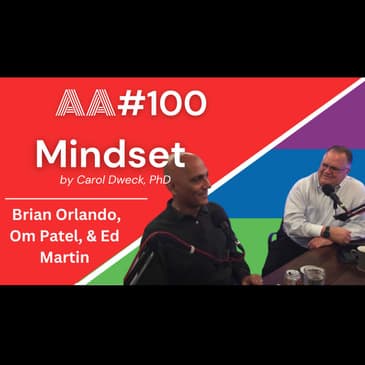
On this episode, we talk about the book Mindset by Carol Dweck, PhD with guest Ed Martin.
0:00 Two Quotes
0:19 Topic Intro - Mindset
1:32 The Fixed Mindset
3:05 Growth Mindset
4:25 Changing Your Mind
5:35 Being Flawless
8:05 Doing Hard Things
9:51 The Drawing Example
11:56 Failure WILL Happen
12:58 Continuous Learning
13:49 Bowling Example
15:37 Business Equivalent of the Bowling Example
17:25 Failure & Feedback
19:02 Getting Around Negative Type Praise
20:57 Coachable People & Leaders
23:15 Remote Work
27:00 Remote Work: Example of Mindset
29:27 Blame = Failure
32:32 Learning Over Blame
35:09 Sailboat Retro
37:12 Stormy-cast
38:22 Women in STEM
42:34 The Scrum Master's Dilemma
45:15 Chapter 5 - Mindset & Leadership
48:52 Brutal Bosses
51:37 The Gemba Walk & Culture
54:47 Taylorism & Rewards
56:39 Profit Sharing
58:11 HR
1:00:04 Mindset for Managers
1:01:25 Where Will Leaders Come From
1:06:43 Crossing the Chasm (of Leadership & Being Remote)
1:10:53 Choosing Mindset
1:14:20 Wrap-Up
= = = = = = = = = = = =
Watch on YouTube
Please Subscribe to our YouTube Channel
= = = = = = = = = = = =
Apple Podcasts:
https://podcasts.apple.com/us/podcast/agile-podcast/id1568557596
Google Podcasts:https://podcasts.google.com/feed/aHR0cHM6Ly9mZWVkcy5idXp6c3Byb3V0LmNvbS8xNzgxMzE5LnJzcw
Spotify:
https://open.spotify.com/show/362QvYORmtZRKAeTAE57v3
Amazon Music:
https://music.amazon.com/podcasts/ee3506fc-38f2-46d1-a301-79681c55ed82/Agile-Podcast
Stitcher:
https://www.stitcher.com/show/agile-podcast-2
= = = = = = = = = = = =
AA100 - Mindset by Carol Dweck, PhD (with Ed Martin)
I got a quote for you. So I got two. You can choose. You can choose Theodore Roosevelt's believe you can, and you're halfway there, right? So for a fixed mindset or growth mindset, if you believe you can, you're halfway there, right? So, which, which side are you believing, right? Yeah. And the other one is Henry Ford's classic whether you think you can, or you can. You're right. I think that's a good one. Yeah. You gotta put a little emphasis on that end, right? Yeah. If you think you can, if you think you can't, , you're right. the podcast topic today is Mindset by Dr. Carol Dweck. Depending on your level of self-awareness, like this could change your life. This book, that's, that's why we're talking about it. Yeah. Because anybody who's tuned into the podcast might be like, well this is, what does this have to do with agile development or whatever. Like, well, it doesn't have anything to do with agile development, but not directly indirect, indirectly definitely does. Right. But I would throw out like if you're a scrum master agile coach or whatever especially the whole chapter on coaching, you need what is in this book. So I can actually give you a direct hook into the agile mindset. Mm-hmm.. So the agile mindset is all about inspect and adapt, right? So inspect and adapt, and then turn around and do a retrospective, right? Turn around and figure out how you're doing. Well, if you have a fixed mindset, you're probably not doing a retrospective on your own daily activities and what you've done, what you've accomplished, what, what's happening in your life. And I would say that there's many times in my life that I've stopped to look and went, this is happening for these reasons. I even I do it every day. I look back at my day and what happened, what went well. I fail a lot just about every day. But I turn around and try to, and try to make it better by that inspect and adapt. And so I would say that from an agile standpoint, growth mindset is all about inspect and adapt, right? I think we should mention for the 600,000 people that are out there watching this, that this is our 100th episode. Oh, oh. I completely forgot to mention. I, yeah, episode 100, we did it. We did. I can't think of a better topic on episode 100 than to start with the tagline of believing your qualities are carved in stone. The fixed mindset creates an urgency to prove yourself. Over and over. this is like the, the direct opposite of what you just said, Ed, about the, like the, the agile mindset of, Hey, we'll try something. If that doesn't work, then we'll change it. We'll do something else. This is the complete opposite of that. Mm-hmm., I have to prove myself over and over. She says people are training this mindset from an early age, anytime she talks about childhood development or how, how people interact with their teachers and how people gain this mindset. Just the experiences in school that part of the book is very tough for me.. , because I'm like,, oh, you're describing my education right now. My Florida education right now. Yep. I couldn't read when I graduated high school. There was actually a video I saw at like 44 years old of my graduation party. And I've always remembered not being able to read clearly my graduation cards. Hmm. And the video showed me trying to read and the way I've always felt for the last 30 years, for those 30 years. Mm-hmm. was exactly how I looked on that video. Yeah. So now I overcompensate and have, what, 150 books behind me in my, in my office. So uh, I fixed that problem. I want to be like, that's terrible, but, oh, like when, I'm not saying that's reality. It's reality. No, it's reality. It's terrible that you held onto to that, you know what I mean? Like, I, I understand this is driven you. Mm-hmm. So you can make an argument like, well if it it wasn't for that, then it, I wouldn't be driven to do whatever. Correct. I understand that. Is there a way that you still could have got the same outcome but not had to put somebody through all that, you know what I mean? Like the, the system that shaped you. Mm-hmm. if you think about it, this is a leadership topic because the leadership of the company that sets the culture and the tone of the company, which we've talked about in many, many podcasts. Yeah, sure. Like if you understand this at a leadership level, you can do a lot. The growth mindset is based on the belief that your basic qualities are things you can cultivate through your efforts, your strategies, and help from others, Although people may differ in every way in their initial talents and aptitudes, interests and temperaments, everyone can change and grow through application and experience. So on that, that's interesting there, right? Because you know, we say the belief that basic qualities are things you can cultivate and that's growth mindset. Growth mindset says you can cultivate your basic qualities. Yeah. But I also tell you that I have some intrinsic values that you can look at my review from 1997 that Sergeant Kipper gave me, and you can look at the review I got last year. And there's some of those qualities that no matter how hard I try are still there. And they're like, you can't, you do this, you do that. And , yeah, I keep I right. So it is interesting that. From my mindset, I've accepted that there's some qualities that they're just part of me. They're just, they're so ingrained they've been there forever, that you just have to accept them, figure out how to put compensating controls around them, and then explain yourself at times. Right? Every now and then when you start working with somebody new, you're like, Hey I might do this, and when I do, please, let's have a conversation.. Yeah, I think that's a great point. So first, I think the first step is to recognize that you have those, right? Yep. You know, or everybody knows. Everybody does. Absolutely. But not everybody accepts that they have them. So if you accept they that you have them, and then decide to do something about it by showing that vulnerability and saying, look, please call me out on this. If I do this, I don't mean to, right? It's habit. Habits are ingrained over a considerable period of time in our lives and they're hard to shake off. so from chapter one, talent's, aptitude's, interest , and temperatures can change through application and experience. Right. And how many times did we hear, oh, you flip flopped on that three weeks ago you said this. Yeah. Well, I spent a lot of time thinking about that in the last three weeks actually. Yeah. And I realized that when we got, we engaged in a conversation about it. I actually listened to what you had to say. I spent some time thinking about it. I didn't come back and check with you, but yeah, I, you educated me. I changed my mind. I believe something differently today. Yeah. And, but then there's this thought process that you can't change your mind. You can't flip flop on something. Once you say it, you're convicted forever. And that's, that's interesting. So for me, yeah, you definitely have to be able to change through application and experiences. It's funny Absolutely. the fixed mindset counterpoint to that one is gonna be like, you're just flip, you're flip flopping, you're wishy-washy. You're like, what? What are you changing your mind all the time? You're undecided. Yeah. You're undecided. Yeah. That's gonna be the like I can, I can hear it in my head Yeah. And as a bring in the DISC profile as a, as a high D we're fire, ready, aim. And so yeah, there's lots of times we do things that other people may be aiming on thinking about getting ready for, and I'm just trying to make a decision cause I need to move forward. Uh, I might not be going in a straight line, but I'm moving forward. I'm not, I'm not standing still waiting for something to happen. Fixed mindset. It's not enough to just succeed. It's not enough to just look smart and talented. You have to be pretty much flawless and you have to be flawless right away. I'm gonna read quite a few uh quotes and call it out again to say, just to remind people watching or listening. the reason I'm bringing this up is like, now you're a better scrum master as a coach, you can call out these traits and be like, oh, I have this one, whatever, manager, supervisor, whatever you wanna call it in the company. And they are resisting this oh, this, this whole like fail fast type of uh, trope that you will hear. I'll call it a trope. That's right. I did that cuz like in some companies they'll say, well fail fast, but then like all, none of their mechanisms are built for that. And, they say, fail fast, but you actually, you better not fail because that means mm-hmm., that's not gonna be bonuses there. And then you're gonna look at you end of the year and say, Ooh, Om, I don't know. Like you didn't do this the right the first time and took you two, three times to figure it out. Like that's a bad thing. Yeah, yeah, yeah. Don't know about your future with this company what about, what about failure is not an option, right? That's right. Failure is not an option. Well, that was great when we were talk, when it was quoted as part of Apollo 13, and we're trying to get people back to earth who are floating in space and lives are on the line. Um, if Susie doesn't get dress next week because the e-commerce store couldn't handle the payload that may or may not be as failure, not an option scenario. so sometimes people use quotes outta context for me, and I was kinda like, I actually know what that context is and I don't have the same context. Context response. Absolutely. I fully agree. Context is king and a lot of people who are thinking about it from the other perspective will use that to their advantage. You know, they'll say Absolutely. Failures not an option. Right. Suzy has to get her dress. Maybe it's a wedding dress she's getting married. I don't know. There's no, we're not, this isn't heart surgery or anything. Right. But people will definitely use use it to their advantage. Yeah. It had a leader once contact us if it, if it happens to one person, that's one person, too many, we can't, we can't allow that. So back to that perfection mindset. Yeah. Yeah you know, sometimes we put that perfection in a, in an expectation and we push that out. I get that it's a goal. I get that it's a need. I get that. It's an ideal scenario, but there's also a reality component of that, that we're just not mature enough to do that yet.. Yeah. I mean, often it's not even a goal, I would say often it's just an aspiration, right? Right. This is what we would love. We would love to get 70% market share by Q3 this year. Right. Right. You're not geared up for that. You know, your fulfillment process isn't there to, to deliver to that so yeah, I, I certainly agree with that. A lot of times you'll see those kinds of statements in in financial declarations or statements that companies make. Right, right. And then they'll just hide behind the fact that they, they might fail by saying, this is a forward-looking statement, so there's no guarantees basically. Right. We were talking about teachers earlier and on page 28. She's talking about an example where they, they put out a, I think they put out a study or they put out a, it was a test. They put out a letter, or was it a test? I don't know. I think it was a test, basically. Basically they were trying to identify the difference between the growth mindset teachers and the fixed mindset teachers, whatever. And it says, teachers with a fixed mindset, were more than happy to answer the questions in the survey. Mm-hmm. about students, and then they have, they got an angry letter. Where uh remove me from the survey. Yeah. Where the person says, you, cannot determine the slope of a line given only one point. So basically, the student's test is only one moment in time, or one, one captured data point in time. you can't determine the slip of a line given just one point. there's no line to begin with. Single point in time does not show trend improvement, lack of effort, mathematical ability, et cetera. And then the idea that one evaluation can measure you forever is what creates the urgency for those with the fixed mindset. That's why they must succeed perfectly and immediately. Every example is like worse than the last. You know what's funny is that people, like people will listen. People with a fixed mindset will listen, listen, be like, well, of course I agree with that. Yeah. Of common sense. Yeah, it makes total sense. Chuck Yeager, the hero of the right stuff begged to differ. There is no such thing as a natural born pilot. Whatever my aptitude or. Becoming proficient. Pilot was hard work. Really a lifetimes learning experience. The best pilots fly more than others. That's why they're the best. So I watch movies for leadership lessons. You see the, you see Last Top Gun, right? Mm-hmm., I'm assuming both of you was already seen that. Yeah, I have. Right? So the mission was impossible. Not making a Tom..., not making a pun there, but the mission was impossible. That's a good pun. Yeah. The mission was impossible until Maverick proved it could be done, right? And so sometimes when you're leading a, a group of folks, or you know, you're trying to inspire or grow them, that thing that's impossible for them becomes a fixed mindset. Oh, I can't do it. Can't do it. Can't do it. Mm-hmm. until you see someone do it right, the four minute mile was unbreakable until somebody broke it. It's taking that time and figuring out how to inspire through example takes a growth-minded person. We talk about the growth mindset and the fixed mindset. Mm-hmm. like two sides, right? There might be a continuum there. Oh, there is. So so it's not just fully growth or fully right. There's like in between. And a lot of, a lot of times, people that are growing in their journey go, go down that path, right? So if you're, if you're not set at station A in not quite there at station B, you're somewhere in between as long as you're heading toward B. What does that mean to people? Who, listen to this podcast and, and if they haven't read the book, like what message do we have? Luckily, you don't have to guess because she, she says it on page 46 and 47. Where she answers the question, can I be half and half and recognize both mindsets in myself? She says people can have different mindsets in different areas. I recognize the I might think that artistic skills are fixed but my intelligence can be developed. Later in the book, she also talks about like, if I know that I can't draw, I realize, like my logical brain realizes I could take the time you know, watch some videos, learn how to draw, and she, there, there's even a, a part in the book where people go through a drawing class, and they come out in one day being able to do like self. They, they do a self-portrait before the class, like at the very start of the class. And like, I think class like six hours or something like that. And then at the end of the class, they draw a self and she puts them all in the book of what they look like before and after. And they're pretty stark contrast before and after. But the, the point is you, you may know, she even says it on the previous page, people tell me they start to catch themselves when they're in the throes of the fixed mindset, passing up a chance for learning, feeling labeled by a failure or getting discouraged when something requires a lot of effort and then they switch into the growth mindset This is exactly that example of like, oh, I know I can't draw. I'm not even gonna try cuz I'm right. It might be a crappy drawing. Like a, but, but like drawing is like a, like nobody, nobody feels offended in that example, right? I I, but I could apply that to a lot of different things, of course, where people would get all woo r ruffle and feathers all over. Yep. But I would say if you realize that hey, this is something that would take a lot of effort, I'm just, I'm just not willing to exert the effort that that's a little bit different than like, again, the, like the Lee Iaccoca examples and stuff that she's gonna use later. Right. Where he's just bent outta shape and obviously destroying his company, everyone knows it, but nobody wants to make him angry or whatever. Cuz he's affecting everyone around him with his crappy mindset. I've always, I wondered by about the Iaccoca example, um Right. Cuz he was at Ford, left Ford and go to, to go to Chrysler. Chrysler, yeah. Right. So he had that in him where he was a competitor and I'm smarter than everyone else. And so I actually questioned whether his growth mindset was real or not. I don't, I don't know. I wasn't there, don't know for sure but was he brilliant in what he was doing? Yeah, he was, he had some brilliance to him. But he, he also made some other bets that weren't so great but yeah, the idea that you can go from you ebb and flow, I think is a season of your life if you get rocked in life and something happens that takes you off your track, the example earlier was in one of the, one of the sections, I think it's chapter three or four, but you know, something happens to the industry within your small town, that industry goes away. Your small town's now suffering. some things are gonna happen that are outside of your control and failure happened. It's how you respond to it. Exactly, yes. It's how you respond to it. So just accept the fact that failure's gonna happen, and knowing once you accept that, your mindset should be, well, what will we do? What do we do? Right? We can't prevent failure from happening, like nature takes its course. Mm-hmm., what can we do? Come up with some strategies, maybe even test some things out ahead of time so you're better prepared. her whole chapter on mindset and leadership, business mindset and leadership. Like that is a super interesting chapter to me. And since you went toward Lee Iaccoca, I'm just cutting straight, cutting like a hundred pages in the book. I think around that same point, one of the things she says is never stop trying to be qualified for the job. Right? So from a growth mindset standpoint, never stop trying to be qualified for the job. Mm-hmm., every day you go to work, every day you're trying to accomplish something. What are your qualifications? And are you still qualified because the requirements continue to move? For the job. Right? A software developer who was developing software at in 2010 doing the same thing today. Mm-hmm. likely has a smaller market share than yeah. If they continue to grow and learn, right? Oh, there's still COBOL developers. Yeah, there are, but there's not as many. And there's, and the market share's not as large. Right so it's still a skill set that you can make some money at and you probably make some great money at. It's just, there're not many opportunities for you. So you have to maintain your qualifications and that takes growth, that takes effort to actually accomplish I've done a lot of self-analysis over my years trying to figure out what drives me, what's my intrinsic values, what's the source of it, what happened? Mm-hmm., I grew up a bowler and I started bowling when I was five. I'm bowling on a league with my wife right now. So it's our date night and it's not a competitive league. It's a fun, it's meant to be a fun league but one of the things I've learned, it took, and this was probably 10 years ago, it took me that long to figure it out, is my desire to bowl a perfect game and all the little things that I have to do as a bowler to bowl a perfect game. I have bowled a perfect game but that desire for perfection as a sport impacted how I did my job. Yeah. Cuz I was, all those little micro adjustments I have to make as a bowler, as the lanes change, as things happen as You just make those little micro adjustments. When you're used to doing that all the time and you're in a business scenario and you're trying to same make those same micro adjustments and no one really understands what you see, why you see it, what the effects are, they get a little turned off by it, they don't understand it. so, it took me a long time to figure that out, to understand that that drive for perfection. at an early age, and, oh, I want 300, want, 300, want 300. Then I got my 300. And it's like, all right, I'm back to proof. Yeah. Proved I could do it really affected my way of working as well. You're taking us straight to the next chapter because if you go to bowl and you end up bowling the perfect game, now now the stress is on because every frame after that, you bowl, now you're super stressed because you, you already proved that you can do it once perfectly. So now, every time you don't do it perfectly after that. Yep. Now, now the the, the pressure's just crushing until the point where you're just like, I don't, you don't enjoy it anymore. Right. And you don't want to do it because it's, you're not gonna be perfect every time anymore. And that's with any sport, right. But as any sport, sure. Yeah. There's some, there's some number, some metric. Right. What's your handicap as a golfer? What's your average as a bowler? What's your time as a runner? There's some metric that when you answer the question, The person sizing you up. Mm, I'm better than you. Yeah. Oh, I wish I could run that fast. Pivot back to business world right quick. A large company that I, I am not naming they would bring people that were successful on one program over to the program that I was on, hoping that they'd be the new leadership person to knock it outta the park or whatever. And then that person would just be completely crushed when they were not immediately successful day one, they haven't fixed all the problems and then whatever, six weeks in their, the management or whatever leadership, I guess you can call 'em leadership if you want, , they've lumped that new leader onto the trash heap with the rest of us but the other thing is that that new leader really didn't step up. They, they were also completely crushed by not being immediately successful as soon as they walked in, cuz they were successful in some other software project. And, and me the whole time sitting there going that software project was completely different, completely different tech stack, completely different team members, everything was completely different. So what, what made you even. That you, because you happen to be successful, happen to be successful. We're not even injecting into this story whether that person really was successful or whether the people under him just been like, yeah, yeah, yeah, yeah.. Well let's, well, let's Let's, let's take the op, let's take the optimist approach. Let's assume they were right and continue to use a sports analogy cuz they work easy that leader may have been a seven iron on a par three. Yeah. Yeah. Right. And you took 'em to a par five and all they still have is their seven iron. Right. And so they weren't equipped for the scenario, for the environment, for the, the, the course they found themselves on. They didn't have the same team, they didn't have the same support and, and the things that they knew didn't apply in this new scenario. Right. And that's where changing companies changing experience, spending time retrospecting on why, why that worked and why that didn't work. What was good about the process, what was not good about the process, what local optimizations you had to make it work matter so that when you do get into your next role, you're not standing with a seven iron when you should have a driver. Or you're not swinging away with a seven iron and a sandpit. Oh, this works. I'm gonna make it And like, and then another one she says later in that same chapter with the kid saying that, oh, you mean I don't have to be dumb. Basically the, the, the kids started handing in assignments, handing in assignments early to get feedback to revise the assignment so they could turn it in again before the due date. Mm-hmm., the idea is you can, you could iterate on your assignment many times right before it's finally due which, which to me, I like, I read this and, what, what school system was this? Because is that, that was not my school system. I, I did not go to school under this. I mean, it makes total sense knowing what I know now and the way that I work, like in professional life. I, I didn't go to school like you got one shot, right? That was it. Yeah. What you turned into, what you turned in deadlines were tight there was so much homework. It was hard to work ahead. So it was good. Preparation pressure for corporate life. Yeah, exactly. for a cer certain type of corporate life. I will agree Failure equals identity or uh, activity. When you fail, is it your, is it your identity? Yeah. You're a failure or was it an activity? I failed. And some of this comes from upbringing so she outlines on page 72 look where you're going, I think is absolutely correct. She says uh, it's based off of what your parent is. Well, could, it's your parent. But I mean, in the business context, could be anyone based off of what they're praising. Mm-hmm. says right after the, right after the praise, we, the, they began to differ. She's talking about praising a kid as we feared the ability praise, pushed students right into their fixed mindset and showed all the signs of it too. We gave them a choice. They rejected a challenging new task they could learn from they didn't wanna do anything. They could expose their flaws and call into question their talent. This is after they're praised for you're so smart. Basically praised on, on something that's not, not easily changeable. Yeah, yeah. Rather than praise on the effort that it took to get there. So basically not the activity. Praising them on the ability, not the activity. Is that what you just said? Am I right on that? I think so., I'm agreeing with you. It does come down to what Praise you received. Yeah. And I think it's a large population, not 50%. When I say large, not majority, but more than 10%. So let's call it 20%. I think 15 to 20% of our population were raised with negative praise. Absolutely. And so if there's that much of a population that was raised with negative, I think there's a lot more than that. So we agree. All right. So I, I was trying to be a lot more. All right, so then let's call it 40. So 40% of the population was raised with negative praise. When you look at who's on your team, , 40% of them were probably raised with negative praise. And you're trying to work with them. You're trying to encourage them. You're trying to coach them, which is counter to what they're used to. So they're uncomfortable with it. And then you're saying failed and they don't wanna fail. There's a, something that was taught me years ago about going above the line and below the line. The line is the space that you can see is above the line. The space you can't see is below the line when you start at the top. The results come from activities. Those are the things you see, results and activities. Mm-hmm. activities come from behaviors. You don't, you don't really, um you don't really, you don't really know why they behave the way they do. Yeah. And then those behaviors came from experiences. The experiences are the deep part of that. If you don't build the relationships with your team where you can understand their experiences to understand why they behave the way they do, why they act, the way they act, right. To then create the results they create. You don't really ever get to understand it. So you have to be able to go below the line with them, just not stay there.. And so that was a, that was a lesson I was taught. Something I've never forgotten and something I try to do as frequently as I can with myself. Why, why did I do that? Why, why did I behave that way? What was, what was the experience I had before? Mm-hmm. that created that response. And then from there, how do I change it so that I have better activity, better results in the future? And that's part of that growth mindset, that if you want to grow, figure out what your experiences were that are causing you to behave in the way you're behaving if you want different actions and results. Also like, I'll, I'll cut you all the way to chapter seven because she's talking about how parents, teachers, and coaches, where mindsets come from. That's a the chapter title, right? And in there she says it can be a fixed mindset message that says you have permanent traits, and I'm judging you on them. It can be a growth mindset message that says, you are a developing person and I'm committed to your development. Right? Like, how do you do this in professional atmosphere? Well, you do it with one-on-ones. In fact, I would argue this is that like one-on-ones is the only venue that you're gonna have an opportunity to, to have an, an intimate enough conversation with a person to get them to reveal any of these. Like what was your education like? What were your parents like? What, you know what I mean? You can't ask that question. Cause like, what is this psychology like our counseling session, like lay down on the couch. Ed , we, we used to talk about your childhood. Like what? I'm sorry. Like my bad. We must, we must have went to the same psychiatrist. Yeah. And praising children's intelligence harms their motivation and harms their performance, which is a, a declaration on page 178, which is hidden in the, in the middle of the whole page, right? Praising children's intelligence harms, their motivation, and it harms their performance. Uh, and then on the next page she's talking about a student, by the way, reflecting. This was my greatest learning disability. The tendency to see performance as a reflection of character. And if I cannot accomplish something right away to avoid the task, to treat it with contempt. So, so basically PE people are fleeing, trying to do hard things, basically. That's, that's what this is. The shocking thing about this book is that like all leaders have not read this book. Cuz she, she cuts right to on page 184, there's a strong message in our society about how to boost children's self-esteem. Mm-hmm. and the main part of that message, Protect them from failure. Mm-hmm., right? In the next page, She says, I met with coaches and they ask me, what happened to the coachable athletes? Where do they go? They seem to want coaches who will simply tell them how talented they are and leave it at that. Mm-hmm., which again, like if we're talking about anything that's completely transferable, like I think of an agile coach, agile coach, scrum masters, I could take this page, lift it out, drop it into any LinkedIn thread and, and say, where of all the coachable leadership, agile leadership gone. Mm-hmm., everyone seems that I they just wanna hire me as a scrum master, and I just want to tell them how talented the they are as leaders and project managers and whatever, and they don't want me to actually like coach up in the organization and then they fire whole division or whatever. Oh no, that's an upcoming podcast. Hey . Yeah. They're all gone. So let's talk about coaching just for a moment, cuz you, there's a key point there is there's a couple, I, I'm trying not to say names. There was a video of a ex football player mm-hmm., who was tough on a kid, on the football team and it made national news clips all over the place. And a lot of the responses are a coach shouldn't put their hands on the kid, blah, blah, blah, blah, blah. Well, the kid was being mouthy the kids on a football team and he's wearing a bunch of pads. He, I mean, if he's, if he's, if he's going to drive his body into another person on the field, a coach grabbing him by the pad and pushing him to the seat isn't really an injury, a harm abuse on a child. He's being a football coach so I struggle sometimes with the parent involvement. So where do the coachable kids go? The parents who are getting too involved with their kids' lives. and making decisions for them, pushing them. The kids aren't ex aren't getting their own experience. I am very happy that I grew up in a time where I could play with fire. I could blow a few things up, not hurt anybody, but I could learn what those things were. Mm-hmm., we have a generation today that is that's gonna make innovation happen. I think innovation is, is being impacted by remote work. There's so many things that happen just by being in the room with other people and seeing them do something. Mm-hmm., did you go, oh, I didn't, I didn't think I could do that. I didn't know you could do that. You just never see it on video. There was so many things we did as coaches in the room that made everyone better. Agile coaches now, not football coaches, agile coaches in the room. That made everyone better by experiencing it as a group that we just don't do in the remote sense. Yeah. I like I, I agree with that. Like, yeah, I'm full transparency, like I'm full-time remote. But, but also I tell people all the time if we, if. did more plannings in person, and I had to travel. I had no problem with that. For example, the time when you're kicking off sprints or when you're doing like roadmap syncs and stuff like that, or vision canvases with leadership and stuff like that. I tell people all the time, like that kind of stuff, like that kind of stuff needs to be in person. Like, I need to see your body language when I'm presenting. Like, we could go down this road, right. I need more input than what I'm getting over. Whatever Zoom or whatever terrible tool you use, that's all of them. Hopefully not. I'm a consultant. I use all of them , but yeah. I, I, I tell people all the time if I'm doing, um user personas or or the, the lean canvas or whatever mm-hmm., any of those tools I would rather be in person for all that kind of stuff. You can do it all remote. You can, it's not very effective though. People we don't admit it, but it's really not very effective. I mean, but the challenge is when everyone is remote and you're trying to fly 10 people, versus one person going to where everyone else is. There's, there's that aspect as well. Right. You're right. Now there's some teams, mine included here is mm-hmm., I have the majority of my team remote that we need to go to client site. If we tru, if we chose to fly everyone in you flew 10 people in at 800, 500 bucks a piece. Sure. That adds up real quick. When you talk about travel budget, that was on the agreement, right? Right. Especially in the current and economic climate. Yeah. Right? Yep. Yeah. Hey, man like, don't maintain a corporate office. Like keep them, keep the expenses down., right? Right. But innovation, but this is a lagging indicator, right? This is, innovation is something that we as a country 10 years from now are gonna go Oh, yeah. Remote work. Right? It's not something that Yeah, you're going to, it's, you can't just decide it until you see it and it, it's just gonna happen. So Covid kind of forced handle bit. They, they did, yeah. It did.. But now the mindset of I like to work remote. I'm a fixed minded person. I don't care how good you, your argument is for coming back into the office for some period of time or so we can collaborate or we've all gone, or we've all gone remote to where our headquarters is in some other city and everyone is remote. It's hard to get everyone back into that city. So it's, it's gonna be, it's, it's gonna be interesting to watch how innovation is impacted. Yeah. Overall as a country, as a we talk about gross domestic product, right? Yeah. What's in, what's innovation gonna be? Just that example of, of working remote and people initially it started off with, I don't know how this is gonna work. I've always worked in the office. Right. Right. I can't see people, especially some management, I won't call 'em leadership. They're like, we don't know if our people are working. So now you, now you've got to a point where those don't want to work. Really work. They'll figure it out. Yeah. Mm-hmm., they've figured out it isn't just about telecommunication, it's about telepresence. Right. They've figured all that stuff out. But you've still got some people to your point, that just say, well, I'd rather work from home. So it's the WIIFM again. Right, right. The WIIFM, what's in it for me? Well, I don't want to get up early and, and commute. Right. If that's what you want to get out of it, then that basically is gonna shape how your attitude is going into it. Right as opposed to people are going in, why are they going in, what, what are they getting? Let me understand that. Maybe I should go in, maybe I'll go in once and see how it goes. I'm seeing a lot of that now where some of the contract folks especially they've now been molded into this line of thinking where if you're not in the office, you're not working. So they show up mm-hmm. and then they jump on a bridge with one another. Right. And then they complain. They're like, I could have done this from home. Say, you're missing the point here. You, you are just there sitting all day with your headset on. What about taking a break and, and talking to people that are there? Right. You mean have lunch talk to people, you can talk to people, you can actually Yeah. Have a real life conversation, not just ping them over some kind of chat channel. When we all worked together, I mean, think about how much we shared over lunch. Oh, goodness. Oh, how much did we learn from each other over lunch? Tremendous. Right? So I'm not, I'm not trying to take a position on remote, hybrid, or in-office. I'm not trying to take a po I'm taking a position on the impact of innovation. Yeah. And how a, how. I feel just the opinion of it's better for me to work from home is almost a fixed minded mindset. If you're only thinking about the benefits for you, not the growth mm-hmm. of the organization, your team, or whatever else. I'm just, I'm not trying to pick Cause I actually like working remote. I'm so back to I have the team, we have a team agreement. That if you are speaking, you're on camera. Right? You can go on and off camera based on what you're doing. Especially for at lunch and for lunch. I don't wanna watch you chew a a hundred percent okay with that, but if you're speaking Yeah, yeah. It's, there's so many non-verbals. Right. When you're speaking, I want to see you on camera because I need that extra visual mm-hmm. to understand how you're feeling today. What's going on with you what might be happening. Do you look tense? Yeah. Right. Yeah, absolutely. There's someone absolutely. If we had so many lessons prior to Covid that said non-verbal communication is so important. It's 90% of communication. You need to watch what the, and now we're like, go on camera. Stay off camera. Yeah.. You. So is that a, am I supposed to change my mind about the value of non-verbal communication now? I don't think so. Yeah, I don't think so. I do wanna go back to coaches real quick. Oh, okay. I'm sorry. Right. I have one quote here from John Wooden. So for me, John Wooden is one of the greatest coaches ever. Yes, yes. Good. John Wooden's quote is, you are not a failure until you start blaming others for your mistakes. Right? Yeah. Right. So, back to that fixed mindset growth mindset. When I talk about the retrospect as I do on a daily basis in my life and what happens, there are times someone else contributed to what happened. So that person becomes a part of my story as to what happened. I accept a hundred percent responsibility for the result. That was my, but I also at times have to look at this happened, this person responded this way, they're part of the story. But when you, when you tell some someone else the story., they can hear, oh, well you're blaming them. Right. I'm not blame, I'm not trying to place blame on them. It's a hundred percent my fault. It's all my fault. I get it it's my responsibility. So it's, it's interesting at times when you think about that quote and the, when you do your retrospectives on your life, don't blame others, but do realize they still contribute. Yeah. Their mindsets, their belief system back to that below line. Above the line. Right. They behaved and acted a certain way based on their experiences that ultimately impacted you. Yeah. I, I think that's really powerful. So one of the things that I've been doing for a long, long time is, is journaling. you, no matter how tired I am, I open my journal book and write down something about what happened during that day. Hmm. It helps me. It really does and then when I go back, usually on a Sunday afternoon or coffee, I'll go back and look at the whole week and, and see how the week went basically. And trying to learn from that. I've been very cognizant of that fact that I wrote, I wrote down it's because of so-and-so that this x, y, Z happened. Right? Right. And I look at that and I end up scratching it out, going, they were just a party. It could have been anybody. Right, right. Look at the way I reacted. Right, right. And then I circle that, my reaction, right. And I circle out of the arrow saying what it should have been., sh you know, maybe a square, right. And go, that's what I should have done. Now it's hindsight granted, but just doing that over time has made me realize that people can influence you in your day-to-day negatively or positively, but ultimately, to your point, you are accountable and responsible for your own actions. Mm-hmm. And results. Sure., that's what matters. Right. And I, and, and I will always apo, I mean, if someone's like, Hey, you owe me to apology, come talk to me. I owe you an apology. I will give you an apology. Right. If you feel that way, then you're probably right. Right., maybe I did something I shouldn't. Exactly I just wanna get to the coach's mindset there. Right? So Coach Wood is a, read his stuff if you haven't read his stuff but that one was, one that's always kind of stuck with me is yes, it takes two people to have conflict you know, the definition of conflict is two people in the same county right. Hatfield McCoy, right. They could, they could never live together, right? They just , it goes back in history. So you just, you have that mindset where things happen to you. They happen for whatever reason. Someone else contributed to the way you responded you responded based on your experiences, your beliefs. And the whole getting along thing is understanding. Everyone has their faults. Things happen. But when you do your retrospectives, when you sit back and figure out why that happened, understand that you don't want to blame them. but they're part of the story when you're telling it to someone else. Right. And some people, when you tell them that story are going to believe you're blaming them and you can't convince them otherwise. We're talking about storytelling now. That's a whole different book, right? I'm sorry. Podcast. Like, although constructing an appropriate story and then figuring out how to craft that story so that it makes sense that that is a legitimate leadership skill that is important. But that's not where you're going with this one. I, I, I feel where you're going with this one is don't make it out. Like you're the victim in this play. That, that, that's where I feel like that's where you're going, right? I'm going back to the book. Right. You're, you're don't have a victim mentality. Right figure out what your parts are and make sure you're learning from those experiences. Right. It's a teachable moment. Right. You know, to your, to your journaling if, what's the purpose of journaling if you never look back and reflect on it. Right. Right. And even just sometimes getting outta your head on a paper is therapeutic because you set it out loud. Right, right. And it helps you see another perspective maybe. Right, right. If you're thinking about it, You are, you, are you. And what you've got on the on paper, in my case, I'm old fashioned is basically a scenario. So you are now looking at it from an external standpoint. That's me. But look at all the players around me, right? That, that views, you don't have that if you keep it up here. Right? And then it's very easy to do that, jump into that snap decision. Well I, I was victimized or I couldn't have done anything. And, and to go back to the book is, I think I'm going back to chapter one, but when you go back to the book is when she asked, when I asked fi fixed minded people what they thought about this, they, they said to themselves, this about failing about the problem, right? They blame themselves. Mm-hmm., they did this, they did that. And so it still goes to the book, the story I'm telling myself is, Ed, you're playing this out, right? Is it true? Is it not? How's it impact you? you have to know how the stories are affecting you. And so a lot of, in the agile minds, a lot of agile writing. Oh, do the five why's? Five why's five why's? The one thing I've always found about five why's is why I get to the fifth. Why I'm blaming somebody., why'd that happen? Oh man, Brian didn't do his job. Right. Why'd that happen? Brian didn't know anything. Uh, right. And so when you do the five why's, you end up with a, to me, you always end up with a person. I just. Why'd that happen? It, someone didn't do this. So I, I like to do the five how's. I think five how's is more of a, discipline it comes from, but the five, hows, how did, how did that happen? Yeah. Well that happened because of this, right? Tends to take the person out of it, right? Yeah, yeah, yeah. You could probably do that at every why couldn't you? Right. You could say why, and then how could that have been different? Right. And then the next why and how could that have been better? You just walked down your chain of command. Exactly. Why'd that happen? Ceo, cfo, it leader, scrum master. And then you always end up with, let me rush up my resume.. Exactly. I I mean you probably could do that exercise by like working with our working agreement where you just don't name people's names to say, well, finance needed whatever. And then you're kind of talking about entities in the organization. I don't know, have you ever, so yeah. You, you used to like to sailboat retrospective, right? I do it quarterly for me from in my environments. I find that a sub retrospective quarterly, when I first take over a team, I wanna do a sailboat retrospective, cuz it kind of gives me. Some ideas of what they're thinking on different aspects. Mm-hmm.. Right? So an an initial retrospective is a sailboat retrospective. When you take over the team, and when I say I do it quarterly in three months, when I do the sailboat retrospective again, and I know a little bit more about going on, and I go back to the first one to reflect, why didn't you guys tell me about that now? And you're, yeah, I, why did I have to wait to find out about it? It was, why didn't you put it on there then? Yeah. Yeah. So that's what I like about the sailboat retrospective is because you can learn a lot early Yeah. And get a collective agreement of what's going on. But if you go back to the original, I'm not sure why I'm getting here, but if you go back to the original sailboat, retrospective to the podcast, you're the right place. There used to be pirates on the original sailboat retrospective. Oh no. Really? I still have 'em on mine. I had no idea. I have pirates and I have a, the new island, the new model no longer has pirates if hidden for about the last five years you couldn't do pirates. And the reason is, I want a lodge, a complaint. I've never seen pirates on my retrospective. All I've got, and the reason you don't have pirates is because you end up blaming somebody. The pirates are the people, they're the bad guys. I had no idea that Pirates, I had like sanitized several. I want, I want I want Johnny Depp Pirates on my like Yeah, exactly. Or, or Amber Heard Pirates. I, I took over a team, I think it was 20 16, 20 17, and I did this retrospective and I'm gonna change the name to save the innocent the pirate was from everybody. Susie, Susie, Susie, Susie, Susie, Susie, and like, okay, so tell me about this Suzy thing. wow. But yeah, there, so thank you for keeping pirates alive, but no, it's not in the, it's not in the pres prescript, it's not in the prescriptive model anymore.. So I, I moved on to theme-based retros. Now, do you know, game of, game of Thrones based? Okay. Retros, stuff like that. Just, just to get people into it. There are quite a few, like the, the Chris Stone, like he puts up all those retros that he puts up there. There are quite a few good ones that he's put up there. I've used a lot of his templates, honestly. Yeah. And he, he shares a whole template. So like, it's like you don't really have to do a lot of work to go, even if you're doing the job part-time, playing the role . But he puts all the assets out there for you, so you don't need to recreate anything. You should go That's right. Steal 'em and borrow them. you guys ready to jump to a contentious point in the book? Oh, yeah. Let's, oh, there's no such thing. Go ahead the, oh, yes, there is. Like, here we go. I don't believe it. I don't believe it. I'm alright. Well, it, it'll only be contentious if we disagreed. Uh well, okay. I'll try to disagree. I don't know if I agree with that., I feel, I feel like when, when Stormy is back we'll, we'll I'll read her this section and then like pages 78 and 79, and then we'll have a whole podcast just on this topic. I'll tell you what, I, I think I'd like to do a podcast with the four of us after that last oh yeah. What I, what I appreciate about Stormy's perspective is she didn't grow up as a technologist. Yeah, you're right. Yeah. Right. You're right. When, when people say, when I tell people, Hey, I was in the Air Force. Well, what'd you do in the Air Force? Yeah. I was a computer programmer.. Right. So I grew up in technology. Yeah. Even in the Air Force, right? Yeah. Yeah So I don't know much more Right. Than this career field. Yeah and so when she brings her medical background mm-hmm., and she brings it from a collaborative, the customer might be dying mindset. I really enjoy that. So I I I truly enjoy Stormy as a host. Yeah. So we found out audience. I'm the one guy, right? When you talk about the one guy, I'm the, I have the YouTube going above my desk while I'm working. I'm telling you. The only thing about a four person podcast is we have to have a pretty stringently moderated discussion. Yeah. It's four, four people is a, it's hard to, it's hard train. Wreck to Flow is a train wreck. Yeah. Yeah. here's the part that I wanted to get into where , oh, we could have a whole podcast with Stormy on this one. All right. I'm reading what she says. This is not my words. Page 78. I swear to you, this is not my language. This is her language. Many females have problems not only with stereotypes, but with other people's opinions of them in general. They trust too much. There's a period of the end that sense. Hang on. I'm, I'll qualify it. Hang on. Yeah, yeah. Hang on. Don't, don't dig into it yet. Nope. Cause I got more when they're little, these girls are often so perfect and they delight in everyone telling. Yeah. Either you're so well behaved. You're so cute, you're so helpful. And they're so precocious. Girls learn to trust people's estimates of them. Boys, this is, she's contrasting boys are constantly being scolded and punished. When we observed in grade school classrooms, we saw that boys got eight times more criticism than girls for their conduct. I grew up in that school. I'm, I'm cutting you forward. Yeah. the point of her bringing this section up is to say that someone said to her in passing, oh, you drip some food on your shirt or whatever, you're such a slob. And then she says, I realize that no one has ever said anything like that to me. She's implying because she's a woman , that's why mm-hmm. And then males say it to each other all the time. But also the fixed mindset plus stereotyping, plus women's trust in other people's assessments of them. All of this contribute to the gender gap in math and science. This brings people directly into our world career field. Yeah. Right. STEM career field because in the world of high math and science, her declaration, another declaration. Math and science need to be made more hospitable places for women and women need all the growth mindset they can get to take their rightful places in the fields. I agree. I agree with that a hundred percent. I think that men did a horrible job of bringing, keeping, I mean not bringing, keeping women in the field. Because when you look back and you understand that Grace Hopper invented COBOL. Mm-hmm. Admiral Hopper mm-hmm. Admiral Right. she did some great things. Yeah. Remember back in, and she wasn't by herself. I know. And back in the day, it was pretty rare to have a woman reach that rank. Correct. You know, let alone invent something like this technology that she did. Right. COBOL, I wouldn't, I wouldn't know that a nanosecond is 11.8 inches if Grace Hopper hadn't talked about the latency of data going to a satellite and back when all her male said, it must be faster. And she went, sir, it can't be faster here, let me, and she was able to figure out how to measure a nanosecond in a physical object. So she had little pieces of wire she used to hand out and say, this is a nanosecond.. And so when you talk about nanoseconds, microseconds, and you grow it all out, when you talk about latency, how many of these does it take to get to there and back? But she was able to visualize that. this point in the book is so weird because you I'm not, when I first read it, I was like, well, where is she going with this? And then she seems to just cut the example off and not go any further. But I think like the point of where she's going with this can be illustrated by the bullet point like that. In the summary of the chapter, she gives a summary of every chapter, right? So in the summary of the chapter, she says, more than half of our society belongs to a negatively stereotyped group. Now. Like, I'm not gonna get into like what stereotype means, ba ba Basically what she's saying is this group has stereotyped themselves by saying, Hey, I I'm a woman in tech, or I'm a whatever. You know what I mean? Basically it's self devalued. Yeah. Rights good. I'm saying cuz every, every group is negatively stereotyped. She points out like, hey once you start pointing out all these groups who've been stereotyped. Like they all add up. So what, what percentage of society is that that has a stereotype that they have to overcome mindset wise that they have to overcome? She says More than half. more than half of our society belongs to a negatively approximately stereotyped group. First of all, you have all the women, and then you have all of the other groups who are not supposed to be good at some thing or another. Give them the gift of the growth mindset. If you understand that, that this group is negatively stereotyped and has this in your own, their own mind you, you as a leader, again, we come back to being a leader in this spot. Like this is the, the under the covers of this podcast is being a leader, right? you have the opportunity to understand that these people are coming in with this specific mindset that you're that you're uncovering in one-on-ones. That you're revealing one-on-ones when you're talking as an Agile coach, scrum master, or even just a, a business leader of some sort. Mm-hmm. And you realize that they, they, that they're worried about these labels. Right. That they've grown up with, for whatever reason, parents, teachers, systemic, whatever issues and you're trying to uncover them and help them above that to, to, to rise above that the opportunity here is to give them the gift to, of the growth mindset, to break them out of the mindset that they were raised in, which at some point, like uh, business person, at some point you have to say like, Hey, is this, is this my job? As a business leader, is this my job? Um, yes, it is. My, my challenge here on the podcast is yes, it is your job. Yes, it is. Absolutely. It's, I will, I'll, I'll comment that what do you want to look back and say? Yeah, I could have been, I gave my all choose your mindset. Mm-hmm.. And so I look back at certain points of my career and I do think, oh, I could have been, this could have gone this way. Yeah. But I also know that at that time, You, I'm pretty sure I gave my all, I'm pretty sure that I made the decisions I made at that time with the experience I had, the knowledge I had, and the understanding I had. And I may have been swinging a seven iron when I needed a driver, but I didn't know I needed a driver at that time. And so there's no doubt in my mind that I'll give in my years of experience that I haven't taken a bowler's mindset of profession and execution, trying to have a, a positive outcome with a large score. High score, good average. I want an average. I want to go in every day and I want to have a good average. I want to have a better than normal average in the way that perform and executed. Now, there are days I had some mad games. There are some days that I, I've drug my average down and I apologize for the people who are affected on those days. Mm-hmm.. But it's all about evolution. I have evolved to be who I am today based on those moments that may have not been my best and they're not, not my brightest moments in life. Yeah. But they didn't stop me. They, I'm, every day. I'm continuing to evolve. you can make that choice every day when you get up as to what you want to do, where you want to be. Mm-hmm., I've used the phrase many times that when you, and I've stole it from someone else, right. Artists steal when you find yourself best in the class, find a new class. There's so many people and teams that go, well, these people won't, blah, blah, blah, blah, blah. And they're blaming the people that are around them. Well, did you train them? Did you teach them? Did you show them what you know? Yeah. Or were you thinking job security was keeping all that knowledge to yourself? Those people tend to go, well, they won't let me. I can't lead because they won't let me. I can't do this because of this. I can't. Yeah, dude, lead where you. Take a, take responsibility for the situation you find yourself in and lead where you are. Pick up your team if you're the best that there is and you're gonna boast about it. Pick up your team and make them better. Figure out a way that you're not carrying the load yourself that you think you're carrying. the Scrum master's dilemma right here, which is I wanna be a coach, but I'm stuck. as Scrum master. Yeah, yeah, yeah, yeah. Because you're not willing to train your supervisor, you're not willing to coach up. Coach up, yeah coach up, but also manage up, manage your managers basically. and either you're not willing to do it. Your organization is not conducive to doing. Or a mix of the both, or, you know what I mean? There, there are many, many reasons for this, but I see a lot of people stuck in that segment there. Yep. You know, a, a a and the easy out is blame. The easy out is the fixed mindset is the easy out here, right? I'm gonna blame, I'm gonna do whatever un uh rather than scheduling one-on-ones with different people and stuff like that. Chapter five mindset and Leadership, chapter five. How do we get to chapter five already? According to Malcolm Gladwell writing in the New Yorker, American corporations have become obsessed with talent. Indeed, the gurus at McKenzie Company. Hey, here we go on McKenzie and Company. I love it.. Were insisting that corporate success today requires the talent mindset. Gladwell writes, the talent mindset is the new orthodoxy of American management. It creates a blueprint for the Enron culture. And sowed the seeds of its demise, Gladwell concludes that when people live in an environment that esteems them for their innate talent, they have grave difficulty. When their image is threatened, they will not take their remedial course. They will not stand up to investors and the public and admit they were wrong. They'd sooner lie. Obviously, a company that can self-correct cannot thrive. I couldn't agree more. You can see the graveyards full of companies that have succumbeded, right? It's just like Enron has because of that Yeah. Mindset. And he's put a label on it, right? And that's fine. Any label. And, and that and she opens in this chapter, where am I? She opens opens this chapter talking about Enron, and she bookends the chapter talking about Enron. Yeah. Don't think I didn't notice. I definitely noticed that because The Enron guy. Yeah she's like, it, like in his book or whatever he wrote, I don't know why he wrote a book, and then I don't know why anyone bought that book, but she's like, they should have shredded it. He, he still says, it wasn't my fault. Of course, of course. It, it's, look, it's that whole ment we talking. It's not me. Yeah, it's you. she references Good to Great by Jim Collins, which is a future podcast episode, by the way. Definitely. Um she says about these, individuals, She's talking about, leaders in the growth mindset they're not constantly trying to prove they're better than others. For example, they don't highlight the pecking order with themselves at the top. They don't claim credit for other people's contributions, and they don't undermine others to feel powerful. Instead, they're trying constantly to improve, and I don't blame others. I think she's kind of saying that without using those words. So in that chapter still within Enron, one of the comments that I had I'd gotten here was my genius not only defines and validate me, it defines and validates the company. It is what creates value. My genius is profit. Then she goes on to say that if genius equals profit, it doesn't matter that Enron people sometimes wasted millions competing against each other. To put one over on one of your own was a sign of creativity and genius. Good grief and Enron. Yeah. Specifically Enron, right? Yeah. Right. But, but I suspect they're not the only company that of course were afflicted by this. Right? Well, it's a team. It's there, there are teams that are doing it too, right? They're, they're teams that create their own little fiefdoms and then they attack themselves. They, and all of a sudden you have, why do we have conflict on our team? Why we, we work for the same company. We should be trying to accomplish the same mission. But so for some reason we have conflict. Son was offended, son, someone didn't like the statement that was made you know, three people ganged up on somebody, whatever. Right? You just, and all of a sudden it's survivor, we're gonna throw 'em off the island. She's talking about Jeff Skilling Enron. Skilling, not only thought he was smarter than everyone else. But like Iaccoca also thought he was luckier. According to two insiders. He thought he could beat the odds. Why should he feel vulnerable? There was never anything wrong. Skilling still does not admit there was anything wrong. The world simply didn't get it. Talking about what you were just talking about of you know, as soon as he books million dollars in profits on a business, before it was generated, before any actual profit was generated, they were booking it off in their books. Yeah. But we still teach that today in the concept of earned value. Right? How many projects have earned value, but yet has it been released? how was value earned? If it's no, you guys know what I'm talking about, right? I do. I do the formula. No, I, I, I jokingly call that intent to earn value, right? Because you really haven't proven it yet. Right? You intend to. It's just an expression of future intent is all it is, right? Yep. I agree. Absolutely. Those are, so you don't Shark Tank? We haven't released the product yet, but I'd like to give you 5% for a two, $2 million investment. So in this chapter, she starts talking about brutal bosses. Mm. Bosses had a few bosses in the fixed mindset. I think I think all of this probably had, quote quite a few like bosses in the, in the, in the fixed mindset. So none of our fixed mindset leaders cared much about the little guy, and many were outright contemptuous of, those beneath them on the corporate ladder. This kind of abuse represents the boss's desire to enhance their own feelings of power, competence, and value. This funny thing is, when I say this out loud, people are gonna be like, well, well, would you ever stick around with you don't really realize it when you're in the situation. This is one of those things where when you're in the situation and you're real close to the problem, you don't see it for what it is, you have to step away and back away. and see it from far away, or see it from outside, step outside to, to see the real problem. These bosses have the power to make people worse off, and when they do, they feel better about themselves. Often the victims are the most competent people because these are the ones who pose the greatest threat to a fixed mindset boss. The brutal boss's situation is a pattern that I've seen more than once. And some could probably say I was brutal at one point in my career as well. being driven is, is a value that I have that I think is important. And sometimes people who aren't as driven see it differently, but brutal bosses, you, you tend to find yourself on this treadmill that you can't seem to get off of that's going faster than you can keep up with. And so this is the job you took. Yeah. This is the boss you have. Getting off that treadmill requires you to plant your feet and be thrown viciously off the backside of it to realize that's the only way off. And it may cost your family stability. It may cost you some mental health and it may put you in a situation where , you become fixed minded because now you're just trying to figure out how to survive. So when your fir your survival instincts kick in, your rational behaviors are have gone to hell. And so you now start exuding behaviors, personality traits that don't make you likable. Yeah. And as you're interviewing it shows up. It's worth pointing out that being driven does not equal ex commission mark equal sign being brutal. Correct. As a boss. Correct. They're two different things. Yeah. Sometimes people who are driven are brutal. Sometimes people who aren't driven are brutal. Right. For their own reasons. So I don't think those two are synonymous by any stretch they, they're examples of great leaders that are driven mm-hmm. um, that are, that are not brutal. Right the one we've talked about on the podcast is an anecdote where I talk about how I got off a flight one time in London and six o'clock in the, it's an overnight, so six o'clock in the morning waiting for my bag at the, a baggage belt. And an old man shows up next to me and asks me how was your flight? I was like, oh, that's fine. And that Mr. Branson, the old man was Mr. Branson. He's done this several times, apparently. And I didn't know that at the time, and I didn't even know it was him at the time. The point is that there are leaders like that, that really care about the business that they don't think it's beneath them to do these sorts of things to really find out. When you have leaders who truly walk up to a, a team member say, Hey, can you show me what you do? Mm-hmm., sometimes they're, they're so afraid to show what they do. Yeah. They're so afraid to be open. Yeah what's gonna happen with that? Why? Where's this go? They're, they're uncomfortable by it. Yeah. So you, as a leader, you have to do that enough that it doesn't scare everybody. Yeah. Yeah. But the first time you walk up to somebody, it's like, show me what you do. They're like, oh yeah. It's, it's, yeah. Well, there, it's hard to get 'em open up there. If we're gonna make a statement in the podcast, like there's a statement right there. Like, if you walk up to someone and they're afraid to show you what they do, organizationally, your culture, your culture, I guess. Mm-hmm. is a fixed mindset culture. Yeah. Well, you've all, I've, I've, you've heard me say culture is a lagging indicator. Yeah. Right. some quotes from the book 124 the minute A leader allows themself to become the primary reality people worry about, rather than reality being the primary reality, you have recipe for mediocrity or worse. She, she goes on to say the leadership had publicly ridiculed managers for mistakes to the point where they inhibited those managers from innovating. And then she says it's hard for courage and innovation to survive a company-wide fixed mindset Which is funny because a couple pages later she starts talking about CEOs who, who do exactly what you were saying. They, they want to go around the company, they wanna find out what's happening. They want to find out what the processes are, what the problems are and she gives some steps. Oh no, 1 28, page 1 27, 28. So you skipped 1 26. So, so Jack, Jack Welch never stopped visiting the factories and hearing the Exactly. Yeah. So an emphasis on teamwork it's basically the opposite of Iaccoca, I'm the hero. And Dunlaps, I'm the superstar. Which, which fun. I, I completely skipped the Dunlap example where he's like, I'm the Michael Jordan of business. And then he had to run a business and he ran into the ground. Basically. Chainsaw Al. Her premise here on these pages, the Growth Mindset Manager is a guide, not a judge. And then she walks through some examples, of how these managers are being guides and not judges shutting down elitism in the company getting rid of brutal bosses, rewarding teamwork rather than individual genius being devoted to growth. Like we talk about that on the podcast probably too much about about if your reward system focuses on individual performance rather than team performance, like you probably are creating a problem for yourself. I feel like a series of Jeff Foxworthy quotes are in order now., if your reward system rewards those things, then yeah, yeah, probably. Right? I mean, very few organizations reward at the team level is what I've seen that they really do token rewards at that point. Right. You know, everybody gets a voucher or Amazon card or Starbucks card that, that's a token gesture. That's really not rewarding the team let them figure out what their rewards should be. How about that? The problem, one of the challenges with the rewards is your reward never equals what the person thinks they, they deserve. Absolutely. Never. Right. And there are some organizations that have limitations, especially in the government, have limitations on how big are, you can't gift something more than this. Yeah. Right. So it's hard to find an appropriate token. To make the person value what you gave them at times. Sure, agreed. But rewards don't always have to be material thing, of course. Right. You can think about that in those situations. Right. Maybe give them a four day week for a little while, whatever. And at Xerox, I was just scanning, one of the things I underlined was Ann at Xerox gave them, everyone got their birthday off. Right? Right. Yeah so yeah, there's certain things you put in place, but then you go back, okay, well, everybody got their birthday off. That's not a reward. Everybody got it. Right. There's this mindset that if everybody gets it, then no, then the name comes an entitlement. Right? Yeah. We touched on this one on the Taylorism podcast. Mm-hmm., because in Taylor's model his bonus was, they're basically on the spot bonuses. Mm-hmm., because people were basically paid every day, probably. Mm-hmm. giving cash, whatever. Yeah. But in his model when you worked above and beyond the quotas that he had outlined in his system, you were basically paid a percentage above, I mean, 50, 60 percentage above or whatever. I, I can't remember what the percentage it was. Like you got paid like 60% above for three times the labor or something. I can't remember what the percentage was. We, we joked about it. The, it wasn't quite equitable, but Yeah. It wasn't completely fair. Yeah. But also he was like, Hey, it's better than like what you were making before. Right. By a., I don't remember what it was. I, I, I should probably go back and figure out what it was, but we did touch on that one. So like, he, he reward, I did watch it. His reward was basically daily. Mm-hmm. And there probably was you know, different spot bonuses on, on at different time periods, maybe. I don't know. I, if, if I were, if I were, if I were working and I was getting rewards daily for going above and beyond, I don't know that, that, that sounds pretty good to me. The whole thing with Taylor right, was it's been applied to so many cases in Agile space and whatnot. Taylor is wrong it works when you're doing widgets and you go in and outta cycles all the time. Right we can't measure knowledge work the same, right. It's, everyone's written about it. It's been said many times I don't, I've yet to figure out what I think is equitable for knowledge work. Right. Because I could, I could, if you gave me more time to think I'd probably solve more problems, I'm too busy context switching from this thing to that thing to really focus on true innovation, true modernization, true change. Mm-hmm.. And I think everyone suffers with that. And I don't think taylorism reward systems necessarily apply. No, they don't. We're we're doing, like you said, complex work now. Right. It's not just widgets. But on rewards, right? Profit sharing, right? Is profit, is profit sharing a a good thing or a bad thing? I think it's a good thing overall, right? If the company can figure out a way to give away enough profit to the team members especially when you're dealing with consultancy mm-hmm. client billing, right? If you have a team member who only bills 50% and you have another team member who builds 120% is that team member making a sacrifice? Are they, are the results there? Yeah. Right. Not just punching a time clock, but are the results there. And if they are and they're making your company more money and you have a profit sharing program than what is equitable, somehow driven by how much money was Yeah. Earned. Yeah. By the company, based on your direct results and so that's where profit sharing is, I think is a good reward and somewhat equitable. The challenge becomes, if they're punching the clock, getting credit for something that wasn't actually done Right. You have to figure all that out. But in its most general flat without all the caveats, I think profit sharing is a good way of rewarding knowledge work. Yeah. I'd have to agree with that. I've seen it executed well in a couple of places. There are really, really small. Mm-hmm. a flat hierarchy which entrepreneurial kind of Right. Startups. Yeah. And they did a fantastic job of that. Right. Right. I mean, and everybody could see that every ev all employees could see what this one person has done. Mm-hmm. over a quarter whatever period of time it was. Yeah. And they could see the reward they got. And it was deliberately done that way, not only for full disclosure visibility, but kind of act as a you know, as a motivator, really. It is, it is competitive at that point when you can see. And, and there's nothing wrong with that. Right. And you can choose, choose. That's healthy competition. You can choose if you wanna play the game or not. Right. Exactly. Yeah. So that's rare though, these days, especially in larger companies. That's harder, I admit to pull it off. Not impossible by any stretch. I, I think organizations like SHRM really need to think about this these days. Right I don't think there's enough focus on those sorts of reward systems. we reference HR people and I'm, I'm hard Everyone that listens to the podcast, I should know. The disciplinarians gonna come yell at you . I was in an interview with an HR person this week with, as a, as a pure inter we were interviewing HR people. Yeah, yeah. But yeah, I, I, I didn't hold back and said, yeah, HR normally works for legal. So yeah, I'm pretty hard on HR as well. Yeah, yeah, yeah. Why don't team members go to their HR and explain their problems? Because it's not a safe place. It's you, you work for legal. You're generally speaking, right? That's the, that's the perception. Yes, indeed. And as soon as you've had a bad experience in another company, back to my, below the line. Above the line I carry that with me. Like you just, you just define the whole podcast episode the, the podcast episode and title HR. it's not a safe space.. That, that's the whole episode right there. Listen, you, you could be doing a lot for your career field and you could be like absorbing a lot of these Scrum master coach skills and talking about organizational design and development and breaking you could have read team topologies, you could understand how to break the team into small groups. You could understand why you don't want to have a a quote team of 300 people or whatever like that. Break your organization into teams and have, have single working backwards. Have, have single threaded leaders be in charge of certain initiatives in the, in those teams and build teams around motivated individuals they could be doing a lot to do all this stuff. I also wanna say though, I've had some really great HR people too, right? Oh, there, it's, the problem is you're the only one they, no, I've, I've, I've had, I've had a few that that were awesome in my career. So so I don't wanna lump 'em all together, but I've had a, I've had a couple bad experiences where it's, it, it does affect that, that openness. Of course. I agree. I've only had one and I should mention her so I could tag her in the episode. And sh she left when the company got bought. She was like, oh, the company got bought. I got I, I, I left the pot on the stove. I, I've gotta leave . That's awesome. Good for her. Bring us back to the topic. This is a page 1 33. Those with a fixed mindset believe that people have a certain fixed amount of management ability and they cannot do much to change it. In contrast, those with the growth mindset believed people can always substantially change their basic skills for managing other people. So one group thought that you have it or you don't. The other thought your skills could grow with the experience. I agree with the latter. Exactly. I agree. There, there are, there are definitely those brutal bosses that only believe you have what you have on the day. You showed up, right? And then the day you showed up, that's all they ever see you as. Right? Right. Eight years later, you're still there, still trotting away, trying to get that, why am I not getting promoted? Because that's all they ever see you as. This is the day you ever started. Right? That's their failure though. Yep. Really is. Or you had a good experience and you come back 10 years later and they still see you as what you were, what, what you were not, what you grew into. Yeah. That's true. That's very true. One more topic on that is, is when you actually helped develop somebody and they're now a leader, another, they're now your boss. Yeah.. And then you think you're helping them and they're intimidated because they're still, they think you're trying to take No, I'm not trying to thought I was helping you. And then so now you have conflict due to that. It's a, it's a weird dynamic. Been there, done it wish it was done better but yeah, it's I don't recommend it. I don't reco. Once you, once you've exported that talent, don't go back to it is, and I'm speaking from experience there. here you go it's uh, page 136. It says we talked about all the well-meaning. Who tried to boost their children's self-esteem by telling them how smart and talented they are. These children of praise have now entered the workforce. We now have a workforce full of people who need constant reassurance and can't take criticism. We've shown in our research that with the right kinds of feedback, even adults can be motivated to choose challenging tasks and confront their mistakes. I'm cutting all over the place here but if businesses don't play a role in developing a more mature and growth-minded workforce, where will the leaders of the future come from? From the select few that are still being raised by old school mindsets? Yeah. Or the cynic in me says from those that come here from other nations where they, people aren't gro grown up this way I mean, look, you look at today's landscape. This is big, large corporations, Google, Microsoft, ibm. I can go on and on and on. The leadership is not. Native American, of course born individuals, right? They're transplants. They have come here from nations where they aren't Molly coddled out of the agreed out, out of the pram as we call it. I'm gonna sit back and cross my arms on this one. Like, oh no, I got, I got a hot take on this one go ahead. It's the, the people that are out there like forcing themselves to learn and consuming new material and trying to understand why , their defects are their defects and trying to overcome them, like they will become these people. And then the majority of the workforce who is what she's talking about will be stuck in place. But I, I struggle with the, the idea that leadership in five, 10 years is gonna be what it always has been the growth of the amount of money you can make by being a, a content creator on some of these social networks. While those may be great potential leaders, not on this one, , no, no. While, not on this one, but while there may be great potential leaders, they're going to be self-employed, self-managed, self-govern self. And so we're losing out of a, a large collection of highly motivated, highly skilled, highly knowledgeable people to self-employment, self-promotion, and they're not getting into the corporate environment. So I wonder back to where's innovation coming from in our organizations, we have a whole workforce that are very talented, that we're never going to see them in a, in a corporate environment that's gonna leave a big void, a big vacuum right where's the batch of next leaders coming from? And then what does the corporate corporate model look like five years from now? And how are we developing those leaders to lead to that new model that is not defined or understood? If you'd have told me two years ago that we would all be, we're working remote as we are today, I, I wouldn't have understood it. I wouldn't have necessarily believed it. I, no way. I can't, it can't function with that many large organizations. Right. Small organizations. I got it. Yeah. I, I run remote teams. I've been there before. Sure. But what it is today is not what we expected. And so I don't think the next three, five years can even be drawn on a board yet. Ah, I think you're right. Uh one of the things, ask a question, I don't have an answer, but just to kind of tease that out a bit more where are the next gen leaders coming from? Right? Where have they come from? You know, in history, right? Mm-hmm., it's typically been the, these business school type people, people that work for some of the consultancies out there. But those, the, the training that they're going through, I feel at least that it hasn't really changed radically. Right. It's still the same, the training hasn't changed. Right. Yeah. Yeah. So they're coming out with these elite , newly minted MBAs, , and they're thought process taught by professors who are mired in their thought processes of yesterday year. They come out in an environment that is completely different. Right. Well, that's what's computer comp sci used to be the same way, right? Yeah. I went to comp, I got my comp sci degree, or here, now I'm gonna teach you how to program. Right. Is your first job was they did, they didn't prepare you for the outside was right. No, that's right. So I, so I'm actually fearful about where are the leaders gonna come from. Right. I'm not fearful that we won't get leaders. I'm fearful about where they're gonna come from. I'm afraid really, as somebody who lives in this country, These leaders aren't gonna be native, you know homegrown leaders in that sense. They're gonna be people that come here from other countries that get an education. But really, their, their, their real education, their upbringing has been in a different way than it is for us here in this country where people are told, you're doing great. You're the best there is. Right. And then they go out into the world and they don't hear that they need to hear it all the time. These folks that come in first of all, there's extreme competition for them to come here. Yes. So the people that you do see over here absolutely. Are the best of the best. Right. Right. Right. They earned it then they have definitely earned it. And there's two ways they can go. They can stay here and they can become leaders of these organizations that we, we know today, or they go back to where they came from, or they go back to some other nations. Right. And now they are direct competitors to the organizations here. That's what I see happening. Let, let me, let me, let me, let me pause you guys right here, this is when organizations put the premium on natural talent. Then everyone wants to be the superstar. Everyone wants to shine brighter than the others, and people maybe more likely to cheat or cut corners to do so. Teamwork can take a nose dive and it says, supervisors in growth mindset companies, on the other hand, rated their. Employees as more collaborative and more committed to learning and growing and as more innovative, and as having far greater management potential these are all things that make a company more agile and more likely to stay in the vanguard. Which is kind of like in line with what you, what you're saying now. You know who, so who, who are the leaders that like where are they coming from? Uh, it's like, I, I don't know if she can answer that in this book. I don't know if we can answer that in the podcast quite honestly. Yeah. I think crossing the chasm kind of falls into here as well, right? So when we talk about leaders, we talk about growth, growth mindset there's a, there's a certain port that is going to be your early adopters and your trendsetters mm-hmm., and they're gonna get going. And then you have your laggards at the end who are fixed minded and they're not gonna do it until it's safe and guaranteed to be successful. so from a leadership growth standpoint it, it's hard to say that a i, when you read Growth Minded Company a company takes on the mindset of the people that work there and, and provide. I, it's the culture. So how do you industrialize the creation of a growth minded company without, Taking into effect the experiences of the people. Mm-hmm.. It's hard to hire with technical experience and cultural background and growth behaviors. we're gonna struggle with that because right now there's this belief that the way I work, the way I show up, the way I do my job is all about being comfortable in my home office and I'm not saying you can't have a growth mindset in your home office. All I'm trying to say is, your reach of influence by modeling a behavior that other people can sit and watch and see is harder. Even when you're on camera in a meeting with 15 other people, you're just a little square over in the corner. You may or may not make it on the screen unless you're one of the last people to speak. Right so you aren't having the influence that you're gonna have as if you were in the room sharing your ideas and thoughts. To somebody who's just watching. Absolutely. Right. I agree with that. If you're just one of the Brady Bunch children on screen, right? Yeah. It it's really hard. I call 'em Hollywood Squares. Yeah.. Yeah, absolutely. It, it is difficult. It really is. I don't know. I don't know where it's gonna go. I mean, we are where we are. We don't know where how Covid is gonna take a turn. Right? But maybe in a year's time, this is the optimist. In May maybe in a year's time, we'll see more people just say, do what's needed. Right. Bring people in as needed. People will themselves say, well, we should maybe get together. And it doesn't have to be for a specific reason, it's just cuz you know, we wanna develop relationships with one another, just establish up rapport. Right. But a growth, a growth-minded company has to build in teachable moments. Yes, absolutely. They have to. We used to have lunch and learns. Mm-hmm., where we'd do brown bag, go in the office and we'd share ideas. Right now there's meetings all hours of the day. There's no defined lunchtime. And you're, at least in my world, and you're just, you're just at it. You're just work, right? You're sure you're, you're, you're in meetings, you're pumping out work, you're putting time, block time blocks on your calendar. You're just trying to figure out how do you keep delivering and executing in a way that is valuable to company shareholders. And so we need to figure out, from a growth-minded standpoint, how do we appeal to the needs of our team members who are not getting the opportunity to grow any other way? It's a, it's a complex problem, I think. Oh, yeah, definitely. I, I think as leaders, one of the things that you could do is just let the team decide the way they want to work, have their protected hours, et cetera you know, they can come up with agreements that suit them as a team. Like, for example, one of my teams has an agreement that says, no
meetings after 4:00 PM Eastern. Mm-hmm.. Okay, fine. We have some people that are on the West Coast and that's in the middle of their day. That's okay. Nothing wrong with that. They can use that time however they want.. If that's what they see value in, then I'll all for it. I have team until they change it. Yeah. I have team members who work with multiple clients during the day. So when you talk about team agreements, there are multiple teams. Yeah there are contact switching. Yeah and so it, it's one of my responsibilities to figure this out as well. Right. So I'm, I'm, I keep coming back to here cuz I'm, I'm noodling on and on a daily basis, how do I Right in a small business with some very wonderful people that I want to invest in and I want to help them be better, but we're in different parts of the world. I can't go just grab lunch and Right. You know, it, it's, it has to be deliberate and it has to take away from client billing. It has to take away it's, it you have to invest in that and they have to want it as well. That's right. Yeah. It's just, I I'd say if that's something that they come up with, if anything that they come up with that you can support, that's way probably to go Right. Uh, cuz they came up with it firstly and then treat that with that experimentation mindset. If it doesn't work, change it up. Right. And that goes back to growth I actually, it was all my thoughts before I got here was growth and a fixed mindset is, there's certain things, I have a fixed mindset. Because I'm just not interested. I don't want to when you look at Marcus Buckingham, go put your strengths to work. Right? There's just certain things that I'm not good at that I don't wanna be good at it, and I'm fixed minded that I'm not gonna do it. But there's other things that just interest the hell out of me. And I spend a lot of time, I can get in flow and not even realize I'm in flow. Yeah. On those things. Yeah. And so it's really hard when you are employed with an organization that you have a job to do. You have to, you're doing that thing and there's certain aspects of it that you can never get in flow on. Right. And you just have to accept it. Yeah. And realize that, ah, that's a weakness. I, yeah. And, and then you're gonna be judged on it. You're not good at that. You need to do better at that. Well, that, that's, that's okay as long as you're not falling into what she points out in one of the late, I think in the last chapter in the book page 224, where she's, she's talking about Erin Beck uh, psychiatrist in the 1960s developing cognitive therapy saying that your belief in things was actually causing the problem. So in cog cognitive therapy, she says Dr. Beck thinks I'm incompetent, or This therapy will never work. I'll never feel better. These kinds of belief caused their negative feelings, not only in the therapy session, but in their life as well. The beliefs caused negative feelings. The Oh yeah. Person's belief caused the negative feelings. So she says people with the growth mindset are constantly monitoring what's going on, but their internal monologue is not about judging themselves and others in this way. what can I learn from this? How can I improve? How can I help my partner be better? Right. As opposed to constantly ju you know, I'm the worst. I, I suck at this, or whatever. So when I, when I listen to your example, I'm, I'm a hundred percent on board with your example, by the way, which is like, I, I know I'm not good at these things. I'm not really willing to exert effort towards, because I got, I got so much other stuff going on. I'm just not willing to exert more effort into that. However, it's not a, I'm not willing to exert effort and I'm suck and I'm, I, I suck and I'm the most terrible person in the world. It's, I know that I have a finite amount of effort to distribute during the day. Right. And night, whatever. Depends. And I'm just not willing to spend more time on that. Right. So it's, it's a conscious uh effort that I'm expending, but at least I'm self-aware of it. Right. Yeah. There's a, Marcus Buckingham has a, a video series, I think, I think it's called Trumpet Player Wanted. Yeah. And and the whole time the kids play the trumpet, he's looking over at the drums. He wants to play the drums. Yeah. And when the whole idea is, I'm trying to get over there, but I gotta fill this spot on the band first. Yeah. And so, Yeah. All too often we are looking at our job, someone else's job. I wish I was doing that. I want to do that. That thing energizes me, but our fixed minded mindset keeps us from creating a path. Mm-hmm. developing a skillset that allows us to get in that direction and just be, I'm not trying to say in envy or covet someone else's role. What I am trying to say though is if that's what you think you want, you need to make a path to get there. Yeah. Yeah don't just keep sitting where you are. And that's the phrase lead where you are. That that's a Bill Hybels phrase, leads where lead where you are, figure out what you can do to get to there, where lead yourself to get there. Go get it if that's what you want. Mm-hmm., don't just keep sitting there waiting for someone to give it to you. I'm not paid to do that. Oh goodness. Well, you will never be paid to do that if you don't do it before you're paid. That's right. Exactly. Start to develop those those arms of the tea, right. The T shake. Yeah, I agree with you. That, but that, that onus is on you. Right. To your point, no one's gonna come to you and say, Hey, I think you might be good at. It's, it's not my job. It's not gonna happen. It's not my job. Well, never will be. That's the individual hindering themselves. Like not my job. Oh, no. Stay where you are. People get paid to do podcasting. Oh, I didn't. Oh, no, not here. They don't . Oh, I wish someone, I wish I knew. well, that's that is Carol Dweck's mindset we probably could have brought it up by chapter and done a, a podcast every single chapter. Sure. I think everybody should read this book. I think if you are an agile. Product manager, scrum, scrum, master coach, definitely. We didn't even barely, you can drop Agile, you can drop agile from that. If you are a leader, if you're a leader, if you're a person in the business space, yeah. If you wanna do anything in your life other than exist, read this book. That's my pitch. If you enjoy the podcast, you should read this book. Let us know down in the comments below, if you'd like us to explore this further, we might be able to do another follow up, part two or two and three, whatever. And don't forget, so subscribe and you might actually get notifications. Oh, episodes. Good point. Yeah. Don't forget, unless you're Pat Smash, subscribe. But yeah, unless you're pa unless you're Patrick then you won't, you don't get a, I don't know why. Sorry, Patrick here's your notification.